Parenting Guide
Parenting is one of the most rewarding yet challenging journeys you’ll ever undertake. Every day brings new questions: Why does my toddler have a meltdown over the “wrong” colored plate? How do I help my child make friends? When should I step in, and when should I let them figure it out? These aren’t just isolated incidents—they’re windows into your child’s developing brain, emotional world, and social understanding.
This guide brings together evidence-based strategies, developmental insights, and practical techniques across every major dimension of parenting. Whether you’re navigating naptime battles with a baby, teaching a preschooler to share, helping a school-aged child cope with exclusion, or understanding why your teenager suddenly takes baffling risks, you’ll find clarity here. We’ll explore not just what to do, but why it works—because understanding the “why” transforms you from simply managing behavior to truly nurturing development.
From attachment theory to neuroscience, from discipline frameworks to digital citizenship, from emotional literacy to environmental stewardship—this is your roadmap to raising capable, compassionate humans.
Understanding Child Development and Learning
Children don’t learn the way adults often expect. When you drop your child at nursery and they spend the morning building block towers and playing in the sand, that’s not “just” play—it’s the foundation of all future learning. Understanding how children actually develop helps you support rather than rush their growth.
The Seven Core Areas of Early Learning
Early childhood education frameworks recognize that young children learn holistically across interconnected domains: communication and language, physical development, personal and social development, literacy, mathematics, understanding the world, and expressive arts. These aren’t separate subjects taught in isolation, but integrated experiences that happen simultaneously when a child builds with blocks, tells you a story, or helps bake cookies.
The key insight? Your three-year-old isn’t “just playing” when they pour water between containers—they’re exploring volume, cause and effect, fine motor control, and problem-solving all at once. Recognizing this transforms how you view their daily activities.
Creating a Rich Home Learning Environment
You don’t need expensive educational toys or structured lessons. The most powerful learning happens through everyday experiences: conversations during car rides, counting stairs together, letting them help with laundry sorting, or exploring puddles on a rainy walk. The home learning environment matters more than formal instruction for young children.
What makes the difference? Responsive interaction. When you follow your child’s lead, expand on their interests, and engage in genuine back-and-forth conversation, you’re building neural pathways more effectively than any app or workbook ever could.
Building Emotional Resilience and Regulation
Emotional resilience isn’t about never getting upset—it’s about developing the capacity to experience difficult emotions and recover. This skill begins forming in infancy and continues developing well into young adulthood. Your role isn’t to prevent all distress, but to teach your child how to navigate it.
Why Routines Build Emotional Security
Predictable daily routines do something remarkable for children’s brains: they reduce the cognitive load of uncertainty. When children know what comes next, their nervous system can relax. Visual timetables using pictures help young children and those with additional needs understand their day, dramatically reducing anxiety and meltdowns.
The common “five-minute warning” often fails because young children lack the temporal understanding to know what five minutes feels like. More effective strategies include visual timers, transition songs, or simply saying “After you put on your shoes, we’ll go to the park.”
Teaching Children to Recognize and Manage Emotions
Before children can regulate emotions, they must first identify them. The simple act of labeling emotions—”I see you’re feeling frustrated”—helps children develop emotional vocabulary and self-awareness. It validates their experience while separating the feeling from the behavior: “It’s okay to feel angry; it’s not okay to hit.”
Creating a “time-in space”—a cozy corner with soft textures, calming visuals, or fidget tools—gives children a safe spot to experience big emotions without shame. This differs fundamentally from punitive time-outs; it’s a retreat for regulation, not isolation as punishment.
Understanding Sensory Meltdowns vs. Tantrums
Not all outbursts are behavioral. Some children experience sensory meltdowns when overwhelmed by lights, sounds, textures, or transitions. Unlike tantrums (which often have a goal), meltdowns represent genuine nervous system overwhelm. A child who can’t tolerate clothing tags or melts down in crowded spaces isn’t being “difficult”—they’re experiencing real sensory pain.
Recognition is key. Sensory meltdowns require environmental modification and calming strategies, while behavioral tantrums respond to boundary-setting and teaching alternative communication.
Fostering Secure Attachment and Connection
Attachment—the bond between caregiver and child—isn’t just about love. It’s the foundation for how children will approach relationships, manage stress, explore the world, and develop self-worth throughout their lives. Secure attachment doesn’t require perfection; it requires consistency, responsiveness, and repair.
The Science of Secure Attachment
Research consistently shows that securely attached children demonstrate better emotional regulation, stronger peer relationships, greater resilience, and even improved academic outcomes. The key isn’t being always available, but being reliably responsive when needed. Children with secure attachment know their caregiver is a safe base to return to when the world feels scary.
Attachment styles aren’t fixed at birth—they’re built through thousands of small interactions: responding to cries, reading emotional cues, providing comfort during distress, and celebrating discoveries.
Rupture and Repair: What Happens After You Yell
You will have bad moments. You’ll yell when you meant to stay calm, you’ll be distracted when they needed attention, you’ll lose patience over spilled milk. What matters most isn’t avoiding ruptures entirely—it’s the repair that follows. Coming back to your child, acknowledging your behavior, and reconnecting teaches them that relationships can survive conflict and that mistakes don’t mean abandonment.
This models accountability, emotional regulation, and resilience better than never making mistakes in the first place.
How Your Own Attachment History Affects Your Parenting
If your own childhood involved inconsistent care or emotional dismissal, you might find yourself either anxiously overprotecting or avoidantly dismissing your child’s needs. Understanding your own attachment patterns helps you respond to your child’s actual needs rather than reacting from your own childhood wounds.
Managing Sleep and Daily Rhythms
Sleep challenges consume enormous parental energy and anxiety. Understanding developmental sleep patterns and individual differences helps you find approaches that work for your family rather than fighting against your child’s biology.
The heated debate around sleep training often misses nuance. Methods exist on a spectrum, from immediate response to graduated waiting. The question isn’t whether one approach is universally right, but which aligns with your family’s values, your child’s temperament, and your capacity. Some babies settle easily; others need more support. Attachment security can develop through many approaches when parents are responsive to daytime needs.
Tools like blackout blinds and white noise aren’t “crutches”—they’re environmental supports that honor biological sleep needs. Similarly, understanding nap transitions (particularly the challenging shift from two naps to one) helps you anticipate and navigate cranky phases rather than questioning what you’re doing wrong.
For early risers, the challenge lies in shifting circadian rhythms, which respond more to light exposure and activity patterns than to your desperate wishes. Gradual adjustments, light management, and appropriate bedtime tweaking work better than simply insisting they “go back to sleep.”
Developing Emotional Intelligence
Emotional intelligence—the ability to recognize, understand, and manage emotions in yourself and others—predicts life outcomes as strongly as cognitive intelligence. It can be taught, and the teaching begins at birth.
Perspective-Taking and Empathy
The simple question “How do you think your friend felt when that happened?” plants seeds of perspective-taking. Young children are naturally egocentric; they must gradually learn that others have different thoughts, feelings, and experiences. Story discussions, role-playing, and reflection on daily interactions all develop this theory of mind.
Gratitude and Positive Emotional Habits
A family gratitude jar—where everyone adds notes about good moments—does more than create warm fuzzies. It actually rewires the brain to notice positive experiences. Our brains naturally fixate on problems (an evolutionary safety feature), but deliberately focusing on appreciation builds neural pathways for optimism and resilience.
Active Listening Skills
Teaching children to truly listen—not just wait for their turn to talk—requires modeling. When you get down to eye level, put away your phone, repeat back what they said, and ask follow-up questions, you demonstrate active listening. When you teach them to ask “And you?” in conversations, you’re building social bridges that will serve them for life.
Letting Children See Your Emotions
Should you let your kids see you cry? The answer depends on context. Sharing appropriate emotions—”I’m feeling sad because Grandma is sick”—teaches children that all feelings are valid and that adults experience them too. What matters is demonstrating healthy coping alongside the emotion, not using your child as your primary emotional support.
Teaching Social Skills and Peer Relationships
Social competence doesn’t come naturally to all children. Many need explicit teaching about conversation skills, personal space, reading social cues, and navigating group dynamics. These aren’t superficial manners—they’re relationship-building tools that directly impact wellbeing and belonging.
Fundamental Social Courtesies
“Please” and “thank you” aren’t outdated formalities—they’re social lubricant that smooths interactions and shows respect. Teaching children to greet others, express appreciation, and acknowledge help builds social capital and teaches them that their behavior affects how others feel.
Reading and Responding to Social Cues
Some children need explicit coaching to notice when they’re standing too close, talking too long about their special interest, or missing signals that others want to change activities. The “bubble” concept for personal space, practicing conversation turn-taking with a talking stick, and role-playing scenarios all help children develop social awareness.
Eye contact deserves special mention: while often taught as essential, it’s culturally variable and genuinely uncomfortable for some neurodivergent individuals. Teaching respectful attention (which might mean looking at someone’s forehead or ear) matters more than rigid eye contact rules.
Navigating Conflict and Exclusion
Hearing “you can’t play” devastates children. Teaching them strategies to join ongoing games (watching first, asking what they’re playing, offering to add a role), cope with rejection, and find alternative playmates builds resilience. Not every social interaction will succeed, and that’s an important lesson too.
For cooperative play, skills like negotiation (“I’ll place these bricks, you place those”), sharing versus turn-taking (they’re different!), and cheering for others’ successes all require teaching and practice.
Navigating the Digital Age as a Family
Technology isn’t inherently good or evil—it’s a tool requiring thoughtful boundaries. The challenge for modern parents is teaching healthy digital citizenship while modeling it themselves.
Establishing Family Technology Agreements
Rules imposed autocratically often breed resistance. Family media agreements created together generate buy-in. When children help establish screen time limits, tech-free zones, and privacy boundaries, they’re more likely to respect them.
Creating physical systems helps: a central charging station where all devices sleep overnight, screen-free sanctuaries like bedrooms or dining tables, and digital detox boxes for designated phone-free family times.
The Parent’s Digital Responsibility
“Digital sunset” means parents put phones away first. Children notice when you scroll while they talk, when you photograph moments instead of experiencing them, when you’re physically present but mentally elsewhere. Modeling healthy boundaries matters more than lecturing about screen time.
Verbalizing your phone use—”I’m picking up my phone to check the weather”—helps children understand intentional versus compulsive use. Making eye contact before checking devices, and apologizing when you get distracted, teaches digital mindfulness.
Understanding Digital Risks
Cyberbullying, privacy concerns, and desensitization to violence require ongoing conversation. Asking weekly “What’s working and what isn’t?” about technology use opens dialogue. Discussing the difference between virtual and real violence, and questioning whether posting children’s photos respects their future digital identity, prevents problems before they emerge.
Setting Boundaries and Positive Discipline
Discipline means “to teach,” not “to punish.” Effective discipline builds internal motivation and problem-solving skills rather than relying on fear or shame. It requires consistency, clarity, and connection.
Why Children Need Consistent Boundaries
Boundaries create safety. When children know the rules and can predict consequences, their world becomes manageable. Inconsistency—saying no nine times then giving in the tenth—creates the “slot machine effect,” where children learn that persistence pays off, intensifying the behaviors you’re trying to reduce.
Distinguishing safety rules (non-negotiable) from preferences (flexible) helps children understand which boundaries are firm and why.
Positive Discipline Frameworks
Solution-focused discipline asks “You spilled it—how can we clean it?” rather than shaming. Logical consequences relate directly to the behavior: if you don’t hang up your coat, it gets dirty (natural consequence), not “no TV tonight” (arbitrary punishment). The tone matters enormously; anger transforms a learning opportunity into punishment.
Family meetings to create rules together, visual routine charts that reduce nagging, and offering limited choices (“Red plate or blue plate?”) all reduce power struggles while teaching responsibility.
Building Internal Values
The ultimate goal is internalization—children choosing good behavior when you’re not watching. This requires explaining the “why” behind rules, demonstrating values through your actions (like returning a found wallet), and noticing good behavior in others. “Because I said so” teaches obedience; explaining teaches judgment and values.
The Power of Books and Literacy
Reading to children does far more than teach letters. It builds vocabulary, emotional intelligence, cultural understanding, and the parent-child bond simultaneously.
Shared reading offers windows into other lives and mirrors reflecting children’s own experiences. Diverse books showing different family structures, abilities, cultures, and gender expressions teach children that multiple ways of being exist and are valid. Moving beyond stereotypes in disability representation or gender roles (princesses who save themselves) expands children’s sense of possibility.
Bibliotherapy—using books to discuss difficult topics like death, divorce, or moving—gives children language and frameworks for their experiences. Stories provide safe distance to explore scary topics and discover they’re not alone.
Supporting Practical Skills and Environmental Stewardship
Children crave competence. Teaching practical skills builds confidence and independence, while environmental awareness connects them to something larger than themselves.
Dressing boards let children practice buttons and zippers without time pressure. The “bunny ears” method for shoe-tying breaks the skill into manageable steps. Morning checklists transfer organizational responsibility to children. These aren’t just practical skills—they’re autonomy-building experiences that communicate “I trust you to be capable.”
Environmental stewardship starts small: explaining why we pick up litter we didn’t drop, turning off taps, sorting recycling, and observing animals without disturbing them. These actions teach that individual choices matter and that we’re responsible for spaces and creatures beyond ourselves.
Parenting isn’t about perfection—it’s about connection, repair, and growth. The strategies in this guide offer frameworks, not formulas. Your child is unique, your family is unique, and your path will be unique. What remains constant is this: when you approach parenting with curiosity, compassion, and commitment to understanding the “why” behind behavior, you give your child the ultimate gifts—security, capability, and the knowledge that they are deeply loved exactly as they are.

How Artistic Expression Helps a Quiet Child Say What Words Can’t
For parents of quiet children, the silence around big emotions can be worrying. This guide shifts the focus from ‘making art’ to using art as a therapeutic language. It explains how specific creative processes—like visualizing anger, assembling feelings in a…
Read more
Logical Consequences vs Punishment: Teaching Responsibility Without Shame
The real difference between a consequence and a punishment isn’t the action, but the emotional safety you create for your child. Punishment focuses on making a child feel bad; consequences focus on helping a child learn and do better. Your…
Read more
Internalizing Values: How to Help Your Child Choose Good When You’re Not Looking
Raising a moral child isn’t about enforcing rules, but about cultivating their capacity for moral reasoning. For a child to choose good when you’re not there, they need more than a list of dos and don’ts; they need an internalized…
Read more
Establishing Rules via Positive Discipline: Teaching Skills Instead of Inflicting Pain
In summary: Effective discipline is not about punishment; it’s about teaching children long-term skills for problem-solving and emotional regulation. Connection is the prerequisite for correction. A child cannot learn when they feel threatened or disconnected. Tools like family meetings, routine…
Read more
Why “No” Is the Kindest Word: The Neuroscience of Setting Boundaries That Help Kids Feel Safe
Contrary to the belief that saying “no” creates conflict, the real key to a child’s security lies in the predictable structure that firm boundaries provide. This guide moves beyond the simple “be consistent” advice to reveal the neuroscience behind your…
Read more
Modeling Healthy Digital Habits: You Are Your Child’s First Influencer
The secret to your child’s healthy digital habits isn’t more rules for them; it’s fewer compulsive reactions from you. Your phone use creates “technoference,” sending powerful signals about what you value and triggering stress responses in your child. Managing your…
Read more
Screen-Free Sanctuaries: Designing Spaces for Deep Rest and Play
Creating a calm, screen-free home isn’t about winning a battle against devices; it’s about designing a sensory environment so inviting that real-world play becomes more compelling. Visual and auditory clutter significantly increases a child’s cognitive load, making screens an easy…
Read more
Creating Tech-Free Zones: Reclaiming Family Spaces from Devices
The constant battle over screen time isn’t a willpower problem; it’s a design problem that can be solved by reshaping your home’s environment. Shifting focus from strict rules to intentional interior design makes disconnecting feel natural, not forced. Creating physical…
Read more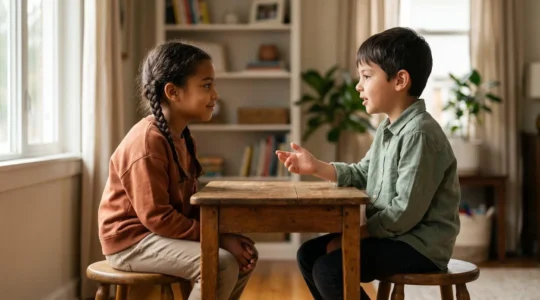
Resolving Conflicts: Teaching Kids to Settle Arguments Without an Adult Referee
The constant refereeing of your children’s fights is exhausting because it tackles the symptoms, not the cause. The solution is to shift from judge to coach, equipping them with an internal mediation toolkit to solve their own problems. This involves…
Read more
Developing Social Competence: Manners, friendship, and fitting in
When your child’s ‘bossiness’ or ‘shyness’ causes social friction, the solution isn’t just teaching them scripts, but coaching the underlying cognitive skills they’re missing. Instead of just demanding politeness, frame manners as ‘social grease’ that makes interactions smoother for everyone….
Read more