Leisure & Discovery
When children appear to be “just playing,” their brains are actually engaged in the serious work of development. Every moment spent building a den from sticks, mixing paint colors, or listening to a folk tale creates neural connections that form the foundation for future learning. Leisure and discovery activities are not supplementary to education—they are its most natural and effective form during early childhood.
The challenge for modern parents lies not in finding expensive programs or specialized equipment, but in recognizing and facilitating the rich learning opportunities already present in everyday life. A muddy puddle offers lessons in physics. A collection of fallen leaves becomes a classification exercise. A simple game of Simon Says strengthens the executive function skills that will later support academic success.
This comprehensive resource explores how play-based discovery across multiple domains—from outdoor exploration to creative arts, from classic games to hands-on science—works together to build capable, curious, and confident learners.
Nature as the Ultimate Learning Laboratory
The natural world provides an ever-changing, multisensory environment that engages children in ways no manufactured toy can replicate. Outdoor discovery activities require no special expertise from parents, only a willingness to slow down and follow a child’s curiosity.
Simple Observation Activities
Observational skills form the foundation of scientific thinking. When children create sound maps—sitting quietly and marking on paper where different noises originate—they practice sustained attention while building spatial awareness. Nature journaling takes this further by asking children to draw what they actually see rather than what they think something should look like, training them to notice details like the asymmetry of real leaves or the patterns in tree bark.
Scavenger hunts structured around properties rather than specific objects (“find something rough,” “find something that used to be alive”) teach children to categorize and compare. Leaf bingo and animal track identification introduce classification systems in context, making abstract concepts concrete.
Hands-On Nature Exploration
Active engagement deepens learning beyond passive observation. Bark rubbings with crayons and paper capture textures while introducing children to tree diversity. Bug hunts become counting exercises (“how many legs?”) and sorting activities (“which ones have wings?”).
These activities require minimal supplies but offer maximum flexibility. A child who loses interest in counting legs might become fascinated by where different insects are found, leading to spontaneous lessons about habitats and adaptation.
Building and Engineering Outdoors
Den building combines physics, engineering, and creative problem-solving. Children learn about structural stability through trial and error—which stick arrangements collapse and which ones hold. Puddle physics turns rainy days into experiments: which jump creates the biggest splash? How does water behave differently in shallow versus deep puddles?
These activities develop spatial reasoning and an intuitive understanding of cause and effect that will later support formal mathematics and science education.
Creative Arts: Building Visual Literacy and Expression
Artistic activities develop more than creativity—they build visual processing skills, fine motor control, and the ability to translate ideas into tangible form.
Understanding Color Theory Through Play
Color theory becomes accessible when children predict outcomes before experiencing them. What happens when blue and yellow mix? Why does red feel hot and blue feel cold? These questions connect abstract concepts to sensory experience.
Finding examples in nature—camouflage colors that help animals hide, warning colors that signal danger—demonstrates that color theory has real-world applications. The color wheel’s complementary pairs make more sense when children see orange pumpkins against blue October skies or notice how purple flowers stand out against green leaves.
Process Over Product: Making Art Accessible
The single most effective way to encourage creativity is to make supplies accessible. When art materials are visible and available rather than locked away for special occasions, children engage in spontaneous creative sessions that follow their own interests rather than adult-directed projects.
Collage activities—assembling disparate parts into a whole—teach composition and spatial relationships. Unlike drawing, which can frustrate young children still developing fine motor skills, collage allows even toddlers to create complex visual arrangements and experience success.
Games That Strengthen Growing Minds
Traditional games have survived generations because they work. Many classic children’s games are actually sophisticated tools for developing executive function—the cognitive skills that help us plan, focus attention, remember instructions, and juggle multiple tasks.
Classic Games for Executive Function
Simon Says directly trains inhibitory control—the ability to stop an automatic response. Children must hold the rule in mind (“only follow commands that start with ‘Simon says'”) while processing incoming instructions. This same skill will later help them catch errors in their math homework or resist distractions while reading.
The Bell Game builds sustained attention by asking children to stay quiet and still long enough to hear a small sound. In an age of constant stimulation, practicing this focused listening has become increasingly valuable.
The “Maybe” Game expands cognitive flexibility by encouraging children to generate multiple possible answers to a single question. This tolerance for ambiguity and ability to consider alternatives is foundational for creative problem-solving.
Collaborative Problem-Solving
Escape rooms designed for children—whether purchased or homemade—require teams to combine different skills and perspectives. One child might excel at finding hidden objects while another sees the logical pattern in a sequence puzzle. These experiences teach children that diverse strengths make groups more effective than individuals working alone.
The satisfaction of solving a puzzle together builds intrinsic motivation—the internal drive to tackle challenges for their own sake rather than for external rewards.
Reading, Stories, and Cultural Connection
Literacy development begins long before a child can decode written words. The foundation is built through language-rich experiences that make books feel welcoming and relevant.
Early Literacy Through Engagement
Concepts of print—understanding that books have a right way up, that text proceeds from left to right in English, that spaces separate words—seem obvious to literate adults but must be explicitly learned. Children absorb these conventions through repeated exposure to books handled correctly.
Character voices during read-alouds make stories more memorable and help children track which character is speaking—an important comprehension skill. Parents don’t need theatrical training; even slight variations in pitch or speed help differentiate characters. The engagement matters more than the performance quality.
Cumulative songs like “There Was an Old Lady Who Swallowed a Fly” teach sequential memory and narrative structure. Children learn to predict what comes next and experience the satisfaction of mastering an increasingly complex pattern.
Heritage and Oral Traditions
Folk tales connect children to their cultural heritage and introduce them to storytelling patterns that recur across human societies. These stories often encode values, historical experiences, and cultural knowledge in memorable narrative form.
For children from immigrant or multicultural families, folk tales can affirm cultural identity while building the bridge between home language and community language, making literacy development more personally meaningful.
Hands-On Science: Experiments in Everyday Life
Scientific thinking develops through direct manipulation of materials and observation of results. Kitchen and garden science requires no special equipment—the goal is to make asking “what if?” questions a natural habit.
Color prediction experiments make chemistry visible. Mixing paints demonstrates that color is additive; children can’t unmix yellow and blue back to their original states, introducing the concept of irreversible reactions.
The dark cupboard experiment—does a plant need light to grow?—teaches the fundamentals of experimental design. Children learn to change one variable (light exposure) while keeping others constant (water, temperature) and observe what happens over time. This builds patience and the understanding that some questions require sustained observation rather than immediate answers.
Worm farming transforms kitchen scraps into rich soil, demonstrating decomposition and nutrient cycles. Children see that waste isn’t simply “gone” when thrown away—it goes somewhere and becomes something else. This concrete experience with matter transformation makes abstract ecological concepts tangible.
Creating Spaces and Rhythms for Discovery
The environment and schedule parents create either facilitate or obstruct children’s natural drive to explore and discover.
Physical Environments That Invite Exploration
A book nook—a cozy, well-lit corner with cushions and an accessible bookshelf—sends the message that reading is a pleasure worth creating special space for. Similarly, an indoor garden provides a green space for observation and nurturing, making plant care part of daily life rather than a special project.
The principle of accessible materials applies across domains. Visible hobbies—letting children regularly see adults reading, cooking, or crafting—model that learning and creating are lifelong activities, not assignments that end after childhood.
Balancing Screen Time with Active Learning
The question isn’t whether screens should be eliminated but how to ensure they don’t displace active learning. A boredom basket—a collection of books, puzzles, and craft supplies kept in tech-free zones—provides alternative options during moments of transition or restlessness.
When screens are used, distinguishing between creation and consumption matters. Apps that let children make music, animate stories, or design structures engage different cognitive skills than those that simply deliver content. Creation requires planning, decision-making, and revision—the same executive functions developed through offline play.
Replacement activities for when internet is unavailable prevent the meltdown of “there’s nothing to do.” Families who proactively build a repertoire of offline activities find that children develop resilience and resourcefulness.
The Power of Undivided Attention
Special time—even just fifteen minutes daily of completely focused, child-led interaction—has disproportionate impact. During this time, the child chooses the activity and the adult follows their lead without correction, instruction, or distraction.
This practice strengthens attachment, builds the child’s confidence in their own ideas, and creates space for them to process experiences through play. The magic isn’t in the duration but in the quality of presence.
The Generalist Advantage: Why Broad Exploration Matters
Parents often worry about whether to specialize early—focusing intensively on a specific skill or domain—or to keep options open through broad exploration. Research on skill development increasingly supports the generalist approach during early childhood.
Children who sample widely across different activities develop transferable skills and make unexpected connections between domains. A child who does both music and sports, art and building, develops a more flexible cognitive toolkit than one who specializes narrowly from an early age.
Broad exploration also allows children to discover authentic interests rather than pursuing paths chosen by adults. A child exposed only to soccer might never discover a passion for theater. One offered only art might miss an aptitude for coding.
The early years are ideal for this experimentation precisely because the stakes are low. There’s time to try, abandon, and return to activities as interests evolve. This freedom to explore without commitment builds the self-knowledge that will later enable more informed choices about where to invest deeper effort.
Perhaps most importantly, generalist exploration during childhood builds intrinsic motivation—the internal drive to learn for its own sake. Children who discover that learning itself is pleasurable become lifelong learners, continually seeking new knowledge and skills long after formal education ends.
The leisure and discovery activities explored here—nature exploration, creative arts, games, stories, hands-on science, and thoughtfully designed environments—work together to build the cognitive, emotional, and social foundations children need. They require no expensive equipment or specialized training, only adult willingness to recognize that children’s play is serious work deserving of time, space, and respect.
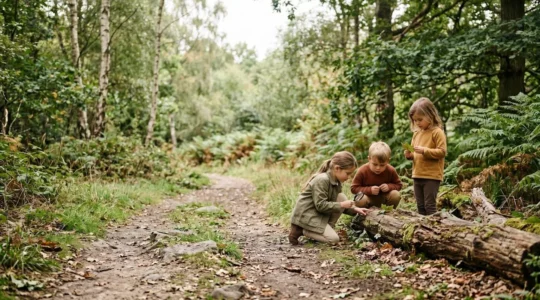
Nature Walks and Outdoor Discovery: Turning a Walk into an Adventure
Getting kids excited about a walk can feel like a battle, often ending in boredom. The secret isn’t better destinations, but a better mindset. This guide reframes simple outdoor activities as exciting ‘learning missions.’ By focusing on sensory details, scientific…
Read more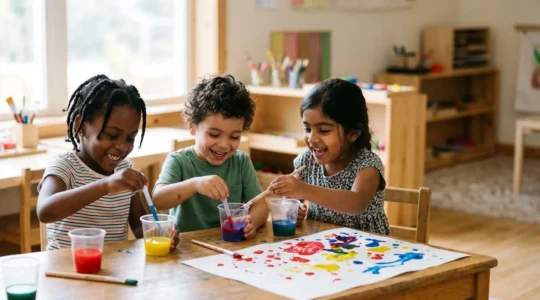
Teaching Color Theory to Kids: Beyond the Rainbow Song
Contrary to popular belief, teaching a child about color isn’t about memorizing the seven colors of the rainbow. It’s about handing them an artist’s lens to see the world differently. This guide shifts the focus from naming colors to exploring…
Read more