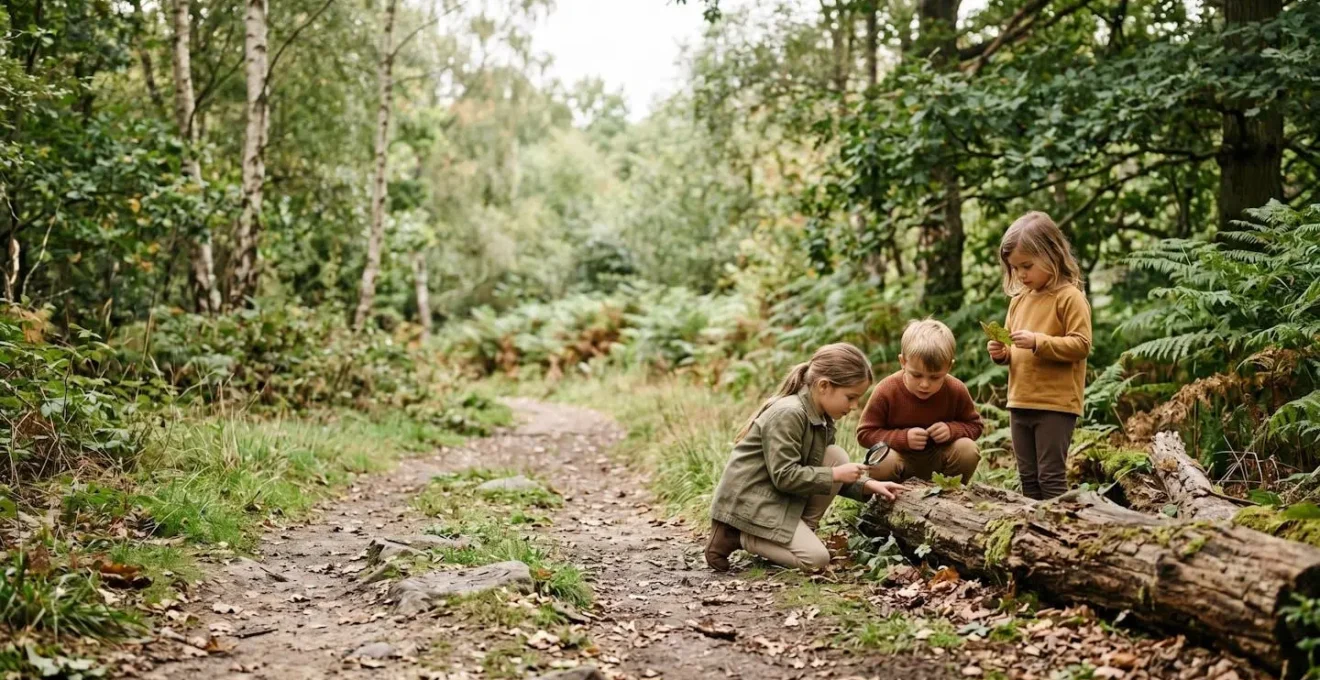
Getting kids excited about a walk can feel like a battle, often ending in boredom. The secret isn’t better destinations, but a better mindset. This guide reframes simple outdoor activities as exciting ‘learning missions.’ By focusing on sensory details, scientific discovery, and mindful observation, you can transform any walk into an adventure that builds curiosity, confidence, and a genuine connection to the natural world, turning ‘I’m bored’ into ‘What’s next?’
As an outdoor educator, I see a common struggle: parents who know their kids need less screen time and more green time, but find that the classic “Let’s go for a walk!” often falls flat. The whining starts, the energy drains, and what was meant to be a refreshing escape becomes another source of stress. We’ve been told to encourage kids to collect leaves or spot birds, but these activities often lack the spark to compete with a tablet.
The issue isn’t the walk itself; it’s the framing. Children, especially in a world of curated digital experiences, thrive on narrative, purpose, and challenge. They don’t just want to wander; they want to be on a mission. This is where we shift from being a guide to being a co-adventurer.
But what if the key wasn’t to invent more elaborate games, but to transform the simple act of observation into a thrilling quest? The secret is to stop seeing a walk as a way to pass the time and start seeing it as a living classroom for developing what I call sensory literacy—the ability to notice, interpret, and describe the world with all five senses. It’s about turning “Look at that tree” into “Let’s become scientists and discover the story of this tree’s bark.”
This guide will equip you with practical strategies to reframe common nature walk activities into compelling ‘learning missions’. We’ll explore how to hunt for concepts instead of just objects, become animal detectives, and understand why letting kids get muddy is one of the most important things we can do for their development.
To help you navigate these missions, this article is structured around eight distinct activities, each designed to cultivate a different aspect of outdoor discovery. Explore them all to build your toolkit for adventure.
Summary: Turning a Simple Walk into an Unforgettable Outdoor Adventure
- Nature Scavenger Hunt: Finding Textures, Colors, and Shapes
- Animal Tracks: Who Walked Here Before Us?
- Leaf Bingo: Matching Fallen Leaves to Trees
- Sound Maps: Sitting Still and Drawing Where Sounds Come From
- Bark Rubbings: Capturing Textures with Crayon and Paper
- Environmental Print: Reading Logos and Signs on the High Street
- Bug Hunt: Counting Legs and Spotting Wings
- Outdoor Exploration: Why Kids Need to Climb Trees and Get Muddy?
Nature Scavenger Hunt: Finding Textures, Colors, and Shapes
The classic scavenger hunt is a great starting point, but we can elevate it from a simple collection task to a rich sensory mission. Instead of a list of objects (“find a pinecone, find a feather”), we shift the focus to concepts and qualities. This moves the child from just grabbing to truly observing and comparing. The goal isn’t to fill a bag, but to fill their minds with new ways of seeing.
Frame the mission as a “Nature’s Museum” collection or a “Micro-Safari.” Challenge them to find ‘adjectives’ in the wild: something rough (like bark), something smooth (like a river stone), something bumpy (like a gnarled root). This simple twist transforms the walk into a language-learning exercise. As one educational approach found, an adjectives-based scavenger hunt is highly effective for building both vocabulary and detailed observation skills by connecting descriptive words to tangible objects.
Further deepen the engagement by including abstract concepts. Can they find “a pattern that repeats,” “five different shades of green,” or “something that makes a rustling sound”? To encourage environmental respect, swap collection for documentation. Have them photograph or sketch their finds in a nature journal. This practice of ethical observation teaches them to appreciate nature without disturbing it, a core principle for any budding naturalist.
Ultimately, this reframed scavenger hunt teaches a powerful lesson: the most interesting things in nature aren’t always objects, but the patterns, textures, and relationships between them.
Animal Tracks: Who Walked Here Before Us?
A patch of mud or a dusting of snow is not just dirt; it’s a storybook waiting to be read. Finding animal tracks transforms a simple walk into a thrilling detective mission. The central question—”Who walked here before us?”—ignites a child’s imagination and turns them into a wilderness investigator. It’s a powerful shift from passive walking to active–problem-solving.
The mission isn’t just to spot a print, but to decipher the story it tells. Encourage your child to get down on their hands and knees and ask detective questions. Which way was the animal going? Was it walking or running? How can we tell? Was it alone? This process hones critical thinking and spatial reasoning skills. Look for more than just tracks; scat, feathers, chewed nuts, or bent grass are all clues that add chapters to the story.
As you can see, the details in a single print are immense. To make the investigation more scientific, bring a small ruler and a nature journal. Measuring the length and width of the prints, noting the distance between them (the stride), and sketching the scene helps solidify the learning. This act of documenting their findings in a “case file” makes them feel like real scientists.
Your Action Plan: The Animal Tracking Detective
- Search for tracks early in the morning or late in the day when long shadows make them easier to see.
- Get down on hands and knees to study the details of the print, noting the number of toes and any claw marks.
- Ask detective questions: Which way was it going? Was it alone? Was it walking or running?
- Measure the track’s length and width, and look at the distance and pattern between prints.
- Look for other signs like feathers, scat, or chewed plants to build a more complete picture of the animal’s activity.
By learning to read these subtle signs, children begin to understand that they are part of a much larger, interconnected world, teeming with life and stories just waiting to be discovered.
Leaf Bingo: Matching Fallen Leaves to Trees
Collecting leaves is a timeless autumn activity, but we can transform it from a simple gathering into a lesson in botany and ecology. “Leaf Bingo” isn’t about finding just any leaf; the mission is to match the fallen leaf on the ground to the tree it came from. This simple act of matching creates a direct link between cause and effect and encourages a more holistic view of the forest.
As you hunt, introduce basic botany vocabulary in a playful way. Talk about the leaf’s “edge” (is it smooth, toothed like a saw, or lobed like an oak leaf?) and the pattern of its veins. This hands-on experience makes scientific terms memorable and meaningful. You can create leaf rubbings by placing paper over a leaf and rubbing with a crayon to reveal these intricate details, creating a beautiful record of your discoveries.
This activity is a gateway to understanding larger ecological cycles. Ask questions like, “Why do the leaves fall?” This opens up a conversation about seasons, decomposition, and how fallen leaves become food for the tree and the soil. It’s a tangible way to illustrate the concept of a nutrient cycle. The benefits of this type of learning are significant, as research on outdoor education shows student gains in science, language arts, and math when teaching is moved outdoors.
You can extend the mission at home by creating “Leaf Creatures” or a “Family Tree of the Forest” with your collected samples. Or, play a sensory game like the “Mystery Leaf Bag,” where a child has to identify a leaf by touch alone. These extensions reinforce the learning and connect the outdoor experience with indoor creativity.
By turning a simple collection into a matching game, you’re not just finding leaves; you’re teaching your child to see the forest as an interconnected system of individual species, each with its own unique signature.
Sound Maps: Sitting Still and Drawing Where Sounds Come From
In our visually dominated world, the sense of hearing is often overlooked. A Sound Mapping mission is a powerful way to develop auditory focus and mindfulness. The challenge is simple but profound: sit still and just listen. This can be a difficult task for an energetic child, so framing it as a secret agent mission—”We need to create a top-secret map of all the sounds in this area”—can provide the focus they need.
Find a comfortable spot, and have your child draw an ‘X’ in the middle of a piece of paper to represent themselves. Then, for 5-10 minutes, they sit quietly (eyes open or closed) and mark on the paper where each sound is coming from. A bird chirping to the left, the wind rustling leaves behind them, a distant car in front. They can use symbols, colors, or words to represent the sounds. This exercise helps them understand spatial relationships and the directionality of sound.
This activity is also an excellent tool for emotional regulation. As one case study on a “Mindset Scavenger Hunt” noted, sensory activities that encourage quiet observation are particularly effective for helping children calm their nervous systems and improve focus after high-energy play. It teaches them that they can use their senses to ground themselves and manage their feelings.
After the mapping is complete, analyze the results. Categorize the sounds: which were natural (birds, wind) and which were human-made (planes, voices)? This introduces the concept of a “soundscape” and how it’s shaped by both nature and human activity. You can deepen the analysis by discussing pitch (high/low) and volume (loud/soft), building a rich vocabulary for describing the auditory world.
A Sound Map is more than a drawing; it’s a snapshot of a moment in time, captured through the ears. It teaches children the art of stillness and the richness of the world that is revealed when we simply stop and listen.
Bark Rubbings: Capturing Textures with Crayon and Paper
While we often teach children to identify trees by their leaves, the bark offers a year-round opportunity for identification and sensory exploration. The mission of bark rubbing is to become a “texture detective,” capturing the unique fingerprint of each tree. This tactile activity helps children develop fine motor skills and a deeper appreciation for the diversity of the natural world.
The process is simple: hold a piece of paper against a tree trunk and rub the side of a crayon over it. The texture of the bark is magically transferred to the page. The magic, however, lies in the comparison. Don’t just rub one tree; make it a scientific investigation. Select three different trees and place their rubbings side-by-side. Ask questions: Which is the roughest? The smoothest? Does this bark look like scales, like puzzle pieces, or like deep grooves?
This side-by-side comparison naturally leads to hypothesis testing. Frame a question like a scientist would: “Do taller trees have rougher bark?” Then, test it by finding a tall and a short tree of the same species and comparing their bark rubbings. This introduces the core concepts of the scientific method: observation, hypothesis, and testing. It transforms a simple art project into a memorable science experiment.
This is also an opportunity for storytelling. The bark is the tree’s “skin” or its “armor.” Does this tree feel old and wise, or young and smooth? This imaginative framing helps children build empathy for the living things around them and understand the function of bark as protection from insects, weather, and fire. The different textures are not random; they are adaptations to the tree’s environment.
By creating a “Texture Library” of bark rubbings, children learn that every tree has a unique identity and a story to tell, written right on its surface.
Environmental Print: Reading Logos and Signs on the High Street
A walk doesn’t have to be in a deep forest to be a nature walk. For many of us, “outdoors” means the local park, the high street, or the walk to school. An outdoor educator knows how to find nature everywhere. This mission connects the very urban skill of reading “environmental print”—logos, street signs, and brand names—to the more subtle art of reading nature’s signs.
Start by pointing out the familiar signs on a walk through town. Children learn to “read” the golden arches or a stop sign long before they can decode letters. This is their first entry into literacy. Acknowledge and celebrate this skill. Then, pivot the mission: “You are an amazing sign reader! Now let’s see if we can find Nature’s Signs.”
This powerful framing, used by innovative educators, helps children transfer their pattern-recognition skills from the built environment to the natural world. What are nature’s signs? A flower bud can be a sign of spring. Dark clouds are a sign that rain is coming. Moss growing on one side of a tree can be a sign pointing north. This teaches them that the natural world is also full of information, if you know how to look for it.
This mission also encourages kids to spot where nature is “reclaiming” urban spaces. Challenge them to find a “secret garden” in a pavement crack, to spot birds nesting on a traffic light, or to trace the path of ivy on a brick wall. This fosters an appreciation for the resilience of nature and helps them see their own neighborhood with new eyes. It’s a profound lesson in environmental awareness, hidden within a simple game of I Spy.
By bridging this gap, we teach a crucial lesson: the skills of observation and interpretation are universal. Whether reading a brand logo or a cloud pattern, we are making sense of the world through its symbols.
Bug Hunt: Counting Legs and Spotting Wings
For many children, the world of insects is a source of endless fascination (or sometimes, fear). A bug hunt mission is the perfect way to nurture this curiosity while teaching respect for even the smallest creatures. The foundational rule of this mission is ethical observation. We are not hunters; we are “Visiting Scientists” or “Bug Documentarians.”
The mission begins by looking for bugs in their homes: under a rotting log, inside a flower, or near a puddle. Emphasize that we are visitors and must be gentle, always returning logs or rocks to their original position. Instead of collecting the bugs, we collect data. Equip your young scientist with a “Field Journal” and a magnifying glass.
For each bug found, the task is to document it. How many legs does it have? (A key lesson: insects have six!). Does it have wings? What is its main color? What was it doing? Sketching the bug, even a simple scribble, helps commit its features to memory. This process of slow, careful observation helps demystify insects and replace fear with fascination. After observing with the naked eye, you can use an app like Seek by iNaturalist to identify the creature together, demonstrating how technology can deepen discovery rather than distract from it.
This is also the perfect time to discuss the roles different bugs play. That bee is a pollinator, helping flowers make fruit. That roly-poly is a decomposer, cleaning up the forest floor. This reframes bugs from pests into essential workers of the ecosystem. The benefits of this connection are profound; long-term studies on nature exposure show that children who spend time in natural environments experience lower stress levels, stronger attention spans, and improved emotional regulation.
By treating a bug hunt as a scientific and ethical mission, we teach children a valuable lesson in empathy and the intricate interconnectedness of life.
Key takeaways
- Reframe activities as ‘missions’ with a clear goal to spark engagement and move beyond simple collection.
- Focus on sensory details—textures, sounds, patterns—to deepen observation skills and build a richer vocabulary for the natural world.
- Embrace ‘risky’ play like climbing and getting muddy; it’s essential for building resilience, confidence, and real-world risk-assessment skills.
Outdoor Exploration: Why Kids Need to Climb Trees and Get Muddy?
In our safety-conscious world, the instinct to say “Be careful!” or “Don’t get dirty!” is strong. Yet, as an outdoor educator, I can tell you that unstructured, messy, and even slightly “risky” play is not just fun—it’s developmentally essential. While recent research indicates that the time children spend playing outdoors is at an all-time low, the need for it has never been greater. The mission here is for us, the adults, to understand the ‘why’ behind the mess and the scuffed knees.
When a child climbs a tree, they aren’t just climbing. They are performing a complex series of calculations involving risk assessment, problem-solving, and physical coordination. They are testing their limits, building self-confidence with every branch they successfully navigate. Similarly, playing in the mud isn’t just about getting dirty; it’s a rich sensory experience that builds creativity, reduces stress, and even strengthens the immune system. These activities provide what is known as “risky play.”
This isn’t just a quaint idea; it’s backed by extensive research. A comprehensive review of 40 studies on risky outdoor play found overwhelmingly positive links to resilience, wellbeing, physical skills, and autonomy. The key finding was that successfully navigating self-chosen challenges in low-stakes environments is a critical mechanism for developing real-world competence and mental health. This is how children learn to trust their bodies and their judgment.
The social and emotional benefits are just as significant. Unstructured outdoor play provides a unique space for children to practice negotiation, sharing, and empathy away from the direct oversight of adults. As researchers Burdette & Whitaker state in their work on the subject:
Outdoor play is important for social and emotional development: it promotes opportunities for interactions with peers; its unstructured nature enables children to practice communication, empathy and sharing; and it provides a sense of freedom that encourages resilience and reduces stress and anxiety.
– Burdette & Whitaker, Research on Risky Outdoor Play in Early Years
Our role as parents and educators is not to eliminate all risk, but to provide a safe enough environment for children to explore those risks. It’s about stepping back, taking a deep breath, and trusting that a child covered in mud, perched triumphantly on a low-hanging branch, is doing some of the most important learning of their life.