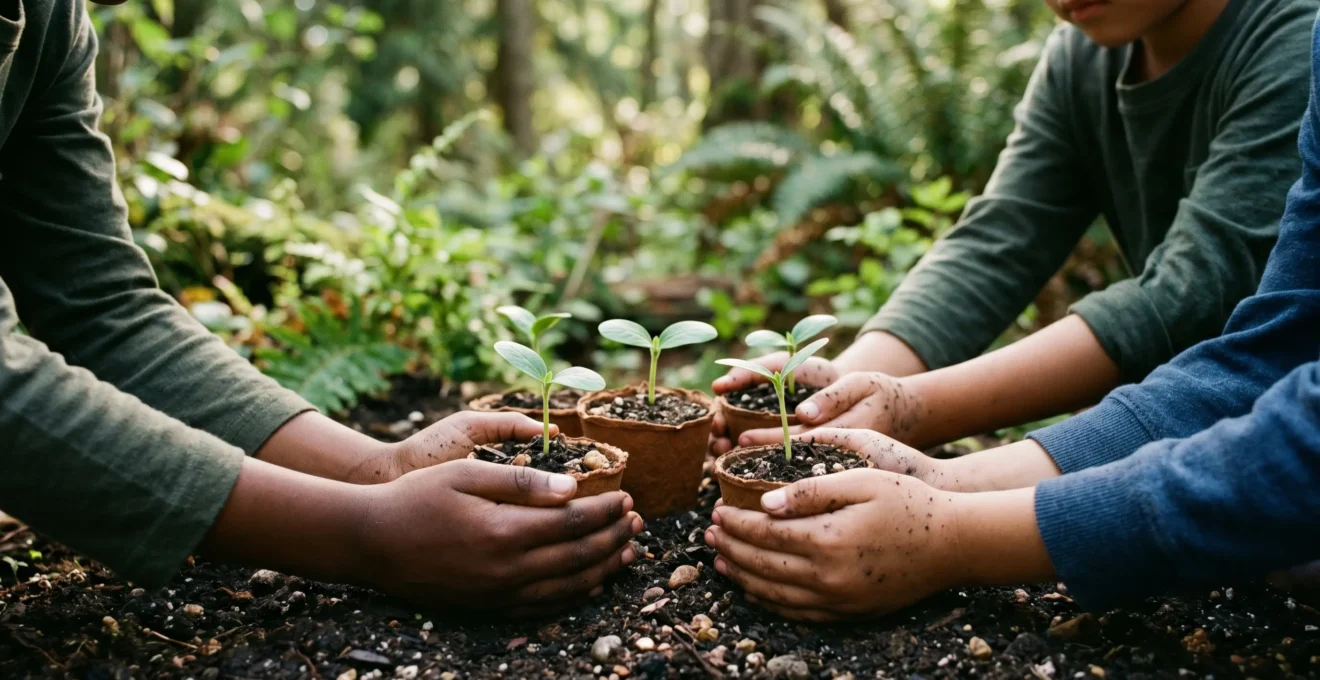
To raise a truly eco-conscious child, the focus must shift from enforcing environmental chores to cultivating an intrinsic “eco-identity.”
- Everyday actions, from sorting recycling to turning off a tap, become meaningful lessons in responsibility when framed as part of a larger story of planetary care.
- Connecting abstract concepts like honesty and digital privacy to their tangible environmental parallels helps build a holistic and resilient value system.
Recommendation: Instead of telling your child what to do, consistently model and narrate the “why” behind your actions to help them internalize stewardship as a core part of who they are.
As a parent, you want to raise a kind, responsible human who contributes positively to the world. A significant part of that in today’s world is fostering a deep respect for our planet. Many of us start with the basics: “Turn off the lights,” “Don’t waste water,” “Put that in the recycling bin.” While these are essential habits, they often remain just that—chores. They are tasks to be completed, rules to be followed. But what if the goal wasn’t just to get our children to *do* eco-friendly things, but for them to *become* eco-conscious individuals at their core?
The common advice to simply lead by example or spend more time in nature often misses a crucial step: the internalization of values. The real challenge, and the greatest opportunity, lies in transforming these actions from obligations into a source of identity and pride. It’s the difference between a child who recycles because they’re told to, and a child who does it because they see themselves as a protector of the Earth. This is the shift from performing tasks to building an eco-identity.
This guide moves beyond the checklist of green activities. We will explore how to frame simple, daily actions—from picking up litter to conserving water—as foundational lessons in a much bigger story. We’ll even connect seemingly unrelated concepts like honesty and digital privacy to environmental stewardship, demonstrating that caring for the planet is part of a larger ethical framework. The objective is to equip you with strategies to help your child not just follow the rules, but to choose good for the planet, especially when you’re not looking.
To help you on this journey, this article breaks down key concepts into practical, everyday scenarios. We’ll explore how to turn chores into games, abstract ideas into tangible lessons, and individual actions into a powerful, internalized sense of global citizenship.
Summary: A Practical Guide to Nurturing Environmental Values
- Litter Picking: Why We Clean Up Messes We Didn’t Make?
- Turn off the Tap: Understanding Water as a Precious Resource
- The Recycling Sorting Game: What Goes in Which Bin?
- Worm Farming: Turning Apple Cores into Soil
- Look Don’t Touch: How to Observe Animals Without Scaring Them?
- The Returned Wallet: Showing Honesty in Small Daily Actions
- The Right to Privacy: Should You Post Your Child’s Bath Photos?
- Internalization of Values: Helping Kids Choose Good When You’re Not Looking
Litter Picking: Why We Clean Up Messes We Didn’t Make?
The act of picking up litter is often a child’s first tangible interaction with environmental care. When a child asks, “Why do I have to clean this up? I didn’t do it,” it presents a pivotal teaching moment. The answer goes beyond simple cleanliness; it’s a foundational lesson in community stewardship. By cleaning a shared space like a park or a sidewalk, we teach them that the environment belongs to everyone, and therefore, its well-being is a shared responsibility, not just the fault of the person who made the mess. This simple act builds a sense of ownership and connection to their neighborhood.
Framing litter picking as a “treasure hunt for trash” or a mission to “save the park” can transform it from a chore into an empowering activity. As children see the immediate visual impact of their work—a clean patch of grass, a litter-free playground—they receive powerful, positive reinforcement. This hands-on experience demonstrates that their small actions have a visible and meaningful effect. It’s a direct lesson in cause and effect that anchors the abstract idea of environmentalism in the real world.
This sense of responsibility is proven to have wider impacts. Research shows that communities with regular clean-up programs experienced a 30% reduction in waterborne pollutants over five years, directly linking local action to broader ecological health. When children participate, they learn that protecting wildlife, keeping waterways cleaner, and improving habitats starts right in their own backyard. It teaches them that being a good citizen means caring for our shared home, regardless of who made the mess.
Turn off the Tap: Understanding Water as a Precious Resource
Moving from public spaces to inside the home, water conservation is another fundamental pillar of environmental education. For many children, water seems infinite—it magically appears from the tap. The challenge is to reveal its true nature as a finite and precious resource. The simple instruction to “turn off the tap while brushing your teeth” can become a profound lesson in resource management when you explain the “why” behind it. This isn’t just a rule to save money; it’s an act of care for the rivers, lakes, and all the creatures that depend on that water.
To make this concept tangible, you can transform water usage into a hands-on science and math experiment. For example, place a measuring cup under the tap while your child brushes their teeth to show them exactly how much water is used. Then, have them brush with the tap off and compare the amounts. Translating the savings into relatable metrics—”We saved enough water for 10 people to drink today!”—makes the impact understandable. This kind of mindful action helps foster positive attitudes, which is critical, as one study found that only 43% of school children had good attitudes towards water-saving awareness.
This is the invisible loop in action: the water that flows down your drain is part of a massive, interconnected system. To illustrate this, you can look at the journey water takes. The illustration below shows how water exists in nature, reminding us of its origin long before it reaches our taps.
Seeing the pristine beauty of water in its natural state helps connect the household tap to the wider world. Each drop saved is a drop that remains in the ecosystem. By establishing consistent routines and explaining the connections, we help children see water not as an endless utility, but as a vital part of the living world that we have a responsibility to protect.
The Recycling Sorting Game: What Goes in Which Bin?
Recycling is often seen as the cornerstone of household environmentalism, but it’s also where good intentions can go wrong. Many of us are guilty of “wishcycling”—tossing an item into the recycling bin hoping it can be recycled, even when we’re not sure. This act, while well-meaning, can contaminate entire batches of recyclables, rendering them landfill-bound. This presents a perfect opportunity to teach children about the importance of mindful action over wishful thinking. The “Recycling Sorting Game” is not just about memorizing rules; it’s about teaching critical thinking.
Turn your kitchen into a detective agency. Before recycling an item, challenge your child to be a “Recycling Detective.” Is the plastic container clean? Does this type of paper have a waxy coating? Is the item made of mixed materials? Many communities now have digital tools or apps that allow you to search for a specific item and see its proper disposal method. Using these tools together empowers children with research skills and demonstrates that responsible action requires a moment of thought and verification. It transforms recycling from a passive toss into an active, informed choice.
The stakes are higher than most people realize. Sobering research reveals that an estimated 76% of recyclables are lost at the household level, often due to contamination from wishcycling. By teaching children to pause and check, you are directly tackling this massive problem at its source. You’re instilling a habit of precision and care, showing them that doing something “right” is more important than just “doing something.” This lesson—that good intentions must be paired with knowledge—is a powerful principle that extends far beyond the recycling bin.
Worm Farming: Turning Apple Cores into Soil
Composting, and specifically vermicomposting (worm farming), is one of the most powerful ways to teach children about the cyclical nature of life. It’s where the concept of the “invisible loop” becomes visible. An apple core isn’t “garbage” to be thrown “away”; it’s the beginning of a new process. Setting up a small worm bin at home provides a fascinating, hands-on window into decomposition, microbiology, and the creation of new life from what we once considered waste.
The process is a perfect story. First, you eat the food. Then, you feed the scraps (like fruit and vegetable peels, coffee grounds, and paper) to the red wiggler worms. The worms, in turn, do their work, consuming the scraps and producing nutrient-rich “castings.” This dark, earthy material is one of the best fertilizers you can find. Finally, you use these castings to fertilize your houseplants or garden, which then grows new food. The loop is complete. Children can see with their own eyes how the end of one thing is the beginning of another.
Setting up a project is surprisingly simple. It requires a suitable container with aeration, moist newspaper bedding, and a starter population of red wiggler worms. As you feed the worms and maintain the bin’s moisture, you’re not just managing waste; you’re caring for a miniature ecosystem. This teaches children about the needs of living creatures and the delicate balance required to sustain them. Vermicomposting closes the circular economy loop right in your home, demonstrating that in nature, there is no such thing as “away.”
Look Don’t Touch: How to Observe Animals Without Scaring Them?
As we expand the circle of care from inanimate resources to living beings, the rules of engagement change. The “look, don’t touch” rule is a fundamental lesson in empathy and respect for wildlife. For a curious child, the instinct is often to get as close as possible, to touch, or to hold. Our role as educators is to channel that curiosity into a more profound form of interaction: quiet, respectful observation. This teaches them that wild animals are not props for our entertainment; they are autonomous beings with their own needs, fears, and lives.
Instead of rushing toward an animal, teach your child to become a nature detective. Encourage them to use their senses from a distance. What color is the bird? What sound is the squirrel making? How does the caterpillar move? Using binoculars or cupping hands behind their ears to listen better can enhance the experience, making observation an active, engaging skill. This approach shifts the goal from “getting” the animal to “understanding” it. It fosters a sense of wonder and patience, showing that we can learn so much just by being still and paying attention.
The key principle here is that our presence has an impact. Getting too close can cause an animal stress, scare it away from its food source, or even cause a parent bird to abandon its nest. Explaining these consequences helps a child understand that our actions, even when driven by curiosity, can have unintended negative effects. By learning to observe from a distance, children are practicing a core tenet of environmental stewardship: enjoying and appreciating nature while minimizing our disruptive footprint. It’s a powerful lesson in coexisting with the world around us.
The Returned Wallet: Showing Honesty in Small Daily Actions
At first glance, finding a lost wallet and returning it might not seem like an environmental lesson. However, it’s a profound exercise in environmental integrity. At its core, environmental stewardship is built on a foundation of honesty and responsibility—the acknowledgment that our actions have consequences for a system larger than ourselves. When you choose not to litter, you are honoring an unspoken social contract to care for a shared space. When you return a lost wallet, you are honoring a similar contract to care for your community.
The principle is the same: choosing to do the right thing even when no one is watching and when doing otherwise might be easier or more beneficial to you in the short term. Discussing a scenario like this with your child helps connect the dots between personal ethics and planetary health. You can ask questions like, “How do you think the person who lost their wallet feels? How would we feel if we helped them get it back?” This builds empathy, the same empathy required to care about a polluted river or an endangered species you may never see.
This is where the eco-identity becomes robust. A person who defines themselves as “honest” is more likely to be honest in all areas of their life, from financial dealings to their claims about being “green.” By teaching your child that integrity is a universal value, you are strengthening the moral foundation upon which their environmental consciousness will be built. Caring for the planet isn’t a separate, isolated set of behaviors; it is a direct expression of core values like honesty, fairness, and responsibility. It’s about being a good person, and good people don’t just care about other people—they care about the shared home we all depend on.
The Right to Privacy: Should You Post Your Child’s Bath Photos?
In our digital age, a new and often overlooked aspect of our impact is our digital footprint. The conversation around “sharenting”—and specifically, posting sensitive photos of our children—is primarily about consent and privacy. But it also offers a powerful modern metaphor for our environmental footprint. Every photo we upload, every video we stream, every bit of data we create requires energy. It is stored on servers in massive data centers that consume vast amounts of electricity and water for cooling. While a single photo is a drop in the ocean, the collective flood is significant.
Teaching children about their digital footprint is a parallel lesson to teaching them about their physical one. The question “Should we post this?” can be framed in the same way as “Should we buy this?” It’s a lesson in mindful consumption. Does this action add real value, or is it a fleeting, thoughtless impulse? By discussing the “invisibility” of the digital world—how our data travels and where it lives—we can draw a direct line to the often invisible impacts of our physical consumption, like the resources used to create a plastic toy or the pollution generated by a car trip.
Just as we leave footprints in the sand, we leave permanent traces online. This illustration serves as a potent symbol for both. Teaching a child to be mindful of what they share online is teaching them to be conscious of the traces they leave behind in all aspects of life. It fosters a mindset of intentionality. This practice of pausing to consider the long-term consequences of a small, immediate action is the very essence of sustainability. It’s about understanding that nothing is truly “away” or “deleted”—whether it’s a plastic bottle or a digital photo.
Key takeaways
- True environmentalism in children stems from an internalized “eco-identity,” not just a list of chores.
- Connect everyday actions (like saving water or sorting recycling) to a larger story of planetary health and personal responsibility.
- Use tangible, hands-on activities like worm farming and litter-picking to make abstract concepts like life cycles and community stewardship visible and meaningful.
Internalization of Values: Helping Kids Choose Good When You’re Not Looking
The ultimate goal of all these lessons is internalization. We want our children to develop a strong inner compass that guides them to make responsible choices, not because they fear punishment or seek reward, but because it’s an authentic expression of who they are. This is the final and most important step in building a resilient eco-identity. It’s the transition from external motivation (your rules) to internal motivation (their values). This happens when a child’s actions and their sense of self become one and the same.
The key to fostering this is in our language and framing. Instead of saying, “You did a good job picking up that trash,” try, “You are such a great helper for our planet.” The first praises the action; the second affirms the identity. When you involve them in finding solutions—”What are some creative ideas you have for our family to use less plastic?”—you empower them as active, capable agents of change rather than passive followers of rules. You are telling them, “Your voice matters. You are part of the solution.”
This process is about weaving a culture of care and responsibility into the fabric of your family life. It’s about modeling these behaviors consistently and connecting your family’s small efforts to the larger global movement of people working to protect the environment. When environmental stewardship becomes part of your family’s story and identity, it ceases to be a list of tasks. It becomes a shared value, a way of being in the world that will stay with your children long after they’ve grown up.
Action Plan: Building an Eco-Identity from Chores to Intrinsic Values
- Reframe Your Language: Shift from praising the action (“good job recycling”) to reinforcing the identity (“you’re a wonderful planet protector”).
- Co-create Solutions: Pose challenges instead of imposing rules. Ask, “What ideas do you have for us to use less energy as a team?” to foster ownership.
- Connect to Bigger Stories: Share examples of youth activists and community projects to show them their individual actions are part of a larger, inspiring movement.
- Make Progress Visible: Create a chart or jar where they can see the collective impact of their efforts, like “trees saved” by recycling paper.
- Model and Participate: Ensure environmental values are learned through consistent observation and active participation in family habits, not just lectures.
By consistently applying these principles, you are giving your child a gift that extends far beyond a clean room or a lower water bill. You are nurturing a compassionate, responsible, and engaged citizen who understands their place in the world and has the confidence to make it better.