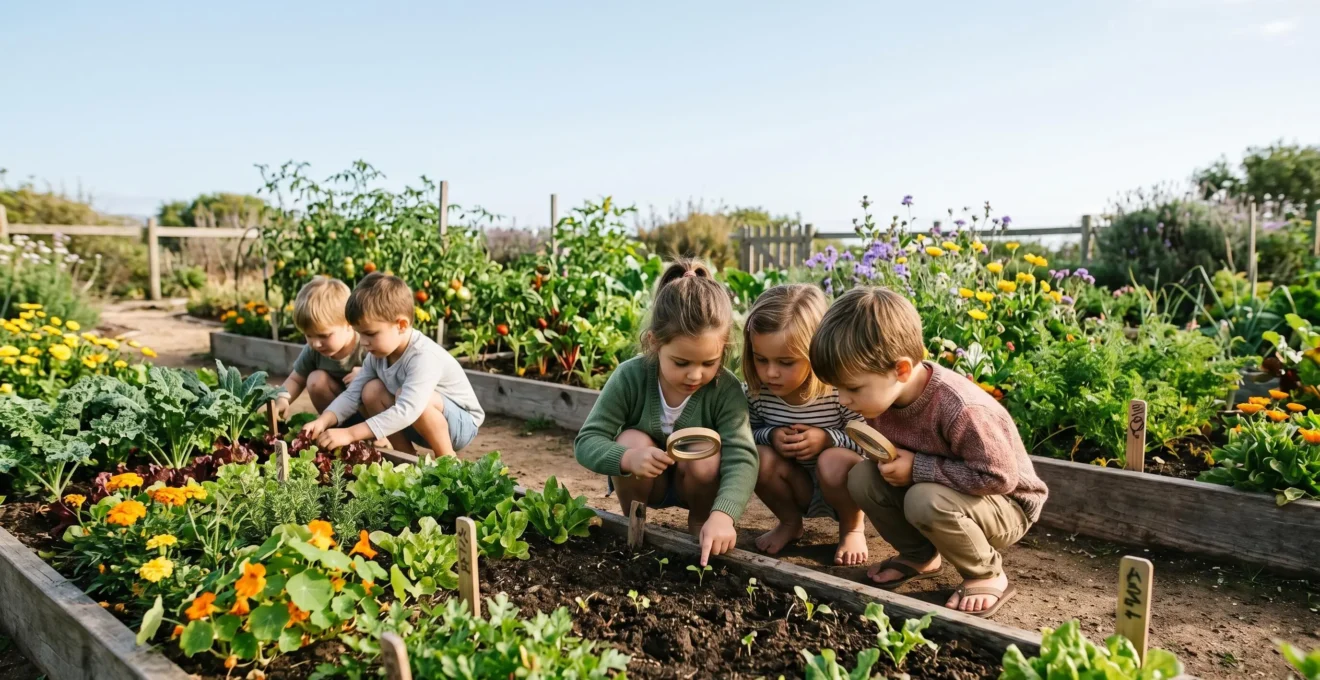
In summary:
- Transform your garden into a living laboratory to answer your child’s “why” questions about nature.
- Focus on hands-on investigation and observation rather than just giving factual answers.
- Use simple tools like journals and magnifying glasses to become “biology detectives” together.
- Model curiosity by asking “I wonder…” questions to foster a scientific mindset.
- Connect understanding with responsibility by teaching children how to care for the living things they study.
That one simple question from a preschooler—”Is it alive?”—can stop a parent in their tracks. How do you explain the complex world of biology to a mind that is just beginning to grasp it? Many guides offer simple diagrams of a butterfly’s life or suggest a generic “nature walk.” While helpful, these often miss the deeper opportunity: the chance to cultivate not just knowledge, but a genuine sense of wonder and the skills of a real scientist.
The truth is, you don’t need to be a biology expert with all the answers. In fact, it’s better if you aren’t. The key is to shift your role from “Answer-Giver” to “Chief Investigator.” Your garden is not just a collection of plants and bugs; it’s a living laboratory waiting for discovery. The most powerful lessons aren’t found in books, but in watching a caterpillar’s daily changes, uncovering where a roly-poly bug sleeps, or figuring out how a plant “drinks” water.
This guide is designed to equip you with the tools to become “biology detectives” alongside your child. Instead of providing dry facts, we will explore a series of hands-on investigations. We’ll build observation skills, model curiosity, and ultimately, foster a deep respect for the intricate web of life right outside your door. It’s time to trade memorization for metamorphosis and turn every “why” into a “let’s find out.”
This article provides a structured approach to exploring these concepts. Below is a summary of the key investigations we will undertake together in our garden laboratory.
Summary: A Parent’s Guide to Garden Biology
- Caterpillar to Butterfly: Watching Metamorphosis in Real Time
- Who Eats Who? Understanding Predators and Prey
- Roots, Shoots, and Leaves: What Does Each Part Do?
- Home Sweet Home: Where Do Bugs Sleep?
- Winter Dormancy: Why Do Trees Lose Leaves and Animals Sleep?
- Nature Journaling: Drawing What You See, Not What You Imagine
- The “I Wonder” Approach: Modeling Curiosity Instead of Giving Answers
- Environmental Awareness: Teaching Kids to Care for Their Planet
Caterpillar to Butterfly: Watching Metamorphosis in Real Time
Metamorphosis is one of nature’s most magical performances. For a preschooler, witnessing a crawling caterpillar transform into a winged butterfly is a core memory in the making. Instead of just showing a picture, this process is the perfect first mission for your biology detectives. The key is to slow down and observe the subtle changes that happen day by day. This isn’t just a science lesson; it’s an exercise in patience and close observation.
By creating a dedicated observation station, you provide a focal point for daily discovery. A simple calendar or chart allows even the youngest children to track time and document changes. The real learning happens when a child notices the caterpillar has grown, shed its skin, or stopped moving to prepare for its next stage. These observations are the foundation of scientific inquiry.
As you can see in the intricate details of a chrysalis, this “resting” stage is bustling with activity on the inside. Explaining this helps a child understand that big changes often happen quietly and out of sight. The hands-on experience of raising and releasing butterflies provides a tangible connection to the concept of a life cycle.
Case Study: Raising Live Butterflies in the Classroom
Educators who use affordable butterfly kits report that raising caterpillars creates an enriching hands-on experience where children observe the entire life cycle. Teachers find that children develop a deeper appreciation for nature and scientific observation skills. One successful approach involves maintaining a butterfly journal where preschoolers record notes on the metamorphosis and track changes over several weeks, fostering both scientific inquiry and literacy development.
Who Eats Who? Understanding Predators and Prey
The garden is full of tiny dramas. A chewed leaf, a ladybug hunting for aphids, a bird swooping down for a beetle—these are not just random events. They are evidence of the garden’s food web. Introducing the concept of predators and prey can seem daunting, but it’s a fundamental part of understanding that everything in nature is connected. The goal is not to scare, but to explain the roles different creatures play. Fortunately, research demonstrates that even young children are capable of understanding these basic relationships; in fact, one study showed that 92% of preschool children correctly identified the predator in simple animal pairings.
You can frame this as a “garden mystery.” Who took a bite out of this leaf? Why are the ladybugs all over this one plant? These questions turn you into detectives looking for clues. The concept of a food chain is simply a way of connecting those clues. It shows how energy moves from the sun to the plants, then to the plant-eaters (prey), and finally to the animal-eaters (predators). It’s a story of survival and dependence, where every character has a crucial part to play.
A simple, visual activity is the best way to make these connections tangible for a child. Using pictures and yarn, you can physically build a food web and see how pulling on one string affects all the others. This helps a child understand that even the smallest bug has an important job. For example, ladybugs are “Garden Protectors” because they eat the aphids that can harm plants.
- Step 1: Gather materials – drawings or pictures of the sun, a flower, an aphid, a ladybug, and a bird. Add colorful yarn or string.
- Step 2: Arrange the pictures in a circle on the floor or table with children sitting around them.
- Step 3: Starting with the sun, connect it with yarn to the flower (plants need sunlight). Then connect the flower to the aphid (aphids eat plants).
- Step 4: Connect the aphid to the ladybug (ladybugs eat aphids), then the ladybug to the bird (birds eat ladybugs).
- Step 5: Discuss how everyone in the garden is connected. Ask: What happens if one piece is missing?
Roots, Shoots, and Leaves: What Does Each Part Do?
To a child, a plant is often just a stem and some leaves. The most fascinating part—the root system—is hidden underground. Answering the question “How does a plant eat and drink?” is a perfect opportunity to reveal this secret world. We can explain that each part of the plant has a very specific job, working together like a team. The leaves are like solar panels, soaking up sunlight. The roots are like straws, drinking up water and nutrients from the soil. And the stem? It’s the plant’s internal elevator, carrying everything where it needs to go.
Making this visible is key. The classic “bean in a jar” experiment is more than just a fun activity; it’s a window into the hidden half of a plant’s life. By placing a bean against the side of a clear jar, children can watch the root emerge and grow downward, while the shoot pushes upward toward the light. This provides undeniable proof of what each part is programmed to do. Documenting this daily growth in a nature journal makes the slow, steady process of germination a visible and exciting event.
But how does the water get from the roots all the way to the leaves? This is where another simple demonstration brings the “elevator” concept to life.
Case Study: The Celery Water Transport Demonstration
In documented classroom experiments, teachers set celery stalks in colored water overnight. The next day, students observe the colored tubes running up the stems, providing visual proof of how stems function as ‘elevators’ carrying water. Teachers report this simple demonstration makes the abstract concept of xylem transport tangible for young learners, sparking discussions about how plants drink.
Home Sweet Home: Where Do Bugs Sleep?
Where do the ants go when it rains? Where does a beetle sleep at night? These are questions of habitat. For an insect, a “home” can be the underside of a leaf, a crack in tree bark, or a space under a rock. Exploring insect habitats is like a treasure hunt, requiring us to look at the world from a much smaller perspective. Providing a child with a magnifying glass is like giving them a superpower—the ability to see the hidden world of micro-habitats all around them.
This investigation teaches children to look closer and more carefully. A seemingly boring log can become a bustling apartment complex for ants, woodlice, and centipedes. This act of discovery fosters empathy and respect for these small creatures and the homes they build. Instead of just seeing “bugs,” children start to see individuals with needs, just like us: shelter, food, and safety.
Once you’ve explored natural bug homes, you can take the next step: becoming a “bug landlord.” Building a bug hotel is a fantastic project that combines a nature scavenger hunt with engineering and design. It provides a variety of small, safe spaces designed to attract beneficial insects like solitary bees and ladybugs, which are excellent pollinators and pest controllers. It’s a hands-on way to give back to the garden’s ecosystem.
- Step 1: Start with a durable structure like a tin can, small wooden box, or large plastic container.
- Step 2: Go on a nature scavenger hunt to gather materials: twigs, pinecones, bamboo pieces, dry leaves, and bark.
- Step 3: Create mini compartments inside the structure using toilet paper rolls or small jars to provide different ‘rooms’.
- Step 4: Work with your child to arrange the materials inside, creating lots of hidey-holes and small spaces.
- Step 5: Place the bug hotel in a sheltered spot and check back regularly to observe which insects move in.
Winter Dormancy: Why Do Trees Lose Leaves and Animals Sleep?
As autumn arrives, the garden begins to change. Leaves fall, flowers fade, and many animals disappear. To a child, it might look like the garden is dying. This is the perfect time to introduce the concept of dormancy and hibernation—nature’s big rest. It’s not an end, but a strategic pause. Trees aren’t dead; they have pulled all their energy and nutrients back into their roots to save them for spring. They are “powering down” to survive the cold, just like a bear sleeps through the winter.
Explaining this helps children see seasons as a cycle of activity and rest. The “death” of the garden in winter is actually a crucial preparation for the “rebirth” in spring. A walk through the winter garden becomes a search for clues about this big sleep. You can look for empty seed pods that have already released their seeds for next year, sturdy bare branches storing energy, and the quiet, empty spaces where insects are hiding underground.
A “Winter Garden Treasure Box” is a wonderful way to collect and study these clues. It transforms a walk in the cold into an exciting mission. Each item—a colorful leaf, an interesting twig, an empty seed head—tells a story about how the plant or animal prepared for its long rest. It’s a tangible collection of evidence that life is still there, just waiting for the warmth and light to return.
- Step 1: Provide a small box labeled “Our Winter Garden Treasures.”
- Step 2: Take a garden walk to look for signs that plants and animals are ‘getting ready for their rest’.
- Step 3: Collect items together, discussing why leaves fell (the tree pulled its nutrients back in) or why seed pods are empty.
- Step 4: Bring the treasure box inside to examine items with magnifying glasses.
- Step 5: Use the collection for indoor observation during winter, comparing it to the new growth you’ll find in spring.
Nature Journaling: Drawing What You See, Not What You Imagine
Every good detective needs a notebook to record clues, and for a young biologist, that notebook is a nature journal. The most important rule of scientific drawing is to draw what you actually see, not what you think you see. This is a profound lesson in observation. For example, a child might have a generic idea of a “leaf” in their head. But when you ask them to draw a specific leaf from a specific tree, they are forced to notice its unique shape, its jagged edges, the pattern of its veins, and any holes nibbled by insects. This is the difference between assumption and observation.
A nature journal is not about creating a masterpiece; it’s about paying attention. It trains the eye to see detail and the mind to notice change. To make it even more powerful, we can move beyond just drawing. A multi-sensory journal encourages children to use all their senses as observation tools. What does the wind sound like? What does the bark feel like? Capturing these sensory details creates a much richer record of their experience.
Your Action Plan: Creating a Multi-Sensory Journal Page
- Step 1: Divide the journal page into three sections using simple drawings: an eye for ‘What I See’, an ear for ‘What I Hear’, and a hand for ‘How it Feels’.
- Step 2: In the ‘See’ section, have your child draw a specific observation – a leaf’s shape, a flower’s color, or a bug’s movement.
- Step 3: In the ‘Hear’ section, help your child record sounds using words or symbols – ‘buzzzz’ for bees or wavy lines for wind.
- Step 4: In the ‘Feel’ section, create leaf rubbings by placing a leaf under the paper and rubbing a crayon over it to capture its texture.
- Step 5: Add a ‘My Questions’ section where you write down your child’s wonderings to investigate later.
Case Study: The “My Pet Plant” Weekly Observation Project
Teachers implementing weekly plant observation pages report significant development in children’s scientific skills. By dedicating one journal page to drawing the same plant once a week, preschoolers visually document growth and seasonal changes. Documentation shows children become increasingly detailed in their drawings over time, noticing new leaves, flower buds, and color changes. This practice transforms the journal into a scientific tool while building patience.
The “I Wonder” Approach: Modeling Curiosity Instead of Giving Answers
This is the single most important tool in your biology detective kit. As parents, our instinct is to provide answers. When a child asks, “Why is that ladybug red?” we want to tell them. But a biology teacher knows that the question is more important than the answer. The goal is to spark curiosity, not just satisfy it. By responding with “I wonder why…” you are doing something profound: you are modeling the scientific mindset. You are showing that adults don’t have all the answers and that the process of finding out is exciting.
Adopting the “I Wonder” approach shifts the dynamic. You are no longer the expert, but a co-investigator. This empowers your child, validating their questions and inviting them to form their own hypotheses. “I wonder what would happen if we moved this worm to the dry dirt?” is an invitation to experiment. “I notice the bees are only visiting the purple flowers. I wonder why?” is an invitation to observe more closely. This method transforms a simple walk in the garden into a series of potential experiments.
This shared posture of discovery is powerful. You are on the same level, exploring the world together. To help you make this shift, here are some simple phrases you can use to turn any observation into an investigation:
- “I notice that…” (Model pure observation)
- “What do you think would happen if…?” (Encourage hypotheses)
- “That reminds me of…” (Help make connections)
- “I wonder why…” (Model your own curiosity)
- “How could we find out?” (Turn questions into investigations)
As the experts at Childhood By Nature note, this simple shift is often all that’s needed to unlock a child’s natural inclination to learn. They state:
Curiosity and good modeling is often all it takes! In fact, you don’t even need to design your own curriculum.
– Childhood By Nature, Nature-Based Learning Curriculums Guide
Key takeaways
- True learning comes from investigation, not just information. Model curiosity by asking “I wonder why…” instead of providing immediate answers.
- Use tangible, hands-on activities like a “bean in a jar” or a “bug hotel” to make abstract biological concepts visible and understandable.
- A nature journal is a powerful scientific tool for practicing close observation and documenting changes over time, not just for drawing.
Environmental Awareness: Teaching Kids to Care for Their Planet
The final step in our journey as biology detectives is to evolve into “garden guardians.” Once we begin to understand how interconnected and fragile the garden ecosystem is, a sense of responsibility naturally follows. Teaching environmental awareness isn’t about lecturing on global issues; for a preschooler, it’s about fostering a personal connection to the living things in their immediate environment. It’s about understanding that our actions have an impact, and we can choose to have a positive one.
This starts with simple, empowering jobs. When a child is the designated “Water Master,” they learn that plants depend on them. When they are a “Compost Contributor,” they learn that they can help “feed” the soil that feeds the plants. These roles give children a sense of agency and stewardship. They are no longer just observers of the garden; they are active participants in its health and well-being. This connection has lasting benefits; according to the Natural Learning Initiative’s research, hands-on gardening with young children tunes their taste buds to fresh fruits and vegetables and builds a positive foundation for healthy eating.
The goal is to instill a sense of reciprocity. If the garden gives us food, flowers, and fascinating bugs to watch, what can we give back? The following “Garden Guardian Jobs” are simple ways to put this principle into action:
- Water Master: Uses a small watering can to give drinks to thirsty plants.
- Compost Contributor: Helps add vegetable peels and eggshells to the compost bin.
- Pollinator Protector: Plants flowers specifically chosen to feed bees and butterflies.
- Worm Watcher: Observes worms in the soil without disturbing their important work.
- Leaf Keeper: Helps leave some fallen leaves on the ground to give insects “cozy winter blankets.”
This hands-on care solidifies the lessons learned through observation. As the Natural Learning Initiative puts it:
The sensory impact of gardening creates a positive understanding of how seeds turn into plants helped by soil, sun, water—and human care.
– Natural Learning Initiative, Gardening with Young Children Resources
By moving from observation to curiosity, and finally to care, you give your child a gift far more valuable than a collection of facts. You give them a framework for lifelong learning and a deep, personal connection to the natural world. Your next step is to choose one small investigation and begin your journey as biology detectives today.