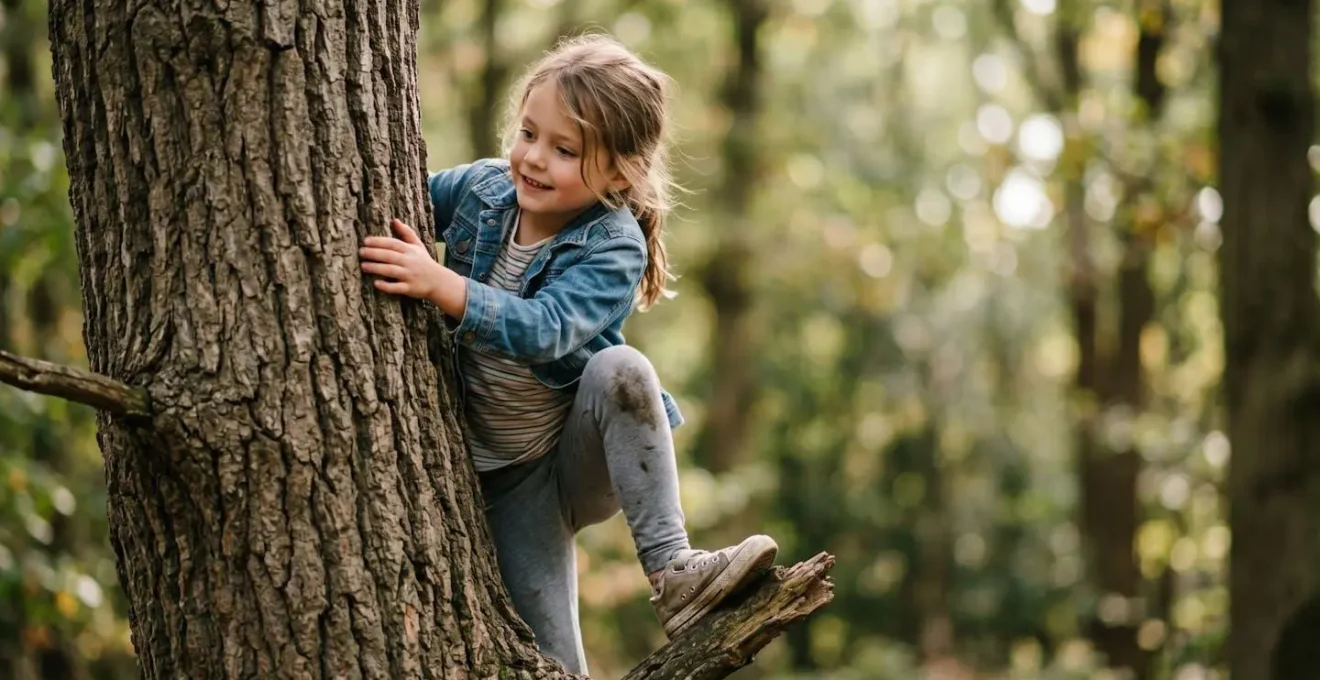
Wrapping children in safety bubble wrap doesn’t protect them; it prevents them from developing essential risk-assessment and resilience skills.
- Calculated ‘risky’ play is a powerful cognitive workout that trains the brain’s executive functions, improving memory and problem-solving.
- Exposure to dirt and natural microbes is not a threat but a vital ‘education’ for a child’s immune system, building robust long-term health.
Recommendation: Shift your mindset from preventing every fall to coaching your child on how to assess challenges, fall better, and get back up stronger.
The sound of a thump from the backyard, a favorite pair of jeans suddenly covered in mud, the sight of your child halfway up a tree—these moments can trigger a wave of anxiety in any parent. The immediate impulse is to shout, “Be careful!” or “Get down from there!” We live in a world of antibacterial wipes, perfectly manicured playgrounds with soft rubber flooring, and a pervasive fear that every stumble could lead to a serious injury. Our culture champions safety and cleanliness above all else.
But what if this obsession with creating a sterile, risk-free environment is the real danger? What if, by trying to prevent every scraped knee and dirty hand, we are inadvertently robbing our children of the very experiences they need to develop into resilient, capable, and intelligent adults? The conventional wisdom tells us to minimize risk. However, a growing body of research and a deeper understanding of child development suggest the opposite. A scraped knee is a lesson in physics and friction. A muddy shirt is an immune system inoculation. The slight fear felt on a high branch is a masterclass in emotional regulation.
This article re-frames outdoor exploration not as a series of potential hazards, but as a crucial, non-negotiable training ground. We will move beyond the platitudes of “fresh air is good for them” and delve into the specific, powerful ways that climbing, balancing, building, and getting dirty actively construct a child’s brain and body. We will explore how these seemingly ‘risky’ activities are, in fact, the most effective tools for building physical intelligence, calibrating internal risk-meters, and fostering true, lasting resilience.
This guide breaks down the science behind the fun. By understanding the profound developmental benefits hidden within each muddy puddle and climbable tree, you can learn to shift your perspective from a gatekeeper of safety to a coach of capability. Let’s explore the essential curriculum of the outdoors.
Summary: Outdoor Exploration: Why Kids Need to Climb Trees and Get Muddy?
- Tree Climbing: Testing Grips and Judging Branch Strength
- Log Walking: Developing Core Strength on Uneven Ground
- Den Building: Engineering Shelters with Sticks
- Puddle Physics: Jumping for Maximum Splash
- Uneven Ground: Why Hiking Builds Better Ankles Than Pavement?
- Muscle Memory: How Does the Brain Learn to Ride a Bike?
- Safety First: Distinguishing Between Preferences and Safety Rules
- Nature Walks and Outdoor Discovery: Turning a Walk into an Adventure
Tree Climbing: Testing Grips and Judging Branch Strength
When a child approaches a tree, they are not just looking for a way to get higher; they are engaging in a complex, real-time physics problem. Every reach is a hypothesis (“Is this branch strong enough?”), and every grip is a data point. This is physical intelligence in action. The child must assess the tree’s structure, plan a route, and constantly adapt their strategy based on tactile feedback. This process of testing grips and judging branch strength is a powerful workout for the brain’s executive functions, particularly working memory—the ability to hold and manipulate information for short-term tasks.
This isn’t just a theory; it’s backed by science. Proprioceptively dynamic activities, like tree climbing, which require active awareness of one’s body in space, have a direct impact on cognitive function. In fact, research from the University of North Florida found a 50 percent improvement in working memory capacity in participants after just a few hours of such activities. The very act of climbing, balancing, and navigating a complex 3D environment forces the brain to work harder and become more efficient.
As the lead researcher on that study explains, this type of play has far-reaching benefits:
Improving working memory can have a beneficial effect on so many areas in our life, and it’s exciting to see that proprioceptive activities can enhance it in such a short period of time.
– Dr. Tracy Alloway, University of North Florida study on tree climbing and cognitive skills
In essence, climbing a tree isn’t just a physical challenge; it’s a cognitive-enhancement exercise. The child is learning to trust their judgment, calculate risks on the fly, and problem-solve with their entire body. This is the very definition of risk calibration, a skill that can only be learned through direct experience.
Log Walking: Developing Core Strength on Uneven Ground
A fallen log presents an irresistible challenge to a child: a natural balance beam. Walking its length seems simple, but it is a sophisticated neurological exercise. Unlike a flat, predictable sidewalk, a log is a dynamic surface. It might be rounded, slightly slippery with moss, or have a subtle wobble. To successfully traverse it, a child must engage in a constant proprioceptive dialogue between their body and brain. Nerves in the feet, ankles, and legs send a continuous stream of information about the body’s position and the log’s surface, while the brain sends back thousands of micro-adjustments to the core and limb muscles to maintain balance.
This isn’t just about not falling off; it’s about building a smarter body. The core muscles, often called the body’s ‘powerhouse’, are working overtime to stabilize the torso. The ankles and feet are learning to adapt to uneven terrain, strengthening ligaments and improving reaction time. This is the kind of functional strength that prevents injuries later in life. A child who has mastered walking on logs is far less likely to twist an ankle stepping off a curb because their body has been trained to anticipate and correct for instability.
More profoundly, this kind of self-directed, challenging play is essential for brain maturation. Research has shown a direct link between free play and the development of the frontal lobe, the brain’s command center for executive functions. Engaging in activities like log walking helps mature the very brain areas that control impulsive urges, promote self-reflection, and enable creative problem-solving. By conquering the log, a child isn’t just improving their balance; they are literally building the neurological architecture for self-control and thoughtful decision-making.
Den Building: Engineering Shelters with Sticks
Den building is far more than a simple game; it is a child’s first foray into engineering, architecture, and project management. The process begins with a vision: a secret hideout, a fort, a cozy shelter. To make this vision a reality, a child must engage in a series of complex cognitive tasks. They must scan their environment for suitable materials—long sticks for the frame, leafy branches for the roof, smaller twigs to fill the gaps. This requires planning and resource management.
Next comes the construction phase, a hands-on lesson in physics and structural integrity. A child quickly learns that a tripod structure is more stable than a bipod. They discover through trial and error which angles are best for leaning branches against a tree trunk and how to weave other materials to create a weatherproof wall. This is not passive learning from a book; it is kinesthetic learning at its most powerful, where concepts like gravity, friction, and load-bearing are understood through touch and action.
Den building is also an incredible exercise in perseverance and problem-solving. When a wall collapses, the child isn’t just failing; they are gathering data. They must analyze what went wrong and devise a new solution. This iterative process of building, testing, failing, and rebuilding fosters a growth mindset and builds resilience. For many parents, the idea of children playing with “dirty sticks” and potentially unstable structures can be nerve-wracking. Yet, the developmental benefits are so clear that most parents intuitively understand their value. In fact, a 2017 study of over 1,600 parents found that 82% of them agreed that the benefits of such risky play activities far outweigh the potential for minor injuries.
Puddle Physics: Jumping for Maximum Splash
For a parent anxious about dirt and germs, a muddy puddle is a public enemy number one. It represents laundry, mess, and a host of unseen bacteria. For a child, however, that same puddle is a laboratory of fluid dynamics and a golden opportunity for sensory joy. The instinctive desire to jump in is not just a mischievous impulse; it’s a drive to experiment and understand the world. How much force is needed for the biggest splash? What happens when you land on one foot versus two? This is an intuitive exploration of cause and effect, displacement, and gravity.
More importantly, our modern fear of dirt is directly undermining our children’s health. The “hygiene hypothesis” suggests that our overly sanitized environments are leaving children’s immune systems undertrained and prone to overreaction. When a child is never exposed to the vast array of harmless microbes found in soil, their immune system doesn’t learn to distinguish between real threats and benign substances. The result? A higher risk of allergies and autoimmune disorders. Indeed, research shows that children in sanitized urban environments are up to 50% more likely to develop asthma and food allergies.
Playing in the mud is not just permissible; it is a biological necessity. It is an “education” for the immune system, teaching it to be more balanced and less reactive. This is not just a theory; it has been demonstrated in practice.
Case Study: The Finland Forest Playground Experiment
A remarkable trial in Finland directly tested the benefits of playing in the dirt. Researchers transformed the gravel yards of four urban daycare centers by covering them with forest floor soil and sod. Within just 28 days, the children playing in these naturalized environments showed a significantly more diverse collection of beneficial bacteria on their skin. More impressively, their blood samples revealed a higher count of T-cells and other crucial immune-regulatory markers compared to children who continued to play on sterile gravel playgrounds. This study provides powerful evidence that exposure to natural soil can rapidly and positively train a child’s immune system.
So, the next time your child barrels towards a puddle, consider it a free, all-natural immune-boosting session. A pair of rubber boots and a change of clothes are a small price to pay for a more robust and well-educated immune system.
Uneven Ground: Why Hiking Builds Better Ankles Than Pavement?
A walk on a paved sidewalk is a monotonous task for the body and brain. The surface is predictable, flat, and requires minimal cognitive engagement. A hike on a forest trail, however, is a completely different experience. Every step is unique. The ground might be soft with pine needles, hard with rock, or squishy with mud. Roots crisscross the path, and the incline is ever-changing. This constant variation is not an inconvenience; it is a high-level training program for the body’s proprioceptive system.
Proprioception is often called the “sixth sense”—it’s your brain’s awareness of where your body parts are in space without you having to look. When you walk on uneven ground, thousands of nerve receptors in your feet and ankles are firing off messages to your brain about the terrain. The brain then instantly computes this data and sends signals back to your muscles to make tiny, continuous adjustments to your posture and foot placement. As a medical review on the topic puts it succinctly:
Detecting uneven ground can tell your body to adapt its center of gravity to balance itself.
– Healthline medical review, Proprioception exercises for balance and coordination
This constant neurological workout does two critical things. First, it physically strengthens the small stabilizer muscles, tendons, and ligaments around the ankle and knee, making them far more resilient to sprains and injuries. An ankle trained on a trail is a “smarter” ankle than one trained only on pavement. Second, it sharpens the communication pathways between the body and the brain, improving overall coordination, balance, and reaction time. This is why athletes in many sports incorporate uneven surface training—it builds a more adaptable and injury-resistant body.
Muscle Memory: How Does the Brain Learn to Ride a Bike?
Learning to ride a bike is a rite of passage, often accompanied by wobbly starts, scraped knees, and a parent’s anxious encouragement. But what is actually happening in the brain during this process? It’s the perfect demonstration of muscle memory, or more accurately, procedural memory. This isn’t the kind of memory you use to recall a fact, like a historical date. It’s the memory of ‘how to do’ something, and it’s stored in a different part of the brain, primarily the cerebellum and basal ganglia.
At the beginning, a child is using their prefrontal cortex—the conscious, thinking part of their brain. They are overthinking every movement: “Push the pedal, steer straight, don’t fall!” This is inefficient and exhausting. The breakthrough moment happens when the task is repeated enough times that the cerebellum begins to take over. This part of the brain is a master of motor control and coordination. It learns the sequence of movements—the precise balance, the subtle shift in weight, the pressure on the pedals—and automates it.
Once this happens, the process becomes unconscious and effortless. The child is no longer ‘thinking’ about riding; they are simply riding. This is why you never forget how to ride a bike. The procedure is deeply encoded as a motor skill. This process of encoding is not just for bikes; it happens with every complex motor skill learned through play, from catching a ball to skipping a rope. It’s the brain learning to trust the body, offloading the task from the conscious mind to the expert motor control system. This frees up cognitive resources, allowing the child to pay attention to their surroundings instead of the mechanics of their movement.
Key Takeaways
- Risky play is a cognitive workout, not just physical fun, actively training the brain for problem-solving and memory.
- Dirt and microbes are not enemies but essential educators for the immune system, helping to build robust, long-term health.
- Your role as a parent is to evolve from a “safety guard” to a “risk coach,” helping your child distinguish real hazards from manageable challenges.
Safety First: Distinguishing Between Preferences and Safety Rules
Advocating for risky play is not an argument for recklessness. The goal is not to eliminate safety, but to redefine it. As a parent, your primary role is to distinguish between a genuine hazard and a manageable risk. A hazard is a danger that a child cannot see, understand, or manage on their own, such as traffic, deep water, or a frayed electrical wire. These require hard-and-fast safety rules. A risk, however, is a challenge that a child can see, assess, and choose to engage with, such as a tall climbing frame or a fast-moving stream.
The crucial shift is moving from a mindset of “I must prevent all possible harm” to “I must teach my child to assess and manage challenges.” This often means separating our own preferences (e.g., “I don’t like muddy clothes”) from actual safety rules (“We do not play near the road”). When we overprotect and shield children from all risks, we rob them of the opportunity to develop their own risk-management skills. Counter-intuitively, this can make them less safe in the long run.
Research in injury prevention supports this seemingly paradoxical idea. Children who are allowed to engage in age-appropriate risky play are often better at assessing risk and have fewer accidents as they get older. They’ve had the chance to learn from small failures—a slip, a fall, a scraped knee—in a controlled environment. A study on this very topic found that overprotection can increase anxiety and lower self-esteem, while managed risk exposure is precisely what builds competence and confidence.
Your Risky Play Safety Check
- Identify the Risk vs. the Hazard: Is this a challenge the child can see and learn from (risk), or a hidden danger they can’t manage (hazard)? Hard rules for hazards, coaching for risks.
- Scan the Environment: Check for true hazards before letting play begin. Look for things like broken glass, unstable heavy objects, or proximity to roads.
- Coach, Don’t Command: Instead of “Don’t climb so high,” try “That looks high. Where will you put your foot next? Does that branch feel strong?” This empowers their own assessment skills.
- Assess the Child’s State: A tired, hungry, or emotionally overwhelmed child has a compromised risk-assessment ability. Risky play is best when they are fresh and focused.
- Plan for the “What If”: For higher-risk activities (like climbing high), think through the “what if they fall” scenario. Is the landing zone clear and relatively soft? Your presence is the ultimate safety net.
Nature Walks and Outdoor Discovery: Turning a Walk into an Adventure
Now that we’ve deconstructed the benefits of specific activities, it’s time to put it all together. The simplest of outdoor activities—a nature walk—can become a rich, multi-layered adventure when viewed through this new lens. A walk around the block or in a local park is no longer just a way to pass the time; it’s a field trip to a living gymnasium and science lab. Your role is to shift from being a supervisor to being a co-conspirator in discovery.
Instead of setting a destination, focus on the journey. Let your child’s curiosity lead the way. That interesting-looking bug? Stop and examine it. That perfect balancing log? Let them traverse it. That hill that looks perfect for rolling down? Encourage it. Every one of these spontaneous detours is an opportunity for learning. You are giving them the gift of autonomy and showing them that their interests are valid and worth exploring. This unstructured approach is profoundly beneficial, as evidence suggests that repeated exposure to high-quality unstructured outdoor play has a positive impact on executive functions, including inhibitory control and working memory.
Turn the walk into a treasure hunt. Look for five different types of leaves, a perfectly smooth stone, or a stick that looks like a sword. This simple game hones observation skills and teaches them to see the detail and diversity in the world around them. Talk about what you see. Use descriptive words. Ask open-ended questions: “Why do you think that moss is growing on only one side of the tree?” You’re not just passing time; you’re building their vocabulary, their scientific curiosity, and your connection with them. The outdoor world is not just a backdrop for our lives; it is an active participant in our children’s development.
So the next time you see that climbable tree or that irresistible muddy puddle, take a deep breath. Instead of seeing a risk, try to see the classroom. Instead of a mess, see a lesson in progress. The real adventure starts when you give them permission to begin.