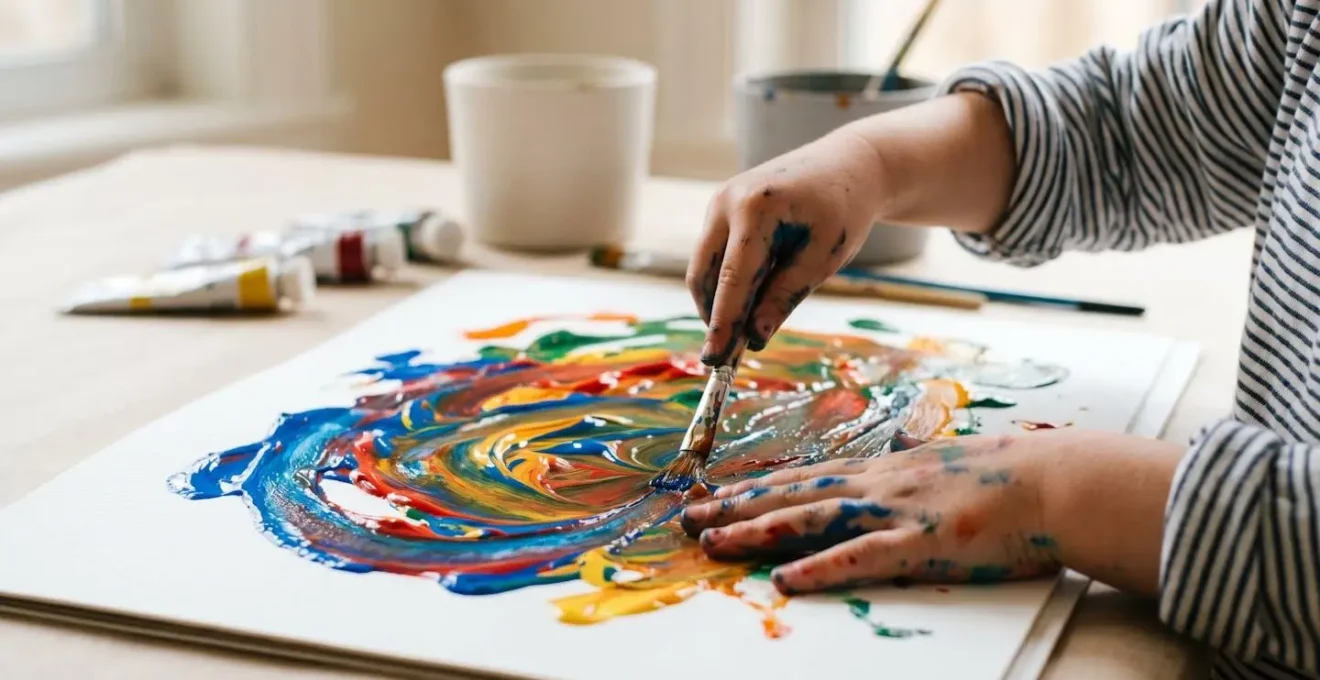
For parents of quiet children, the silence around big emotions can be worrying. This guide shifts the focus from ‘making art’ to using art as a therapeutic language. It explains how specific creative processes—like visualizing anger, assembling feelings in a collage, or externalizing fears into ‘worry monsters’—allow a child to process emotions they cannot verbalize, turning a blank page into a safe space for non-verbal dialogue and healing.
As a parent, you know your child better than anyone. You see the subtle shift in their posture when they’re anxious, the flicker of frustration in their eyes, or the quiet withdrawal that signals sadness. When a child is naturally reserved or struggles to find words for their big feelings, this silent world of emotion can feel inaccessible, leaving you wondering how to connect and offer support. You might have tried asking “What’s wrong?” only to be met with a shrug, or perhaps you’ve set up fun craft projects that end in frustration.
The common advice is to encourage children to “talk about it,” but this overlooks a fundamental truth: for many children, especially quiet ones, emotions are not experienced as words. They are felt in the body as a tangled knot, a buzzing energy, or a heavy weight. This is where the conventional approach falls short. The true key isn’t forcing a verbal conversation they aren’t ready for, but offering a different language altogether—the language of art.
But this isn’t about creating a masterpiece for the fridge. This is about using art as a therapeutic tool. The real power lies not in the finished product, but in the process: the act of scribbling, tearing, squeezing, and arranging. This guide, from the perspective of an art therapist, will walk you through specific, powerful techniques that help your child externalize, understand, and manage their feelings. We will explore how to turn anger into a tangible object, why the messy experience of creating is more valuable than a perfect picture, and how you can become a safe, observant guide in their creative-emotional journey.
To help you navigate these powerful techniques, this article is structured to build your understanding step by step. Below is a summary of the key areas we will explore to transform art time into a profound opportunity for connection and emotional healing.
Summary : A Guide to Using Art for a Child’s Emotional Expression
- Draw Your Mad: Visualizing Anger on Paper
- Process Art vs Product: Why the Experience Matters More Than the Fridge Picture?
- Collage: Assembling Disparate Parts into a Whole
- Visual Thinking Strategies: Asking “What’s Going on in This Picture?”
- The Blank Page: Overcoming the Fear of Making a Mistake
- “Name It to Tame It”: Why Labelling Emotions Reduces Their Power?
- Worry Monsters: Tools to Help Kids Externalize Their Fears
- The Power of Labeling Emotions: Why “I See You Are Sad” Works
Draw Your Mad: Visualizing Anger on Paper
Anger is a powerful, energetic emotion that can be overwhelming for a child who lacks the words to describe it. It often manifests physically—clenched fists, a tight jaw, a stomping foot. Instead of trying to talk them down, art therapy offers a way to match that energy and move it from inside their body to outside, onto a piece of paper. This is a core therapeutic concept called externalization. By giving anger a visual form, the child is no longer consumed by it; they can look at it, separate from it, and begin to feel a sense of control.
Invite your child to “draw their mad.” This isn’t about drawing a person with an angry face. It’s about translating the *sensation* of anger into marks. Give them crayons (hard wax is great for pressure) or paint and encourage them to show you what the anger looks like. It might be fast, jagged scribbles, hard-pressed lines that nearly tear the paper, or dark, swirling colors that cover the whole page. The goal is a physical release. Your role is not to judge the outcome but to witness the process, offering simple observations like, “I see you’re pushing very hard with that red crayon.”
Once the anger is on the paper, it becomes something manageable. You can then guide them through a ritual of containment. Does the anger need to be crumpled into a tight ball? Torn into tiny pieces? Or perhaps placed in a special “Anger Box”? This final, physical act of containing the drawing gives the child a tangible conclusion to their emotional experience, teaching them that they have power over their feelings, not the other way around. This process transforms a potentially destructive impulse into a constructive, controlled release.
Action Plan: A Ritual for Releasing Anger
- Invite the child to draw their anger on paper using any colors, shapes, or textures that feel right.
- Guide observation of the physical process – comment on pressure, speed, and marks: ‘I notice you’re pressing very hard’ or ‘That scribble is fast and jagged.’
- Create a narrative for the anger – ask ‘What does this angry shape want?’ or ‘What made it so mad?’ to externalize the emotion.
- Perform a containment ritual – crumple the paper, tear it into pieces, or place it in a special ‘anger box’ to give the child tangible control.
- Complete the release – walk the container outside, create a ceremony, or declare the anger ‘locked away’ to mark closure.
Process Art vs Product: Why the Experience Matters More Than the Fridge Picture?
In our goal-oriented world, we often praise children for the things they *make*: a recognizable drawing of a house, a colorful necklace, a neatly painted picture. This is “product art,” where the focus is on the final outcome. For a quiet child processing emotions, however, this focus on a “good” result can be paralyzing. The real therapeutic magic happens in “process art,” where the experience of creating is the entire point. It’s about the sensory journey—the feeling of squishing clay, the sound of tearing paper, the mesmerizing sight of colors blending together.
When the pressure to create something “pretty” or “right” is removed, the child is free to simply be with their feelings and express them through the materials. This approach is profoundly regulating for the nervous system. As one analysis on the science of art therapy highlights, the physical act of creation itself is what brings healing. As Art Therapy Research notes in “The Neuroscience of Art Therapy”:
The tactile experience of smearing paint, molding clay, or tearing paper sends non-verbal, calming signals to the brain’s emotional center (the amygdala), effectively reducing stress without needing words.
– Art Therapy Research, The Neuroscience of Art Therapy: How It Heals Differently from Talk Therapy
This explains why a child might spend twenty minutes just mixing paint into a brown sludge or methodically tearing paper into strips. They aren’t trying to make a “product”; they are engaging in a deeply satisfying sensory activity that helps them self-soothe and process internal chaos. Research confirms the value of this approach; research on structured art therapy programs found a significant increase in positive emotional expression scores among adolescents, demonstrating that the guided process yields measurable emotional benefits. As a parent, your role is to shift your praise from the product (“That’s a beautiful drawing!”) to the process (“I see how focused you were while you were mixing those colors.”).
Collage: Assembling Disparate Parts into a Whole
Childhood emotions are rarely simple. A child might feel sad about moving to a new school but also excited about their new room. They might love their baby sibling but also feel jealous of the attention they get. These conflicting feelings can be confusing and hard to articulate. Collage offers a perfect medium for exploring this complexity. It is the art of integration—of taking different, disconnected pieces and arranging them into a new, cohesive whole.
Provide your child with a variety of materials: old magazines, scraps of fabric with different textures, colored paper, photos, leaves, and buttons. The prompt can be simple: “Let’s make a picture about how you’re feeling today.” They might be drawn to a picture of a stormy cloud from a magazine to represent sadness, a piece of shiny gold foil for excitement, and a rough piece of sandpaper for frustration. They don’t need to explain their choices. The act of searching for, selecting, and arranging these disparate elements is a non-verbal way of sorting through their internal landscape.
As they place the pieces on the page, they are literally making sense of their emotions. They decide what goes next to what, what overlaps, and what stands alone. This process mirrors how the brain works to integrate complex experiences into a coherent story. It gives them a sense of agency over feelings that might otherwise feel chaotic and overwhelming. Research supports this, showing that creating collages can foster self-reflection and acceptance by allowing children to organize complex internal states into a unified visual narrative.
Case Study: The Self-Portrait Collage
The practice of self-portraiture through collage is a powerful tool for self-reflection. When children create collages representing different aspects of their personalities—using images, words, and textures that resonate with them—they engage in a deep act of making sense of their own identity. By arranging these different parts into a single image, they are practicing the skill of accepting all parts of themselves and creating a unified, visual narrative of who they are in that moment.
Visual Thinking Strategies: Asking “What’s Going on in This Picture?”
Once your child has created something, the next challenge is talking about it without shutting them down. The instinct to ask “What is it?” or to interpret the art for them (“Oh, that looks like a sad monster!”) can put them on the spot. A more effective approach is using Visual Thinking Strategies (VTS), a method designed to facilitate open-ended conversations about art. It shifts you from the role of an interpreter to that of a curious and neutral facilitator.
The VTS method, developed by Philip Yenawine and Abigail Housen, is based on three simple, powerful questions. As Yenawine outlines, you start by asking:
What’s going on in this picture? What do you see that makes you think that? What more can we find?
– Philip Yenawine, Visual Thinking Strategies for Preschool: Using Art to Enhance Literacy and Social Skills
The first question is a gentle, open invitation. The second question asks for evidence, encouraging the child to look closely and ground their ideas in what they see, but without judgment. The third question encourages deeper exploration and validates that there is always more to discover. You are not looking for a “right” answer. Your role is to listen, point to the areas they mention, and paraphrase their statements to show you are hearing them (“So, you see jagged red lines here, and that makes you think it’s feeling angry.”). This technique creates a safe, non-verbal dialogue where the child is the expert on their own work. It teaches them that their perspective is valid and encourages them to build meaning from their own creations. The benefits are clear, as a pilot study demonstrated that engaging children in discussions about visual art using VTS enhanced students’ argumentative writing and critical thinking.
The Blank Page: Overcoming the Fear of Making a Mistake
For some children, especially those who are sensitive or perfectionistic, a blank white page can be incredibly intimidating. It represents a vast space where they might “mess up” or fail to create something “good.” This fear can be a major barrier to the free, expressive release that art can offer. As a parent-therapist, your first job is to de-fang the blank page and give your child explicit permission to be messy and imperfect.
One of the most effective ways to do this is to “ruin” the page’s perfection on purpose. Before they even start, make a single, intentional mark yourself—a dot in the middle, a random squiggle, or even a splatter of water. This simple act instantly breaks the tension and reframes the activity from a test of skill to a shared space for play. It communicates non-verbally that this is not a precious space; it is a safe space for exploration.
You can also model a healthy relationship with “mistakes.” If a color spills or a line goes where it wasn’t intended, reframe it with curiosity instead of frustration. Use discovery-oriented language like, “Oh, look at that new color we made by accident!” or “What did we discover there?” This teaches resilience and flexible thinking. It shows your child that unexpected outcomes aren’t failures, but opportunities for new directions. The key is to shift the focus entirely away from aesthetics and onto observation. Instead of evaluative praise like “That’s beautiful,” use neutral, process-oriented comments:
- “I see you’re using a lot of blue in that corner.”
- “You worked on that one spot for a long time.”
- “Your hand was moving really fast when you made those lines.”
This validates their effort and experience without placing any value judgment on the final product, slowly dissolving the fear of the blank page.
“Name It to Tame It”: Why Labelling Emotions Reduces Their Power?
The phrase “Name It to Tame It,” popularized by Dr. Daniel Siegel and Dr. Tina Payne Bryson, is more than just a catchy rhyme; it’s a profound neurobiological principle that is central to emotional regulation. When a child is in the grip of a big feeling like fear or anger, their right brain—the seat of intense emotion and non-verbal sensations—is firing on all cylinders. They are flooded, and logic is offline. The act of labeling the emotion (“This feels like anger,” or “I see sadness”) helps to engage the left brain, which is responsible for language, logic, and order.
As Dr. Tina Payne Bryson, co-author of “The Whole-Brain Child,” explains, labeling an emotion helps to integrate the brain. It builds a bridge between the feeling right side and the thinking left side. This integration is what allows a child to move from a state of being overwhelmed *by* an emotion to a state of being able to observe and manage it. It doesn’t make the feeling disappear, but it does reduce its intensity and power. The simple act of putting a name to the experience provides a sense of understanding and control.
This isn’t just theory; it’s observable in brain scans. Groundbreaking neuroscience research has found that labeling emotions decreases activity in the brain’s emotional centers, specifically calming the fear-based amygdala while simultaneously activating the more regulatory prefrontal cortex. When you help your child find a word—any word—for the feeling they’ve expressed in their art, you are helping them perform a powerful act of self-regulation. You are helping them build the neural pathways that are the foundation of lifelong emotional intelligence. The label acts as an anchor in the emotional storm, giving their brain a focal point to begin the work of calming down.
Worry Monsters: Tools to Help Kids Externalize Their Fears
Anxiety, with its “what ifs” and worst-case scenarios, can be a particularly sticky emotion for children. Worries can feel huge, amorphous, and all-consuming. Just like with anger, a primary therapeutic goal is to externalize the feeling—to get it out of the child’s head and into a tangible form. One of the most beloved and effective tools for this is the “Worry Monster.”
A Worry Monster is a handmade creature—it can be a decorated box, a sewn puppet, or a clay figure—with a mouth that opens. The concept is simple and powerful: the child writes down or draws a picture of their worry and “feeds” it to the monster. The monster’s job is to hold onto the worry so the child doesn’t have to. This act of transference is deeply symbolic. It provides a physical ritual for letting go, giving the child a concrete action they can take when an anxious thought pops into their head.
Creating the monster itself is also a therapeutic process. The child can design it to look silly, scary, or friendly, giving them complete control over the being that will contain their fears. This process gives them agency and a sense of mastery. Once the worry is “fed” to the monster, it creates a healthy distance between the child and their anxiety. The worry isn’t gone, but it is contained. It’s no longer a formless dread swirling inside them; it’s a specific thing, inside another specific thing, that they can see and touch.
Case Study: The Emotion Monsters Activity
The “Emotions Monsters” activity empowers children to design characters that embody their specific feelings, such as a ‘Sadness Slime’ or an ‘Anger Volcano.’ By externalizing emotions into these physical characters, children gain distance from overwhelming feelings and develop the ability to observe and manage them from the outside. The therapeutic result is enhanced self-expression, improved emotional regulation, and a sense of empowerment as children learn to navigate their internal world through creative, tangible externalization.
Key takeaways
- Externalization is the first step: Art helps move a big, internal feeling into a visible, manageable form outside the child.
- The process matters more than the product: Focus on the sensory experience of creating, not on the aesthetic quality of the finished piece.
- The parent’s role is to be a curious, non-judgmental witness, validating the child’s effort and expression without interpreting their work.
The Power of Labeling Emotions: Why “I See You Are Sad” Works
We’ve explored how art helps a child express feelings non-verbally and how “naming” tames them neurologically. The final, crucial piece of the puzzle is your role in connecting these two worlds. When you look at your child’s drawing—perhaps a small, isolated figure in a corner—and gently say, “It looks like that person might be feeling a little lonely,” you are doing something profound. You are offering a verbal label for a non-verbal expression. This act of attuned validation is where deep healing and connection occur.
Saying “I see you are sad” or “That looks frustrating” doesn’t fix the problem or take the feeling away. Its power lies in something more important: it tells your child that they are seen. It communicates that their internal experience is real, valid, and not something they have to carry alone. For a quiet child who may feel misunderstood or invisible in their struggles, this validation is a lifeline. It builds a foundation of trust and emotional safety, making it more likely they will continue to share their inner world with you, whether through art or, eventually, words.
Art provides the safe, non-verbal outlet, and your words provide the validating anchor. This combination is incredibly effective. Multiple studies have shown the impact of this approach, with a 2013 study finding that arts enrichment programs showed measurable improvements in emotional expression and regulation for at-risk young children. This success hinges on the presence of a supportive adult who can help the child make sense of their creative expressions. Your simple, observant words bridge the gap between their art and their awareness, teaching them the language of their own heart.
By shifting your focus from the finished product to the emotional process, you transform art from a simple pastime into a powerful tool for connection. Start today by observing not what your child creates, but *how* they create, and you will open a new, profound dialogue with their inner world.