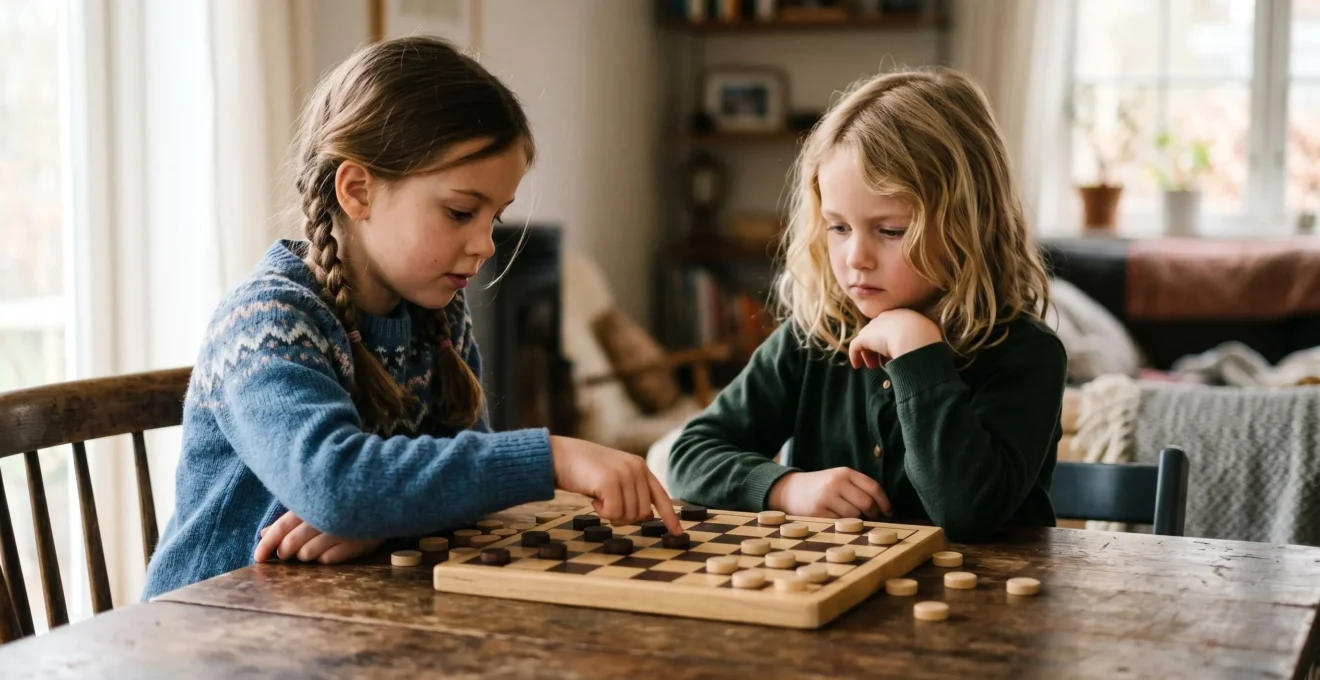
To curb impulsivity, stop telling your child to “think ahead” and start training their brain like a chess master.
- Impulsive actions often stem from a still-developing prefrontal cortex, not a lack of willingness to listen.
- Simple board games are the perfect gym to train specific cognitive skills like blocking, sacrificing, and visual planning.
Recommendation: Shift your focus from correcting impulsive behaviour to coaching the underlying cognitive skills through structured play.
As a parent, you’ve likely seen it a hundred times: the leap without a look. The piece moved in a game without a moment’s thought, the quick, impulsive decision that immediately backfires. It’s a common frustration for parents of children who seem to operate on pure instinct, and the typical advice is to simply tell them to “slow down” or “think about their next move.” But what if that advice is like telling a novice weightlifter to “just lift heavier”? It ignores the fundamental need to build the right muscles first.
This guide takes a different approach. As a chess coach, I don’t just tell my students to “play better.” I teach them to see the board, to understand the value of each piece, and to recognize patterns. We will apply that same philosophy here. We’ll move beyond the generic platitude of “play more board games” and dissect how specific, classic games can be used as a training ground for the brain. We’ll explore the neuroscience behind impulsivity and see how these games directly strengthen the very parts of the brain responsible for planning and self-control.
The goal isn’t to raise a grandmaster, but to equip your child with the cognitive tools to navigate the complex “game” of life. It’s about transforming you from a frustrated parent into a strategic coach. We will look at how to teach blocking, the art of the calculated sacrifice, the importance of visual planning, and even how to turn a loss into the most valuable lesson of all. This isn’t just about playing games; it’s about rewiring the brain, one move at a time.
This article breaks down key strategic concepts your child can learn through simple, classic games, turning playtime into a powerful tool for cognitive development. Each section focuses on a specific game and the essential thinking skill it teaches.
Summary: A Coach’s Playbook for Building a Strategic Mind
- Noughts and Crosses: The First Lesson in Blocking an Opponent
- Connect 4: How Does Understanding Neuroscience Change the Way You Parent?
- Checkers/Draughts: Sacrifice a Piece to Win the Game
- Maze Books: Tracing the Path with Eyes Before Pencil
- Catan Junior: Trading and Building for a Goal
- The Marshmallow Test: Can You Teach Delayed Gratification?
- The Art of Losing: Teaching Good Sportsmanship in Board Games
- Educational Games and Logic Puzzles: Brain Training That Feels Like Play
Noughts and Crosses: The First Lesson in Blocking an Opponent
The first step in moving from impulsive play to strategic thinking is recognizing that you are not playing in a vacuum. There is an opponent, and they have a plan. Noughts and Crosses (or Tic-Tac-Toe) is the perfect “opening gambit” for teaching this fundamental concept. An impulsive child will focus only on their own goal: getting three of their symbols in a row. They will place their ‘X’ or ‘O’ wherever an opportunity appears, often ignoring the opponent’s growing threat until it’s too late.
Your role as a coach is to shift their focus. After a loss, replay the game and ask, “At what point could you have stopped my win?” This introduces the concept of defensive thinking. The goal is to get them to scan the board for the opponent’s threats before looking for their own opportunities. This simple shift is monumental. It is the first exercise in moving attention from an internal goal to an external reality, a core component of strategic awareness.
This isn’t just about game mechanics; it’s about cognitive development. Playing board games helps strengthen the connections in the brain responsible for planning and problem-solving. By teaching a child to block an opponent, you are giving them their first tool to actively “read the board”—a skill that extends far beyond the 3×3 grid. It’s the foundational step in training the brain to look before it leaps.
Connect 4: How Does Understanding Neuroscience Change the Way You Parent?
If Noughts and Crosses is about seeing one move ahead, Connect 4 is about seeing several. This is where we move from simple blocking to multi-step planning, and understanding the neuroscience of your child’s brain is a game-changer for you as a parent-coach. Impulsivity is not a character flaw; it’s a feature of a developing brain. The prefrontal cortex, the brain’s CEO responsible for judgment and impulse control, is under major construction throughout childhood and adolescence. In fact, neuroscience research confirms that this region doesn’t reach full maturity until the mid-20s.
As one expert explains, this part of the brain is critical for strategic thought. In Brain and Life Magazine, Tom A. Hummer, Ph.D., notes:
The prefrontal cortex—the locus of judgment, decision-making, and impulse control—undergoes major reorganization during adolescence.
– Tom A. Hummer, Ph.D., Brain and Life Magazine
This explains why your child struggles to see the consequences of dropping a checker in the wrong slot. They are not being defiant; their brain’s hardware for long-term planning is still being installed. Games like Connect 4 are the perfect workout for this developing region. It forces the player to simulate future outcomes: “If I go here, they will go there, which lets me go here.” This “what if” thinking directly exercises the working memory and planning functions of the prefrontal cortex.
When you see your child make an impulsive move, your new understanding allows you to shift from frustration to coaching. Instead of “Why did you do that?” you can ask, “What did you think I was going to do next?” You are no longer policing their moves; you are helping them build the neural pathways that will one day let them see the whole board on their own.
Checkers/Draughts: Sacrifice a Piece to Win the Game
For a mind wired for immediate gratification, the concept of a calculated sacrifice is the most advanced and counter-intuitive lesson in strategy. In Checkers, every piece feels precious to a beginner. The thought of voluntarily giving one up seems like madness. The impulsive player’s goal is to capture as many of the opponent’s pieces as possible, a direct and satisfying action. But a strategist knows that sometimes, the path to victory involves a planned loss.
Imagine this scenario: your opponent has a line of single pieces blocking your path to the king’s row. You see a move where you can capture one of their pieces, but it leaves your own piece vulnerable to be captured on the next turn. The novice sees only the immediate loss. The coach helps them see the bigger picture. “Yes, you will lose this piece,” you might explain, “but look at the board *after* that happens. Their blocking line is now broken, and your other piece now has a clear path to become a king.”
This is a profound lesson in delayed gratification. You are teaching your child to trade a small, short-term loss for an overwhelming long-term advantage. This directly combats the impulsive urge to grab every immediate reward. It reframes “losing” a piece not as a failure, but as a strategic investment. By creating these scenarios and talking through them, you are building a mental model for your child that values future outcomes over present gains—a cornerstone of mature decision-making.
Maze Books: Tracing the Path with Eyes Before Pencil
The simple maze is a brilliant and often-underestimated tool for teaching impulse inhibition. An impulsive child’s first instinct when faced with a maze is to immediately put pencil to paper and start moving. They charge down the first open path they see, only to hit a dead end, get frustrated, and have to backtrack. The maze, in this sense, becomes a perfect metaphor for their decision-making process. The lesson you want to coach is simple but powerful: trace the path with your eyes first.
This single instruction forces a pause. It separates the planning phase from the action phase. By visually scanning the maze from the *end* to the *beginning*, a child can identify the correct path before making a single mark. This act of visual planning, of using “the mind’s eye,” is a direct exercise for the prefrontal cortex. It is the physical act of looking before you leap, made tangible in a puzzle.
Encourage this “eyes before pencil” strategy. Celebrate when they find the path without making a mistake, not because they are “good at mazes,” but because they demonstrated self-control and planning. This skill is directly transferable to board games—scanning the board before moving a piece—and, ultimately, to real-life decisions. You are teaching them that a moment of observation up front can save a great deal of frustration and wasted effort later.
Action Plan: Activities to Strengthen the Prefrontal Cortex
- Matching Games: Use simple card-matching games to build attention and working memory. The act of remembering where a card was located, even after a failed match, trains a child to hold information in their mind and handle small disappointments.
- Puzzles: Jigsaw puzzles are excellent for practicing persistence. A child learns to test ideas (does this piece fit?), adjust strategies when it doesn’t, and keep working toward a final goal.
- Building Play: Whether with blocks or LEGOs, building activities support planning and problem-solving. Encourage them to set a goal first (“Let’s build a tall tower with a bridge”) and then adjust as they go, even when things fall apart.
- “First/Then” Routines: Use short, predictable verbal cues in daily life to practice impulse control. “First we put away the toys, then we can have a snack.” This builds working memory and flexible thinking by establishing a clear, two-step sequence.
- Mindful Pausing: Before answering a question or starting a task, introduce a “one-breath pause.” This simple habit of taking one deep breath creates a tiny gap between a stimulus and a response, the very space where strategic thinking happens.
Catan Junior: Trading and Building for a Goal
As children master the basics of one-on-one strategy, it’s time to introduce a more complex and social element: resource management and negotiation. Games like Catan Junior are a brilliant next step because victory doesn’t just depend on outmaneuvering an opponent, but on building, planning, and interacting with others. The goal is not simply to capture or block, but to achieve a long-term objective by accumulating and spending resources wisely.
For an impulsive child, the instinct is to hoard everything. The idea of trading away a resource they possess, even if they have a surplus of it, feels like a loss. Your coaching role here is to introduce the concept of “value.” Ask questions like, “You have a lot of wood, but you need wool to build a ship. Is the wood you have doing anything for you right now? What if you could trade one of your extra wood for the one wool you need to win?”
This teaches several key strategic concepts at once:
- Goal-Oriented Planning: Players must have a long-term goal in mind (e.g., building a certain number of pirate lairs) and make all their decisions in service of that goal.
- Resource Valuation: A resource is only as valuable as its usefulness to your current plan. This introduces flexible, context-dependent thinking.
- Negotiation and Social Strategy: Players learn that sometimes the fastest way to get what you want is through cooperation and fair exchange.
Catan Junior moves the training from a zero-sum game (I win, you lose) to a dynamic ecosystem where everyone is trying to build something. It teaches that sometimes the best move isn’t on the board itself, but in the conversation you have with the person sitting next to you. It’s a vital lesson in seeing the bigger picture and understanding that strategic thinking can be collaborative as well as competitive.
The Marshmallow Test: Can You Teach Delayed Gratification?
The famous “Marshmallow Test” has long been the poster child for delayed gratification. The premise was simple: kids who could resist eating one marshmallow now for the promise of two later were destined for greater success. For decades, this put immense pressure on parents to teach “willpower.” But what if the test wasn’t really measuring what we thought it was? This is where your coaching needs to adapt to new evidence.
Recent research is challenging this classic interpretation. A landmark 2024 study published in *Child Development* found that performance on the test was not a strong predictor of adult outcomes. The ability to wait for the second marshmallow was less about innate willpower and more about other factors. This is a liberating insight for a parent struggling with an impulsive child. It’s not a failure of their character or your parenting.
So, what does the test actually show? It’s less about willpower and more about trust and strategic assessment. As the experts at Parenting Science point a crucial detail out:
The marshmallow test is supposed to measure a child’s willingness to delay gratification. But delayed gratification isn’t always a matter of willpower. When adults appear unreliable – or downright untrustworthy – kids choose instant rewards over future benefits.
– Parenting Science, Marshmallow Test: Delayed Gratification Research
This is a profound shift. A child who grabs the first marshmallow might not be “weak-willed”; they may be making a smart, strategic decision based on their experience. If past promises of “later” have been broken, taking the sure thing now is the most logical choice. As a coach, this means the best way to teach delayed gratification is not by lecturing about patience, but by being a reliable and trustworthy adult. When you say you will play a game in 10 minutes, do it. Your consistency builds the trust that makes waiting for the second marshmallow a rational and worthwhile strategy for them.
The Art of Losing: Teaching Good Sportsmanship in Board Games
For an impulsive child, losing a game can feel catastrophic. The board gets flipped, pieces are thrown, and tears flow. The immediate, visceral reaction is to reject the negative feeling. As a parent, the instinct is to either punish the outburst or placate the child. The coach, however, sees a golden opportunity. A loss is not an endpoint; it is the most valuable data you can possibly collect. The key is to teach metacognition—the art of thinking about your own thinking.
Instead of focusing on the emotional outburst (“It’s not nice to be a sore loser”), shift the focus to a strategic debrief. After emotions have cooled, revisit the game. This is not about rubbing it in; it’s about analysis. Ask curious, non-judgmental questions: “That was a close game! Where do you think the turning point was?” or “I made my winning move here. What could you have done on your previous turn to stop me?”
This process transforms a loss from a personal failure into an impersonal puzzle to be solved. It teaches the child to separate their ego from the outcome and to view their mistakes as valuable information for the next game. This is the essence of good sportsmanship and a growth mindset.
Case Study: Turning Losses into Lessons with Metacognition
As research on game-based learning shows, the cognitive benefits of playing are massively increased when combined with reflection. Studies show that adults who prompt children to explain *why* they made certain decisions during a game turn that game into a much more powerful learning tool. For example, after a game of Checkers, a coach might ask, “You decided not to capture my piece there. What was your thinking?” This probing makes the child reconstruct their strategy, identify potential flaws, and consider alternatives. The loss is no longer just an emotional event; it becomes a structured lesson in critical thinking and mental acuity, directly strengthening their ability to plan for the next encounter.
By coaching your child through a loss, you teach them the most important strategic skill of all: resilience. You show them that every game, win or lose, makes them a stronger player for the next one.
Key Takeaways
- Strategic thinking is a set of trainable cognitive skills, not an innate talent.
- Impulsivity is often a sign of a developing prefrontal cortex, which can be strengthened through targeted play.
- The best coaching happens when you shift from correcting outcomes (a bad move) to questioning the process (“What were you thinking there?”).
Educational Games and Logic Puzzles: Brain Training That Feels Like Play
The final piece of the strategic puzzle is understanding the limits of your student’s brain and tailoring the training accordingly. Piling on complex rules and demanding high-level strategy too quickly is a recipe for frustration and shutdown. As a coach, you must respect the player’s current capacity. This is where the concept of cognitive load becomes your most important guide.
Cognitive load theory explains that our working memory—the mental space where we actively process information—is extremely limited, especially in children. In fact, research suggests a child’s working memory can only hold about four or five pieces of information at once before becoming overloaded. This is why a child might seem to understand a concept when you explain it slowly, but becomes confused and gives up when too much is presented at once. They are not being difficult; their mental “RAM” is simply full.
Therefore, your strategy should be to use games and puzzles that provide the “just right” challenge. Logic puzzles, pattern games, and building challenges are perfect for this. They are self-contained, have clear rules, and allow a child to focus on a single problem at a time. They provide the satisfaction of a solution, which builds confidence and a desire for the next challenge.
Your role as coach is to be the curator of these challenges. Start simple. Celebrate the small victories. When a puzzle is solved, don’t just move on. Ask, “How did you figure that out?” This encourages them to become aware of their own successful thought processes. Over time, you can gradually increase the complexity, always being mindful to keep the challenge within a range that stretches their abilities without overwhelming them. This is the art of coaching: creating a training environment where hard brain work feels engaging, rewarding, and, most importantly, like play.
Ultimately, the goal of this strategic coaching is not to eliminate your child’s wonderful, energetic spirit, but to give them the tools to channel it effectively. By understanding the “why” behind their impulsivity and using these games as a targeted training regimen, you are building a foundation for a lifetime of better decisions, both on and off the board. Start today by choosing one game and focusing on the single strategic concept it teaches best.