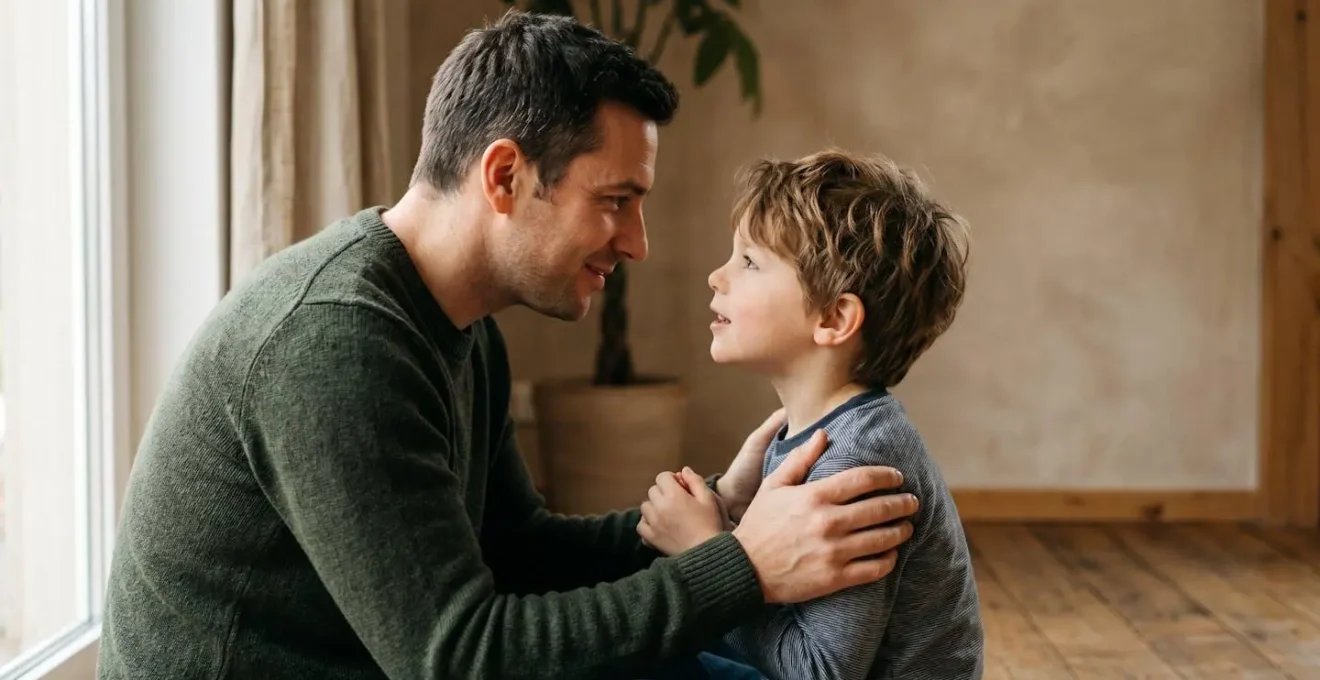
Raising a truly kind child goes beyond teaching manners; it involves actively building their brain’s capacity for empathy and emotional regulation.
- Emotional skills are not fixed traits but trainable abilities that can be developed through specific, playful activities.
- Understanding the ‘why’ behind feelings (both their own and others’) is the foundation for genuine compassion and strong social bonds.
Recommendation: Shift your focus from correcting behaviour to coaching emotions. Use everyday moments as opportunities to practice these essential EQ skills.
Every parent wants their child to be kind. We dream of raising a person who is compassionate, considerate, and a positive force in the world. Often, our approach involves teaching manners, encouraging sharing, and modeling polite behaviour. While these are important, they only address the surface. They teach a child how to *act* kind, but not necessarily how to *be* kind from the inside out. This is a common frustration for parents who see their children follow the rules but struggle with genuine empathy when challenges arise.
The conversation around raising good kids often gets stuck on behavioural correction. We are told to use reward charts or implement consequences. But what if the true key to unlocking a child’s innate capacity for kindness lies deeper? Development of emotional intelligence (EQ) isn’t an abstract concept for adulthood; it’s a concrete set of skills that can be nurtured from the earliest years. It’s the foundation that includes self-awareness, self-regulation, empathy, and social skills—the very building blocks of a happy and well-adjusted life.
This is where our approach shifts. As an EQ coach, I see this not as a mystery, but as a training opportunity. The secret isn’t in generic advice, but in using specific, science-backed interactions as targeted ‘brain exercises’. It’s about intentionally building the neural pathways for empathy and emotional regulation. This guide moves beyond the ‘what’ and dives into the ‘how’ and ‘why’. We will explore practical, playful, and powerful techniques that transform everyday moments into foundational lessons in what it means to be a truly empathetic human.
This article provides a roadmap of eight core emotional intelligence pillars. We’ll explore how to turn simple games and conversations into powerful tools for building a child’s EQ, creating a foundation for lifelong kindness and happiness.
Summary: A Parent’s Guide to Nurturing Emotional Intelligence
- Emotion Charades: Guessing Feelings From Facial Expressions
- Perspective Taking: “How Do You Think Your Friend Felt?”
- The Art of Losing: Teaching Good Sportsmanship in Board Games
- Gratitude Jar: Why Focusing on the Good Rewires the Brain
- Active Listening: Teaching Kids to Listen to Understand, Not Just Reply
- Walking in Their Shoes: How Stories Reduce Prejudice
- ‘Name It to Tame It’: Why Labelling Emotions Reduces Their Power
- Emotional Regulation: Teaching Kids to Calm Down Without Suppressing Feelings
Emotion Charades: Guessing Feelings From Facial Expressions
The first step in building empathy is the ability to accurately recognize emotions in others. We often assume children will just pick this up, but it’s a skill that requires practice. A simple game of “Emotion Charades” can be a fun and powerful training tool. Instead of just acting out “happy” or “sad,” we can help our children develop emotional granularity—the ability to identify and differentiate between complex feelings like “disappointed,” “frustrated,” or “anxious.” This richer emotional vocabulary is the bedrock of self-awareness and social understanding.
Start with a set of cards showing different facial expressions. Have your child guess the feeling, and then take turns acting them out. As they get better, introduce more nuanced emotions. You can ask, “Where do you feel ‘excited’ in your body?” to forge a somatic connection between the feeling and physical sensations. This playful approach does more than just teach vocabulary; it builds the neural pathways for rapid, intuitive social perception. In fact, it provides benefits that extend beyond social skills.
Teaching children in a way that encourages them to empathise with others measurably improves their creativity.
– University of Cambridge researchers, Cambridge Research Study on Empathy and Creativity
By making this a regular family game, you’re not just having fun; you’re providing a structured workout for the parts of the brain responsible for social connection and understanding. You are giving them a foundational map to navigate the complex world of human emotions.
Perspective Taking: “How Do You Think Your Friend Felt?”
Once a child can identify emotions, the next crucial step is developing perspective-taking, or cognitive empathy. This is the ability to imagine what someone else might be thinking or feeling in a given situation. It’s the difference between seeing a friend is crying (emotion recognition) and understanding *why* they might be crying and what they might need (perspective-taking). This skill doesn’t develop passively; it must be actively coached through curious questioning.
After a playdate conflict or a scene in a movie, resist the urge to jump to judgment or solutions. Instead, ask a simple but profound question: “How do you think they felt when that happened?” Guide your child to consider the other person’s point of view without shaming them. This habit of inquiry is a powerful tool for developing prosocial behavior. The impact of this kind of targeted empathy training isn’t just theoretical; it’s been proven to enhance cognitive abilities in profound ways, and research demonstrates that structured empathy programs are highly effective.
Case Study: The Cambridge Empathy and Creativity Project
A year-long study by the University of Cambridge with 13-14-year-old students provided compelling evidence of this connection. The research, published in 2023, found that students who received instruction focused on empathy showed measurable improvements in creativity on the Torrance Test of Creative Thinking. By actively encouraging students to consider the thoughts and feelings of others, the program awakened creative abilities and supported wider learning outcomes, proving that empathy is a catalyst for broader cognitive growth. This demonstrates that empathy isn’t just a ‘soft skill’ but a driver of flexible, innovative thinking.
By making “How do you think they felt?” a regular part of your conversations, you are exercising your child’s brain to see the world through multiple lenses, a foundational skill for compassion, collaboration, and creative problem-solving.
The Art of Losing: Teaching Good Sportsmanship in Board Games
Board games are a perfect microcosm of life. They are filled with moments of triumph, frustration, and unexpected setbacks. For a child, losing a game can trigger intense feelings of anger, disappointment, and injustice. Our parental instinct is often to say, “It’s just a game!” or to let them win to avoid a meltdown. However, these moments are golden opportunities to coach one of the most difficult and important EQ skills: emotional regulation in the face of disappointment.
The goal isn’t to suppress the feeling of frustration but to teach a child how to experience it without letting it take over. Before playing, co-create a “frustration ritual.” This could be squeezing a stress ball, taking three deep “dragon breaths,” or doing a ‘frustration stomp’ in a designated spot. This gives the big feeling a physical outlet—a safe and acceptable way to be expressed and released. It validates the emotion while teaching a constructive coping mechanism.
As this image shows, the focus is on a physical, healthy release. When you see your child getting upset, you can gently prompt, “Looks like you’re feeling frustrated. Is it time for our dragon breaths?” This transforms you from a referee into an emotional coach. You’re not punishing the feeling; you’re offering a tool to manage it. This practice teaches them that feelings are temporary and manageable, a lesson that is far more valuable than winning any single game.
Gratitude Jar: Why Focusing on the Good Rewires the Brain
Kindness and empathy are not just about responding to negative situations; they are also about proactively noticing and appreciating the good. A daily or weekly gratitude practice is one of the most effective tools for building a positive and prosocial mindset. It actively combats the brain’s natural “negativity bias”—our tendency to focus more on threats and problems than on positive experiences. A “Gratitude Jar” is a simple, tangible way to implement this powerful habit.
The concept is easy: each day, every family member writes down one thing they are grateful for on a small slip of paper and adds it to the jar. It can be something big (“a fun day at the park”) or something small (“the taste of my hot chocolate”). Periodically, you can read the slips aloud as a family. This simple ritual does more than create warm feelings; it physically rewires the brain’s neural pathways. By consistently focusing attention on positive experiences, you strengthen the circuits associated with happiness, optimism, and prosocial behavior.
This isn’t just feel-good psychology; it’s grounded in neuroscience. The act of feeling and expressing gratitude has a direct impact on the brain’s architecture.
Gratitude practices can activate specific brain regions, particularly the medial prefrontal cortex and anterior cingulate cortex, which are associated with empathy, context-setting, and prosocial behavior.
– Andrew Huberman, as referenced in a Psychology Today article on gratitude and neuroscience
The Gratitude Jar, therefore, is not just a quaint activity. It is a scientifically-backed intervention that helps build a more resilient, empathetic, and ultimately happier brain. It teaches a child to scan their world for goodness, a habit that will serve them for a lifetime.
Active Listening: Teaching Kids to Listen to Understand, Not Just Reply
In a world of constant distraction, one of the greatest gifts we can give our children—and one of the most potent ways to model empathy—is the skill of active listening. This is the practice of listening not just to hear the words, but to understand the meaning and emotion behind them. It’s about listening to connect, not just to wait for your turn to talk. For children, this is a complex skill that requires explicit teaching and consistent modeling from the adults in their lives.
A core technique is the “Echo Rule.” When your child tells you something, especially if it’s emotionally charged, start your response with, “So, it sounds like you’re feeling…” and summarize what you heard. For example, “So, it sounds like you’re feeling left out because you weren’t picked for the team.” This simple act does two things: it confirms to your child that they have been truly heard, and it helps them label their own emotions. Furthermore, research demonstrates that children with well-developed listening abilities show increased reading comprehension and improved retention, proving its academic benefits.
Modeling this yourself is the most powerful lesson. Put down your phone, make eye contact, and give your child your full attention when they speak. This non-verbal communication shows them that they are valued and that their words matter. Auditing and improving our own listening habits is the first step toward teaching our children this essential skill.
Your Action Plan: Auditing Your Active Listening Habits
- Points of Contact: Identify key communication moments with your child (e.g., mealtimes, bedtime, car rides) where you can be most present.
- Data Collection: For one day, track how often you use reflective listening (“So, it sounds like…”) versus immediately offering advice or solutions.
- Coherence Check: Does your body language (eye contact, posture) consistently match your intention to listen, or are you often multi-tasking?
- Emotional Impact: When you give praise, is it a generic “good job,” or is it specific feedback like, “I really noticed how you waited for your sister to finish talking. That was great listening!”?
- Integration Plan: Choose one specific listening game or incorporate the “Echo Rule” into your daily routine this week to build the habit.
Walking in Their Shoes: How Stories Reduce Prejudice
Stories are empathy machines. They allow us to step out of our own experiences and into the mind and heart of someone else. For children, literature is one of the most powerful tools for building compassion and reducing prejudice, especially toward people whose lives and backgrounds are different from their own. By intentionally curating a diverse library, we give our children “windows” into other worlds and “mirrors” that reflect their own experiences in a broader human context.
When a child reads a story about a refugee, a child with a disability, or someone from a different culture, they are doing more than learning facts. They are vicariously living another life. They feel the character’s hopes, fears, and triumphs. This imaginative transportation breaks down the “us vs. them” mentality that is the root of prejudice. The emotional connection forged with a character on a page can translate into real-world empathy. In fact, some studies reveal that after being read stories with Black protagonists, white children showed no in-group bias in their empathetic responses.
The key is to go beyond simply reading the story. Engage in conversations afterward. Ask questions like, “What do you think it was like for them to move to a new country?” or “How would you have felt if that happened to you?” A bookshelf filled with diverse stories isn’t just decoration; it’s a carefully selected toolkit for expanding your child’s capacity for human understanding and building a more inclusive worldview.
Key Takeaways
- Emotional intelligence is not a fixed trait but a set of trainable skills essential for kindness and happiness.
- Simple, playful activities like charades and gratitude jars are powerful ‘brain exercises’ that build neural pathways for empathy.
- The most effective coaching happens when we validate a child’s feelings first, then guide them toward constructive ways to manage and understand them.
‘Name It to Tame It’: Why Labelling Emotions Reduces Their Power
Big emotions can feel like a tidal wave to a child, overwhelming and scary. The “Name It to Tame It” strategy, coined by Dr. Daniel Siegel, is a cornerstone of emotional regulation. It’s a simple yet profoundly effective technique based on neuroscience. When a child is able to label their feeling—”I am angry!” or “I feel disappointed”—it activates the left side of their brain, the more logical and language-oriented hemisphere. This process helps to calm the reactive, emotional right side of the brain.
Simply putting a name to the feeling creates a bit of distance from it. The child is no longer *drowning* in the emotion; they are observing it. As parents, our role is to be an “emotion detective,” helping our child find the right word. We can say, “Your fists are clenched and your face is red. It looks like you’re feeling really mad. Is that right?” This does not dismiss the feeling; it acknowledges, validates, and labels it. This skill is a powerful predictor of well-being, as research with 410 primary school students proves a direct link between EQ skills and better mental health outcomes.
Teaching this skill has long-term benefits that go far beyond managing tantrums. It builds a foundation of self-awareness that is critical for mental health and resilience.
Children with higher emotional intelligence have lower anxiety, depression, and aggression levels.
– Best Choice Counselling Calgary researchers, The Science Behind Emotional Intelligence in Children
By consistently helping your child name their emotions, you are giving them the power to understand and manage their inner world, turning overwhelming chaos into manageable feelings.
Emotional Regulation: Teaching Kids to Calm Down Without Suppressing Feelings
The ultimate goal of all these practices is to help a child develop effective emotional regulation. It’s crucial to understand this does not mean suppressing or ignoring feelings. Emotional suppression is counterproductive and teaches children that certain feelings are “bad” or unacceptable. True regulation is about acknowledging the emotion, allowing it to exist, and choosing a constructive way to respond to it. As parents, we are their primary co-regulators; they learn to manage their feelings by first having us manage them with them.
This process is especially important after a conflict—what is often called the “rupture and repair” cycle. Ruptures (arguments, misunderstandings, parental mistakes) are inevitable. The magic is in the repair. When you, as the parent, have lost your cool, the repair process is your most powerful teaching moment. This involves calming down, returning to your child, taking responsibility (“I’m sorry I yelled. I was feeling frustrated.”), and reconnecting. This models humility, accountability, and the fact that relationships can be repaired after conflict. This positive parenting approach is directly linked to better well-being, as shown by a comprehensive 2024 study on parenting styles and emotional intelligence involving over 1,600 students.
This act of repair, of kneeling down to their level and reconnecting, is more than an apology. It teaches resilience. It shows a child that mistakes don’t break bonds and that big feelings can be weathered together. By guiding them through this cycle, we are not just raising a “kind” child, but one who is emotionally robust, self-aware, and capable of navigating the complexities of human relationships with grace and compassion.
By consistently integrating these practices into your family life, you are doing more than managing behaviour; you are building your child’s brain for a future of happiness, connection, and genuine kindness. The next step is to start small and be consistent. Choose one of these strategies to focus on this week and begin your journey as your child’s EQ coach today.