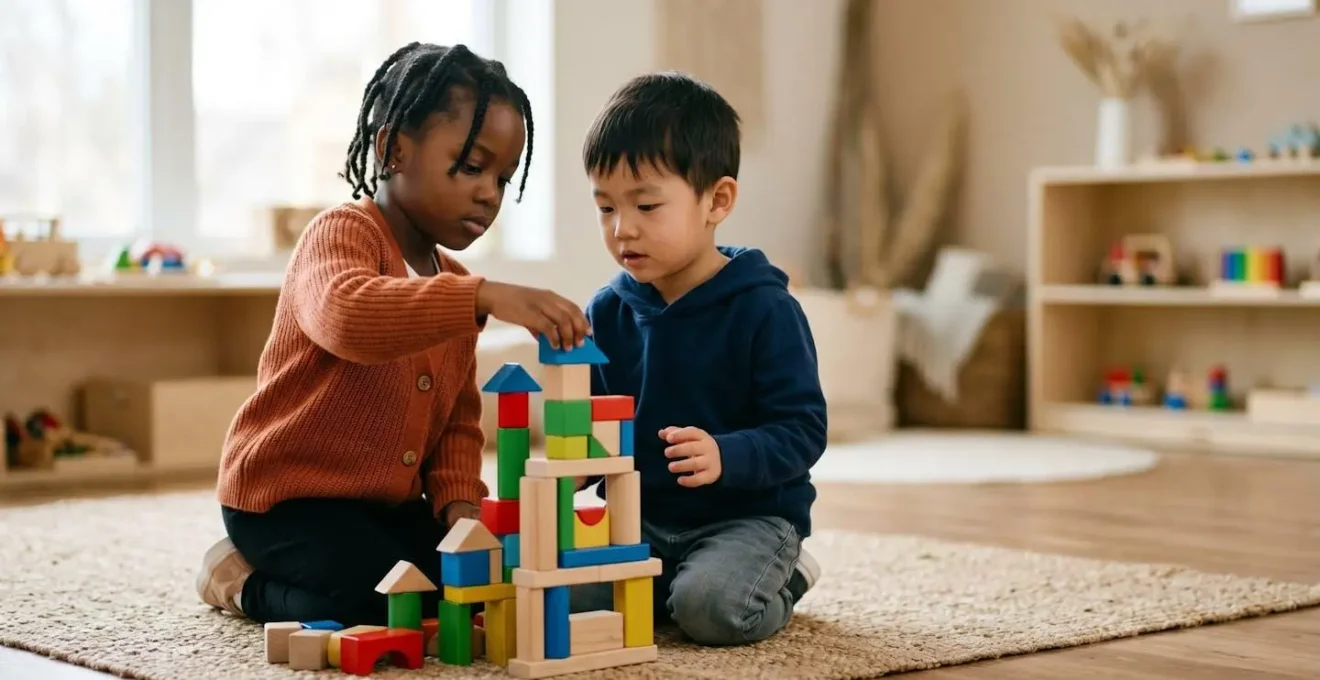
Contrary to popular belief, teaching teamwork isn’t about forcing kids to share or just giving them more toys; it’s about coaching the hidden ‘social syntax’ of collaboration.
- Parallel play is a normal developmental stage, not a social deficit. The transition to teamwork requires active guidance.
- Focus on teaching negotiation, turn-taking, and conflict resolution as explicit skills, rather than just expecting them to emerge.
Recommendation: Shift your role from a referee who solves disputes to a coach who provides children with the language and strategies to solve problems themselves.
You see it all the time. Two toddlers in a room full of toys, happily engaged, but entirely in their own worlds. One is building a tower, the other is driving a car. They are playing *near* each other, in what experts call “parallel play,” but not *with* each other. As a parent, it’s natural to wonder: when does the switch happen? When do they start to connect, to build together, to become a team? The common advice is to encourage sharing or organize group activities, hoping collaboration will magically blossom. But often, this leads to more frustration, cries of “Mine!”, and you stepping in as a referee.
The truth is, collaborative play is not an automatic developmental milestone. It is a complex set of skills that need to be learned and practiced. It’s less about the specific game and more about mastering the unwritten rules of working together: the art of negotiation, the grace of taking turns, the resilience to resolve conflicts, and the joy of celebrating a shared victory. Forcing a child to share a toy they are deeply engaged with can backfire, creating resentment rather than a spirit of generosity. The real key lies in a subtle but powerful shift in your role—from director to coach.
This guide moves beyond the simple lists of “cooperative games.” Instead, it provides a playbook for you, the parent, to coach the fundamental micro-skills of teamwork within everyday play. We will break down how to turn a simple Lego project into a lesson in negotiation, transform role-play into an exercise in empathy, and reframe conflicts not as failures, but as crucial learning opportunities. You will learn to provide the “scaffolding” your children need to build their own social bridges, moving them gracefully from playing side-by-side to truly playing as a team.
This article provides a detailed roadmap for nurturing these essential collaborative skills. Explore the sections below to discover practical strategies for transforming everyday play into a powerful teamwork laboratory.
Summary: The Parent’s Playbook for Nurturing True Teamwork
- The Lego Project: Negotiating Who Putting Which Brick Where
- Role Play: Who Gets to Be the Mum/Dad/Doctor?
- Sharing vs Turn-Taking: Why “Forced Sharing” Backfires?
- Escape Room for Kids: Solving Puzzles as a Team
- High Fives: Encouraging Kids to Cheer for Each Other
- The Cardboard Box: Why Pretend Play Is a Sign of Higher Intelligence?
- How to Join In: Teaching the Skill of Entering a Game
- Resolving Conflicts: Teaching Kids to Settle Arguments Without an Adult Referee
The Lego Project: Negotiating Who Putting Which Brick Where
A pile of Lego bricks is more than a toy; it’s a miniature construction site where the first principles of project management are learned. When two children decide to build something together, they are not just stacking blocks. They are navigating a complex social landscape of shared goals, resource allocation, and creative differences. As play specialists note, it’s in these moments that children learn to analyze situations, brainstorm solutions, and make decisions collectively. The challenge isn’t the structure itself, but the negotiation of “who puts which brick where.” This is the foundational grammar of teamwork.
Instead of letting it be a free-for-all that might end in a tug-of-war over the last red brick, you can provide a gentle structure. Frame the activity as a team project. This shifts the focus from individual creation to a shared objective. The goal is no longer “my tower” versus “your tower,” but “our castle.” This simple reframing introduces the concept of a collective vision, a cornerstone of any successful collaboration. By providing a framework, you help children see each other not as competitors for resources, but as partners with a common purpose.
Action Plan: Project Management Steps for Collaborative Building
- Establish the shared goal: Ask “What are we building together?” to create a collective vision.
- Assign project roles: Designate an Architect (who has the vision), an Engineer (who ensures stability), and a Supplier (who finds the right pieces).
- Use planning language: Teach phrases like “What’s our next step?” and “How can we work together on this part?”.
- Reframe setbacks as team challenges: When the structure collapses, ask “How can we rebuild it stronger together?”.
- Celebrate collaborative recovery: Acknowledge and praise the teamwork that led to overcoming the problem, not just the final product.
Role Play: Who Gets to Be the Mum/Dad/Doctor?
If building with Lego is about negotiating over tangible objects, role-playing is about negotiating intangible identities. The critical question of “Who gets to be the doctor?” is a high-stakes social negotiation. It requires a child to understand that others have different thoughts, feelings, and perspectives—a cognitive skill known as Theory of Mind. This ability is a massive leap in social development.
This is precisely why these seemingly simple games of make-believe are so vital. When children argue over roles, they are practicing persuasion, compromise, and the art of seeing the world from another’s viewpoint. According to developmental psychologists, around age 4, children typically develop these crucial Theory of Mind skills, which unlocks this more complex, cooperative form of play. Your role isn’t to assign the roles for them, but to facilitate the negotiation. You can ask questions like, “It sounds like you both want to be the doctor. Is there a way we can have two doctors? Or maybe one can be the doctor first, and then you can switch?”
These prompts provide a “social script” for compromise. You are not solving the problem for them; you are giving them the tools to build their own solution. This empowers them to manage their social world, turning a potential conflict into a successful exercise in shared decision-making and empathy.
Sharing vs Turn-Taking: Why “Forced Sharing” Backfires?
The parental mantra of “You have to share!” is one of the most common, well-intentioned, and often counterproductive interventions in a toddler’s social life. When a child is deeply engaged with a toy, being forced to give it up doesn’t teach generosity; it teaches that adults can arbitrarily confiscate things you love. This can lead to resentment and a tendency to hoard toys in the future. Experts advise to avoid forced sharing, as it undermines a child’s sense of security and ownership, which are crucial for their developing identity.
A child’s passionate cry of “Mine!” is not just selfishness; it’s a declaration of self. They are learning where they end and others begin. The more effective and developmentally appropriate strategy is to introduce the concept of turn-taking. Unlike forced sharing, turn-taking respects ownership. It communicates: “This is yours, you are in control of it, and you will get it back.” This security makes a child far more willing to let someone else have a turn. Furthermore, developmental research indicates that sharing strongly increases in middle childhood, reassuring parents that a toddler’s possessiveness is a phase, not a permanent character trait.
Your role is to be a coach for turn-taking, providing the language children need to navigate these situations politely. Here are some scripts you can model and teach:
- Instead of “Share now!”, coach the waiting child to say: “Can I have it when you are finished?”
- Acknowledge ownership security: “This is your truck, and it will come back to you.”
- Provide time transparency: “You can play for 5 more minutes, then it’s Sarah’s turn.”
- Empower self-advocacy: Teach phrases like “I’m still using this” or “I’ll let you know when I’m done.”
Escape Room for Kids: Solving Puzzles as a Team
Once children have some foundational skills in negotiation and turn-taking, you can introduce more complex collaborative challenges. A DIY “escape room” for kids is a perfect way to do this. The core principle is designing puzzles that are impossible to solve alone, creating a genuine need for teamwork. This isn’t just about working alongside each other; it’s about interdependence, where each child’s contribution is essential for the group’s success.
You can create this interdependence with simple setups. For example, one child might have a key, while another has the map to the locked box. Or one child holds a flashlight to illuminate a dark corner while another reads a hidden clue. These scenarios naturally create distinct and valuable roles. You can amplify this by observing and assigning tasks based on strengths, saying things like, “You’re so good at finding things, can you be our clue-hunter?” This validates each child’s unique abilities and shows them how different skills combine to create a powerful team.
Case Study: The Blindfolded Obstacle Course
A simple yet powerful cooperative activity involves children working in pairs. One child is blindfolded, and the other must provide clear, calm verbal directions to help them navigate a simple obstacle course made of pillows and toys. This exercise is a masterclass in interdependence. The blindfolded child must learn to trust and listen carefully. The guide must learn to communicate with precision and empathy, understanding their partner’s needs and perspective. Both work toward a common goal with completely distinct but equally vital roles, proving that success is only achievable together.
The goal is to design a challenge where the “we” is more powerful than the “me.” After the game, a quick debrief (“What was the hardest part? How did you solve it together?”) helps solidify the learning, turning a fun game into a lasting lesson in collaborative problem-solving.
High Fives: Encouraging Kids to Cheer for Each Other
Collaboration doesn’t end when the task is complete. The final, and perhaps most important, piece of the teamwork puzzle is celebrating success together. Establishing a small ritual, like a team high-five, a group cheer, or a “teamwork hug” after completing a challenge, is incredibly powerful. This act of shared celebration closes the loop on the collaborative experience, reinforcing the positive feelings associated with working together.
This ritual does more than just mark an ending; it solidifies the group’s identity and makes the effort feel worthwhile. It shifts the focus from the individual achievement (“I put the last block on!”) to the collective process (“We built this amazing tower!”). This is a critical component of fostering what psychologist Carol Dweck calls a growth mindset—the belief that abilities can be developed through dedication and hard work.
Having children focus on the process that leads to learning (like hard work or trying new strategies) could foster a growth mindset and its benefits.
– Carol Dweck, Carol Dweck Revisits the Growth Mindset
By consistently celebrating the *process* of teamwork—the negotiation, the problem-solving, the mutual support—you teach children to value the collaboration itself, not just the outcome. You are wiring their brains to associate helping, listening, and cooperating with the rewarding feeling of shared joy and accomplishment. This simple high-five becomes a symbol of their collective power.
The Cardboard Box: Why Pretend Play Is a Sign of Higher Intelligence?
A simple cardboard box can be a spaceship, a castle, or a secret cave. This ability to see one thing as something else—symbolic or pretend play—is not just a cute phase of childhood. It is a direct indicator of developing cognitive sophistication. When a child engages in pretend play, they are running complex mental simulations. They have to hold a goal in their mind (“We are astronauts”), assign roles (“You’re the captain”), and follow unwritten rules (“The floor is lava!”). This is a heavy workout for the brain.
Specifically, pretend play is a powerful engine for developing what are known as executive functions. These are the high-level cognitive skills that allow us to manage our attention, control our impulses, and plan for the future. As research from the Child Mind Institute confirms, pretend play can improve these skills that help people self-regulate and achieve goals. When a child resists the impulse to knock over the “castle” because they are playing the role of a “guard,” they are practicing self-control. When they plan a “tea party,” they are practicing organization and sequencing.
So, when you see your child transforming a cardboard box, you are not just witnessing imagination at work; you are seeing the architecture of higher intelligence being built in real-time. This form of play is the brain’s natural way of practicing the abstract thinking, planning, and self-regulation skills that are essential for success in school and in life. Encouraging and participating in this play is one of the most effective ways to nurture your child’s cognitive development.
How to Join In: Teaching the Skill of Entering a Game
For many children, one of the most daunting social challenges is figuring out how to join a game that’s already in progress. A direct “Can I play?” can sometimes feel too risky, and a clumsy interruption can be met with rejection. The skill of successfully entering group play is a delicate one, requiring observation, social attunement, and a low-risk strategy. Instead of pushing your child to jump right in, you can coach them on a more subtle technique: observe, then orbit.
This strategy involves two steps. First, the child watches the game from a short distance to understand its rules, rhythm, and roles. Who is chasing whom? What is the goal of the building project? This observation phase provides crucial information and reduces the chance of a disruptive entry. Second, the child begins to “orbit” the game, moving closer and showing interest without demanding to be included. This can be done by offering a non-verbal contribution or a value-adding comment.
Teaching low-risk entry phrases and actions can build confidence and provide a clear script for these tricky moments. Practice these scenarios at home to make them feel natural:
- Offer a value-adding comment: “Wow, that’s a cool castle you’re building!”
- Contribute a relevant prop: “Here, this block could be the flag for your castle!” This is an offer, not a demand.
- Ask an open question: “What are you guys making?” This shows genuine interest in their world.
- Mimic the play: Start doing a similar activity nearby, showing you share their interest.
By coaching these gentle entry strategies, you are equipping your child with a sophisticated social tool that respects the existing play and increases their chances of being welcomed into the group.
Key Takeaways
- Coach, Don’t Referee: Shift from solving disputes to providing your children with the language and strategies (like turn-taking) to negotiate solutions themselves.
- Conflict is a Lesson: Reframe arguments over toys or roles not as a failure of play, but as a critical opportunity to teach negotiation and empathy.
- Celebrate the Process: Make a ritual of celebrating the teamwork itself (the “how”), not just the finished product (the “what”), to reinforce the value of collaboration.
Resolving Conflicts: Teaching Kids to Settle Arguments Without an Adult Referee
Conflict is not a bug in collaborative play; it’s a feature. Every argument over a toy, a role, or a rule is a real-world opportunity to practice one of life’s most essential skills: conflict resolution. As a parent, the instinct is often to rush in, identify the “culprit,” and impose a solution. However, this robs children of the chance to develop their own “playground diplomacy.” Your goal is to move from being the judge and jury to being a neutral facilitator who empowers them to find their own peace treaty.
One of the most effective methods is to establish a “Peace Corner” or a simple, repeatable conflict resolution framework. This provides a predictable structure for de-escalating emotions and moving toward a solution. It’s a process you can guide them through initially, with the ultimate goal of them using it independently. The framework turns a heated, emotional clash into a logical, step-by-step problem to be solved together. This teaches them that anger is a normal feeling, but it doesn’t have to control their actions.
The process of “playground diplomacy” can be broken down into clear steps that even young children can learn:
- Cool Down: Before any talking can happen, emotions need to be managed. Both children take three deep breaths in a designated calm space.
- Express Feelings (Using ‘I feel…’): Each child gets to state their perspective without interruption, using “I feel…” statements (e.g., “I feel sad because you took the blue car”). This teaches them to articulate emotions constructively.
- State Wants: Each child then shares what they want to happen (“I want a turn with the blue car”).
- Brainstorm Solutions: Together, they must come up with two or three possible win-win ideas that could work for both of them.
- Choose and Try: They select one solution and agree to try it out, checking back later to see if it worked for everyone.
By coaching this process, you are instilling a powerful life skill: the ability to navigate disagreements respectfully and find common ground. You are teaching them that their voice will be heard and that solutions are something you build together, not something that is imposed.