Many parents worry about tracking cognitive milestones, fearing their child is “behind.” The truth is, these checklists often miss the genius hidden in plain sight.
- Repetitive games like Peek-a-Boo and “the dropping game” are not random; they are sophisticated cognitive experiments building your child’s brain.
- Imaginative play isn’t just fun; it’s a primary indicator of higher intelligence and a key tool for developing executive functions like frustration tolerance.
Recommendation: Instead of judging, learn to become a “developmental detective,” decoding the purpose behind your child’s actions to best support their unique journey.
As a developmental psychologist, I often meet parents holding a checklist of cognitive milestones, their faces etched with a single, profound question: “Is my child on track?” This anxiety is understandable. In a world of comparisons, it’s natural to wonder if your child is “gifted,” “average,” or “behind.” We’re told to look for the first word, the first step, the ability to stack blocks. While these markers have their place, they tell only a fraction of the story. Focusing on them exclusively is like trying to understand a masterpiece by only counting the colors of paint used.
The true story of cognitive development is far more nuanced and beautiful. It’s written not in checklists, but in the seemingly chaotic, repetitive, and often baffling behaviors of early childhood. Your child’s mind is not passively waiting to be filled with information; it is an active, dynamic laboratory, running constant experiments to understand the world. The frustration for many parents is that they haven’t been given the key to decipher these experiments.
This guide offers a different perspective. We will move beyond the “what” of milestones and delve into the “why” of behavior. Our goal is to transform you from an anxious scorekeeper into a “developmental detective”—an observer who can see the brilliant cognitive work happening inside a simple cardboard box or during a messy meal. We’ll explore how to decode these developmental signals, understand the incredible neural architecture being built, and learn how to best support the budding genius you are raising.
This article will guide you through the hidden science behind your child’s most common behaviors. By exploring these key developmental phases, you will gain a deeper appreciation for the intricate processes at play and learn how your interactions can foster a resilient, intelligent, and capable mind.
Summary: A Parent’s Guide to a Child’s Developing Mind
- Peek-a-Boo Science: Why Babies Are Fascinated When You Hide Your Face?
- The Cardboard Box: Why Pretend Play Is a Sign of Higher Intelligence?
- The “Dropping Game”: Why Your Baby Keeps Throwing Food on the Floor?
- Sorting and Matching: How Toddlers Learn to Organize Their World?
- Frustration Tolerance: When to Help and When to Let Your Child Struggle?
- Serve and Return: How Simple Interactions Build Brain Connections?
- Simon Says: Why Classic Games Build Working Memory?
- How to Support the Development of the Prefrontal Cortex in Young Children?
Peek-a-Boo Science: Why Babies Are Fascinated When You Hide Your Face?
For an adult, peek-a-boo is a simple, repetitive game. For a baby, it’s a Nobel Prize-worthy discovery. This fascination isn’t just about your funny faces; your baby is grappling with one of the most fundamental concepts of reality: object permanence. Before this cognitive leap, the world operates on an “out of sight, out of existence” principle. When you hide, you have, for all intents and purposes, vanished into thin air. The magic of peek-a-boo is the moment of your reappearance, which triggers a delightful surprise and a powerful learning moment.
Each round of this game is a miniature scientific experiment. The baby forms a hypothesis (“That face is gone forever!”), you reappear, and the hypothesis is shattered. This cycle of prediction, surprise, and resolution is profoundly important. It teaches the baby that objects and people continue to exist even when they can’t be seen. According to developmental research, this is a crucial cognitive leap that emerges around 4-7 months, laying the foundation for memory and symbolic thought. As noted in a case study on synaptic strengthening, the visual stimulation and repetition of peek-a-boo literally build and reinforce the neural architecture for memory and social bonding. When you play, you are not just entertaining; you are co-constructing your baby’s understanding of the universe.
The Cardboard Box: Why Pretend Play Is a Sign of Higher Intelligence?
Hand a child a complex, battery-operated toy, and they may be entertained for a few minutes. Give them an empty cardboard box, and they can be occupied for hours. This isn’t a sign of a short attention span, but a hallmark of developing intelligence. The box’s power lies in its simplicity. It requires the child to engage in symbolic thought—the ability to let one thing stand in for something else. This box is not a box; it’s a race car, a spaceship, a castle, or a secret cave. This act of transformation is one of the most sophisticated cognitive skills a young human can perform.
This “pretend play” is the very foundation of all higher-level abstract thinking. The ability to see a box as a car uses the same mental muscles required later to understand that the symbol ‘A’ represents a sound, or that the numeral ‘5’ represents a quantity. It is the bedrock of literacy, mathematics, and creative problem-solving. When a child engages in this purposeful play, they are not just escaping reality; they are actively practicing how to manipulate it in their minds. They are developing narratives, planning scenarios, and negotiating rules with imaginary friends, all of which are critical executive function skills.
The “Dropping Game”: Why Your Baby Keeps Throwing Food on the Floor?
For parents, “the dropping game” can be one of the most maddening phases. The moment you place food back on the highchair tray, it is launched overboard with gleeful determination. It feels like a test of your patience, but it’s actually a test of physics. Your baby has become a tiny Isaac Newton, conducting a rigorous, repeated experiment on the laws of gravity, cause and effect, and object trajectory. This isn’t an act of defiance; it’s an act of pure scientific inquiry. Each drop is a new data point in their research.
The questions their developing brain is asking are surprisingly complex: “If I drop this, does it always fall? Does it fall at the same speed? What sound does it make when it lands? Will that big person pick it up *again*?” As Alberta Health Services notes in their guidance on early cognitive development, “Babies develop keener vision at around 4 months, and their brains are now able to combine what they see with what they taste, hear, and feel through sensory integration.” The dropping game is a perfect example of this. They see the food fall, hear the splat, and feel the texture before it’s released. It’s a multi-sensory feast of information.
Sorting and Matching: How Toddlers Learn to Organize Their World?
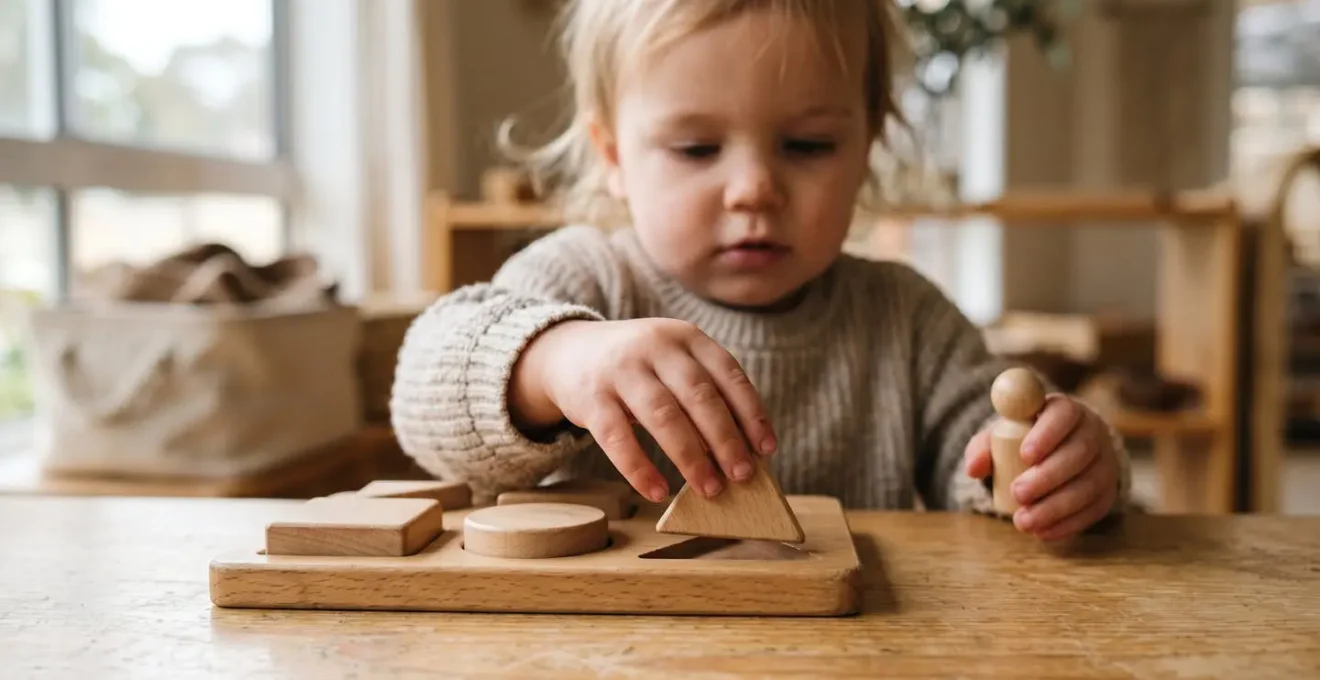
A toddler meticulously lining up all the red blocks, separating the toy cars from the toy animals, or putting all the forks in one drawer is not demonstrating an early-onset organizational obsession. They are engaging in the foundational acts of logic: classification and categorization. The world is a chaotic influx of sensory information. To make sense of it, the brain must learn to find patterns, group similar items, and understand the concept of “same” versus “different.” This is a monumental task, and it begins with simple, hands-on sorting.
This skill explodes in complexity during a critical window, as research shows that cortical neuron development peaks between 2-4 years of age, making the brain uniquely primed for this kind of pattern recognition. When a child sorts by color, they are learning about attributes. When they sort by shape, they are engaging with geometry. When they match pairs of socks, they are practicing one-to-one correspondence, a precursor to counting. These activities build the neural architecture necessary for mathematical thinking and scientific reasoning. They are creating mental file folders that will allow them to store and retrieve information efficiently for the rest of their lives.
Frustration Tolerance: When to Help and When to Let Your Child Struggle?
Witnessing your child’s intense frustration while trying to fit a square peg into a round hole is a difficult moment for any parent. The instinct to rush in and “fix it” is powerful. However, navigating these moments of struggle is one of the most critical aspects of cognitive development. This is where a child builds resilience, problem-solving skills, and frustration tolerance. The key is not to eliminate struggle, but to keep them within what psychologist Lev Vygotsky called the “Zone of Proximal Development”—the sweet spot where a task is challenging but achievable with minimal support.
Pretend play is a surprisingly powerful tool for building this resilience. A five-week randomized controlled study confirmed that children who engaged in daily pretend play showed significant improvements in executive function. Why? Because during imaginative play, children create and follow rules (“In this game, the floor is lava”), regulate their emotions to stay in character, and adapt to changing scenarios. These are the exact skills needed to manage frustration during a difficult task. The study found that this form of play acts as a protective cognitive factor, especially for children facing adversity, enhancing their ability to manage frustration and build resilience.
Serve and Return: How Simple Interactions Build Brain Connections?
The most powerful tool for building your child’s brain isn’t an expensive toy or a special program; it’s you. The simple, back-and-forth interactions you have every day—a concept known as “serve and return”—are the primary drivers of brain development. When your baby babbles (the serve), and you respond with eye contact and a coo (the return), you are doing more than just communicating. You are building and strengthening the very foundation of their brain’s architecture. During the first few years of life, the brain is forming more than one million new neural connections per second, and these interactions determine which connections get stronger and which fade away.
Think of it like a game of tennis. Your child sends a signal—a point, a sound, a facial expression—and you return the serve by responding in a supportive and meaningful way. This could be as simple as naming the object they are pointing to or mirroring their smile. Each rally builds crucial neural pathways for language, social skills, and emotional regulation. As experts from First 5 emphasize, “Brains are built over time, but the primary foundations are constructed early in life.” Your consistent and responsive engagement tells your child their voice matters, that they are seen, and that the world is a responsive, predictable place. This sense of security is essential for confident exploration and learning.
Simon Says: Why Classic Games Build Working Memory?
Classic childhood games like “Simon Says” or “Red Light, Green Light” are more than just a way to pass the time; they are powerful brain-training exercises. These games are specifically designed to target a crucial set of executive functions, particularly working memory and inhibitory control. Inhibitory control is the ability to stop a dominant or automatic response in favor of a more considered one. In “Simon Says,” the automatic impulse is to follow every command. The cognitive challenge is to suppress that impulse when the magic words “Simon says” are missing.
This skill is a cornerstone of self-regulation. The ability to pause and think before acting is critical for everything from sitting still in a classroom to resisting peer pressure later in life. Working memory is also heavily engaged, as the child must hold the rule (“only act if Simon says”) in their mind while processing the incoming commands. Games that involve patterns, sequences, and rule-based actions are essentially fun-filled workouts for the prefrontal cortex, the area of the brain responsible for these higher-order skills. By playing these games, you are helping your child build the mental muscles for focus, attention, and self-control in a low-stakes, joyful context.
Action Plan: 5 Games to Build Your Child’s Inhibitory Control
- Start with ‘Simon Says’ focusing on helping children actively suppress impulses when the magic words aren’t said—this builds the foundation of self-regulation.
- Introduce ‘Red Light, Green Light’ to practice stopping on command, teaching children to control their physical impulses and wait for the correct signal.
- Try simple drumming or clapping pattern games where children must clap the pattern only after specific cues (not if you cough or snap), training selective attention and inhibition.
- Engage in role-playing games where children must remember their character’s rules and behaviors, strengthening working memory while exercising impulse control.
- Gradually increase complexity by combining multiple rules or extending wait times, allowing children to build stronger executive function skills through progressive challenge.
Key Takeaways
- Everyday behaviors are windows into your child’s cognitive development; they are not random but part of a sophisticated learning process.
- Purposeful play is the essential work of childhood, building the foundations for abstract thought, executive function, and resilience.
- Your role as a parent is not to be a judge of milestones but a supportive “developmental detective” who facilitates learning through responsive interaction.
How to Support the Development of the Prefrontal Cortex in Young Children?
The prefrontal cortex is often called the “CEO of the brain.” It’s responsible for executive functions: planning, decision-making, working memory, and, crucially, impulse control. The great challenge for parents of young children is that this CEO is still in training and works very limited hours. It’s the last part of the brain to fully mature, a process that continues into the mid-twenties. With an astonishing 90% of a child’s brain development complete by age 5, the early years are critical for laying the groundwork for this vital region.
The most important thing to understand is that a young child’s meltdowns or impulsive actions are not a reflection of your parenting or their “character.” They are a reflection of their neurobiology. As researchers at I-LABS state, “Young children can’t yet control their emotions or impulses because they simply do not yet have the neural networks in place to do so.” Expecting a three-year-old to consistently manage their impulses is like expecting them to solve calculus problems. The best way to support the development of their prefrontal cortex is not through punishment, but through patience, co-regulation, and routine. When you comfort a distressed child, you are lending them your mature prefrontal cortex to help them calm down. Predictable routines also help, as they reduce the cognitive load on the developing brain, freeing up mental resources for learning and self-control.
Start applying this “developmental detective” mindset today. By shifting your focus from judging milestones to decoding behavior, you can transform moments of frustration into opportunities for connection and transform your view of your child’s growth, building a stronger, more understanding, and more joyful relationship.