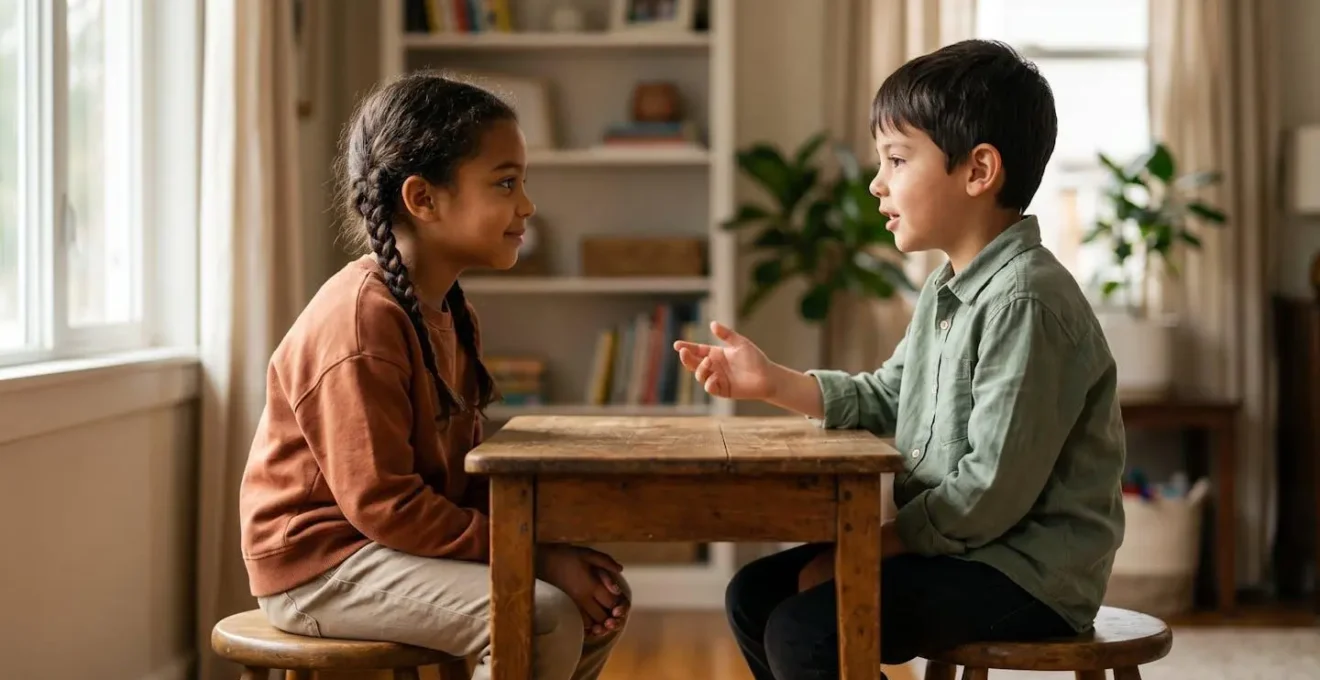
The constant refereeing of your children’s fights is exhausting because it tackles the symptoms, not the cause. The solution is to shift from judge to coach, equipping them with an internal mediation toolkit to solve their own problems.
- This involves moving beyond forced “sorries” to teaching the four components of a genuine apology and the difference between fixing an object and repairing a relationship.
- It means empowering them to name their emotions to calm their brains and use “I-Messages” to communicate feelings without blame.
Recommendation: Start by focusing on just one skill, like labeling emotions, and model it yourself. This isn’t about perfection, but about building a family culture where conflict is a solvable problem, not a catastrophe.
The shriek from the other room is a sound every parent recognizes. It’s the opening bell for another round in the endless boxing match of sibling rivalry or peer squabbles. You’re tired of being the judge, the jury, and often, the frustrated enforcer. The common advice is to separate them, demand apologies, and enforce sharing. We are told to teach them to “use their words,” but we often don’t give them the right words or the emotional framework to make them matter. This approach only teaches them that the biggest person in the room solves the problem, leaving them unequipped for the inevitable conflicts of life.
But what if the goal wasn’t to stop the fights, but to change *how* they fight? What if, instead of being a referee who calls fouls, you could be a mediator who builds bridges? The true key to resolving childhood conflict lies not in memorizing scripts like “I’m sorry,” but in building an internal ‘mediation toolkit.’ This is a set of core emotional intelligence skills that empower children to navigate disagreements autonomously. It’s about understanding the ‘why’ behind their big feelings and learning the ‘how’ of genuine, lasting repair.
This guide will walk you through the essential skills that form this toolkit. We will move beyond surface-level fixes to explore the neuroscience of calming down, the structure of a real apology, and the practical steps to foster empathy and collaborative problem-solving. Your role is about to change from constant crisis manager to the respected coach of a team that knows how to resolve its own disputes.
Summary: Resolving Conflicts: Teaching Kids to Settle Arguments Without an Adult Referee
- Hands Down: Immediate Safety Steps When Kids Hit
- “Name It to Tame It”: Why Labelling Emotions Reduces Their Power?
- The “I Message”: Teaching Kids to Say “I Feel X When You Do Y”
- Perspective Taking: “How Do You Think Your Friend Felt?”
- Brainstorming Fixes: “How Can We Solve This So You’re Both Happy?”
- Beyond “Sorry”: The 4 Parts of a Real Apology
- Making Amends: Fixing the Tower You Knocked Down
- Fostering Emotional Intelligence Growth: The Key to Future Happiness
Hands Down: Immediate Safety Steps When Kids Hit
When a conflict turns physical, the priority shifts instantly from teaching to safety. Before any mediation can occur, the aggressive behavior must stop. Your role here is not to punish, but to be a calm, firm boundary. Yelling or shaming only adds more chaotic energy to an already overwhelmed nervous system. Instead, physically and calmly intervene, acting as a shield, not a weapon. Use a simple, non-negotiable script like, “I cannot let you hit. My job is to keep everyone safe.” This frames your intervention as a protective act, not a punitive one.
Once the immediate physical action is stopped, the goal is co-regulation. Both children are likely in a state of emotional distress, and trying to problem-solve now is futile. Guide them to separate spaces to calm down. This isn’t a “time out” for punishment, but a “time in” for self-regulation. Tools like emotion thermometers or stoplight visuals can help them identify and process their state. Effective intervention in these moments is a powerful tool; research demonstrates that targeted interventions can achieve a 35% reduction in aggressive behaviors. The discussion can only begin when everyone is back in the “green zone” of their emotional state.
Once calm, a crucial but often-missed step is conducting a body check-in. Asking, “Where did you feel the anger in your body?” helps a child build interoceptive awareness—the connection between an emotion and a physical sensation. This is a foundational skill for emotional regulation, teaching them to recognize the early physical warning signs of anger (like a hot face or clenched fists) before it explodes into hitting.
“Name It to Tame It”: Why Labelling Emotions Reduces Their Power?
The phrase “Name It to Tame It,” coined by Dr. Dan Siegel, is more than a catchy rhyme; it’s a concise summary of a powerful neurobiological process. When a child is overwhelmed by a big feeling like anger or frustration, their primitive, emotional “Downstairs Brain” (including the amygdala) is in full control. Trying to reason with them at this point is like trying to negotiate with a fire alarm. The act of labeling the emotion—saying “I see you’re feeling really frustrated”—engages the more rational “Upstairs Brain” (the prefrontal cortex). This simple act sends calming signals to the amygdala, reducing its intensity and control. You are essentially turning on a light in a dark, scary room, allowing the rational brain to see what’s going on and regain control.
This is not just a theory; neuroscience research demonstrates this interaction. When a parent accurately labels their child’s emotion, it serves as powerful co-regulation. The child feels seen, heard, and understood, which in itself is deeply calming and reduces their need to escalate the behavior to get their distress acknowledged. You are lending them your “Upstairs Brain” until theirs is fully back online. This process builds neural pathways that, over time, will allow them to self-regulate more effectively.
To make this a regular practice, build your family’s emotional vocabulary. Move beyond the basic “mad, sad, glad.” Introduce more nuanced words like disappointed, embarrassed, jealous, overwhelmed, or anxious. A great tool is a “feelings wheel” or chart with facial expressions. You can also normalize this talk through simple daily routines, like sharing a “high” and a “low” from the day at dinner, making sure to name the feelings associated with each experience. When you model self-labeling (“I’m feeling frustrated because the traffic is so slow”), you show them that all feelings are normal and manageable.
The “I Message”: Teaching Kids to Say “I Feel X When You Do Y”
Once a child can identify their feeling, the next skill is to express it constructively. This is where the “I-Message” comes in, a communication tool designed to express feelings and needs without blaming or attacking the other person. Instead of an accusatory “You-Message” like “You’re so mean! You always knock my tower down!”, the child learns to say, “I feel frustrated when you knock my tower down because I worked hard on it.” This simple shift is transformative. It moves the focus from the other person’s character to the speaker’s internal experience and the specific, observable behavior that caused it.
The power of this technique is backed by research. A Hong Kong study found children were far more receptive to I-messages that revealed genuine feelings from their mothers, while they responded antagonistically to critical “you-messages.” This confirms what mediators know well: accusations trigger defensiveness, while expressions of vulnerability invite empathy. An “I-Message” keeps the lines of communication open, making a collaborative solution possible. It is a core component of assertive communication.
A complete “I-Message” has three essential parts: name the feeling (“I feel…”), identify the specific behavior (“when you…”), and explain the impact (“because…”). This “because” clause is crucial as it builds empathy by providing context. Teaching this requires practice. Use low-stakes role-play with puppets or stuffed animals to build muscle memory. It’s also vital to teach the receiver’s role: their only job is to listen and acknowledge they heard, perhaps by saying “I hear you.” This prevents the immediate defensive reaction and allows the message to land.
Perspective Taking: “How Do You Think Your Friend Felt?”
After a child has expressed their own feelings, the next leap in emotional intelligence is to consider the feelings of the other person. This is perspective-taking, the ability to step into someone else’s shoes and imagine their emotional experience. It is the bedrock of empathy. Asking the simple, non-judgmental question, “How do you think your friend felt when that happened?” shifts the focus from blame to understanding. It’s a skill that can be explicitly taught and, crucially, improves with practice. In fact, a study demonstrated that training in this area leads to significant improvements in children’s perspective-taking abilities, with effects that persist over time.
There are several practical techniques to build this skill. The “Movie Director” technique involves asking a child to “rewind the tape” and describe the conflict scene from the other person’s point of view, as if a camera were on their shoulder. A more physical exercise is “Story Switching,” where the children physically switch seats and retell the story from the other person’s first-person perspective. These exercises help break down the self-centered view that is natural in childhood and open their minds to the possibility of multiple valid experiences within the same event.
Literature and media are powerful allies in teaching empathy. When reading a book or watching a show, pause and discuss the characters’ feelings. Ask, “How did Harry feel when Ron ignored him? What clues in his face or words tell us that?” Research shows that actively discussing character emotions over a couple of months can significantly improve a child’s emotion comprehension and empathy. Using a visual tool like an emotion wheel can also help children identify more nuanced feelings in others beyond just “mad” or “sad,” recognizing possibilities like “frustrated,” “embarrassed,” or “disappointed.”
Brainstorming Fixes: “How Can We Solve This So You’re Both Happy?”
Once both parties have had a chance to express their feelings and listen to the other’s perspective, you’ve arrived at the heart of mediation. The goal now is to pivot from the past problem to a future solution. The key question, “How can we solve this so you’re both happy?” signals this shift. It moves the dynamic from adversarial to collaborative. You are no longer two opposing sides, but a team with a shared problem: finding a “win-win” solution.
As the mediator, your role is to facilitate, not dictate. The first step is to generate ideas without judgment. Set a rule: “There are no bad ideas in brainstorming.” One child might suggest, “He never gets to play with my Lego again!” and the other might suggest, “She has to give me all her dessert for a week!” Don’t dismiss these. Write them all down. This process validates their feelings and creativity. Often, the extreme suggestions give way to more reasonable ones once the initial frustration is aired.
After generating a list of possible solutions, the next step is to evaluate them together. Go through each option and ask, “Would this work for you? Would it work for you?” Help them see the consequences. “If you never let him play with your Lego again, you won’t have anyone to build the big castle with. Is that a price you’re willing to pay?” This teaches them to think critically about outcomes and compromises. The goal isn’t for you to pick the “best” solution, but to guide them to a mutually agreeable one. This process teaches a life-long skill: collaborative problem-solving. It empowers them to believe that even in conflict, a path forward that respects everyone is possible.
Beyond “Sorry”: The 4 Parts of a Real Apology
The forced, mumbled “sorry” is a staple of childhood conflict, but it teaches very little. It often becomes a get-out-of-jail-free card that bypasses true remorse and repair. To move beyond this, we must teach children that a meaningful apology isn’t just a word; it’s a process with four distinct parts. A real apology demonstrates accountability and a commitment to change, forming the foundation for genuine repair. It shows the other person they were heard and that their hurt matters.
The four parts of a meaningful apology framework are:
- Acknowledge the Hurt: This means naming the specific impact on the other person. Instead of a generic “sorry,” it’s “I know you’re sad that I knocked down your tower.” This shows you understand *how* your action affected them.
- Take Responsibility: This is the part where you own your action without excuses. It’s a simple, “I’m sorry for knocking it down.” Critically, it must not be followed by “but.” A phrase like “I’m sorry, but you were in my way” is not an apology; it’s a justification.
- State Future Action: An apology is more credible when it includes a plan to prevent a recurrence. “Next time, I’ll be more careful and walk around your buildings.” This shows a commitment to changing the behavior.
- Ask How to Help: This final step gives agency to the hurt person and opens the door to making amends. “How can I make it right?” or “Would you like me to help you rebuild it?” This completes the circle from causing harm to actively participating in the healing.
Understanding the difference between a real apology and its counterfeit versions is critical for both the giver and the receiver. It helps children recognize when they are being dismissed and empowers them to ask for what they truly need to feel repaired.
| Type of Apology | Example | Why It Fails | Impact on Relationship |
|---|---|---|---|
| Real 4-Part Apology | ‘I know you’re sad I broke your toy. I’m sorry I wasn’t careful. Next time I’ll ask before touching your things. Can I help fix it?’ | N/A – This is effective | Builds trust, demonstrates accountability, facilitates genuine repair |
| Sorry-Not-Sorry | ‘I’m sorry you got mad’ or ‘I’m sorry you feel that way’ | Places responsibility on the victim’s reaction, not the action itself | Erodes trust, feels dismissive, creates resentment |
| But-Apology | ‘I’m sorry, but you were hogging the toy’ | Justifies harmful behavior, negates the apology with blame | Escalates conflict, recipient feels blamed and defensive |
| Forced Apology | ‘Say sorry right now!’ (child mumbles ‘sorry’ without meaning it) | Lacks sincerity, teaches compliance over genuine remorse | Teaches performative behavior, doesn’t repair harm or teach empathy |
Key takeaways
- The goal isn’t to stop fights but to teach kids *how* to fight fairly and resolve disputes themselves.
- Safety first: When hitting occurs, calmly intervene to stop the behavior before any teaching can begin.
- True repair involves more than a forced “sorry”; it requires a genuine apology and making amends.
Making Amends: Fixing the Tower You Knocked Down
An apology, even a perfect four-part one, is only words. The final, and perhaps most important, step in the mediation toolkit is making amends. This is the action that follows the apology, the tangible effort to repair the damage done. Child development experts distinguish between two crucial types of repair. The first is Restitution, which involves fixing or replacing the physical damage—rebuilding the block tower, taping the ripped page, or replacing the broken crayon. This addresses the material harm.
However, equally important is Relational Repair. This addresses the emotional harm and focuses on rebuilding trust. It’s the action that says, “Our relationship is more important than this conflict.” When teaching children to make amends, the most effective approach is to empower the hurt child by asking, “What would help you feel better?” Their answer might be restitution (“Help me rebuild it”), or it might be something purely relational (“I just need some space right now,” or “I want to play a different game, just the two of us”).
This approach does two things: it ensures the solution actually addresses the impact of the harm, and it teaches the child who caused the harm that integrity means aligning your actions with your apology. It’s about demonstrating through deeds that you care about the other person’s well-being. Offering a menu of possible amends can help children who are stuck on how to fix things. This transforms the abstract concept of “making it right” into a concrete set of choices.
Action plan: Auditing Your Amends Toolkit
- Physical Restitution: Can you identify the tangible damage? List ways to directly fix, replace, or clean up the mess that was created.
- Relational Gestures: What non-physical actions can rebuild connection? Brainstorm ideas like drawing a picture, writing a kind note, or giving a genuine compliment.
- Acts of Service: How can you serve the person who was hurt? Consider options like letting them have the first turn, helping them with a chore, or sharing something special.
- Space and Time: Is the best immediate action no action at all? Evaluate if giving the person quiet time to process their feelings is the most respectful amend.
- Collaborative Planning: How can we prevent this from happening again? Draft a simple, one-sentence plan for how you’ll handle a similar situation in the future.
Fostering Emotional Intelligence Growth: The Key to Future Happiness
Each conflict, successfully navigated, is a deposit in your child’s emotional intelligence bank account. These skills—emotional regulation, assertive communication, empathy, problem-solving, and making amends—are not just for managing sibling squabbles. They are the foundational building blocks of healthy relationships, academic success, and professional competence. In fact, comprehensive research with 410 primary school students shows that children with higher emotional intelligence have lower levels of anxiety, depression, and aggression.
The ultimate goal is to embed these skills so deeply that they become the default family culture. One powerful way to do this is to create a “Family Constitution” for conflict. In a calm moment, sit down together and collaboratively define 3-5 core principles for how your family handles disagreements. These could be things like, “In our family, we use I-Messages,” “We don’t call each other names,” or “We take breaks when we feel hot.” Write these rules on a poster, have everyone sign it, and display it publicly. This creates shared ownership and a common language.
This constitution should also include a principle for handling disappointment. It’s important to acknowledge that a perfect “win-win” isn’t always possible. Sometimes, the outcome is a compromise where no one is perfectly happy. The non-negotiable, however, is that everyone is treated respectfully throughout the process. Most importantly, you, the parent, must model these agreements. When you inevitably slip up and break a rule, explicitly acknowledge it and make a full, four-part apology. This shows your children that these principles apply to everyone and that repair is always possible.
Your journey as a conflict mediator for your children is a long-term investment. By shifting from a punitive judge to a patient coach, you empower them with the tools they need not just to survive conflict, but to grow from it. Begin today by choosing one of these skills to practice and model in your home.