Contrary to common belief, the Early Years Foundation Stage (EYFS) is not an academic checklist for toddlers, but a powerful map that reveals the complex learning happening inside everyday play.
- The framework’s 7 areas are interconnected lenses for observing development, not separate subjects to be taught.
- Activities that look like “just playing” are intentionally designed by practitioners to build foundational brain architecture, social skills, and pre-literacy competence.
Recommendation: Shift your focus from “teaching” specific skills to enriching your child’s play environment; this is the most effective way to support all 7 areas of learning at once.
As a new parent or an early years practitioner, the term “Early Years Foundation Stage” (EYFS) can feel both important and intimidating. It’s the official standard for learning, development, and care for children from birth to five in the UK. Often, it’s presented as a list of seven distinct areas, leading to the anxious question: “Am I doing enough to cover all the bases?” Many parents worry they need to become mini-teachers, armed with flashcards and structured lessons on literacy and maths. This pressure stems from a misunderstanding of what the framework truly is.
The EYFS is divided into two parts: three ‘Prime’ areas, which are the absolute bedrock of development, and four ‘Specific’ areas, which grow from this strong foundation. The Prime areas are Communication and Language; Personal, Social and Emotional Development (PSED); and Physical Development. The Specific areas are Literacy; Mathematics; Understanding the World; and Expressive Arts and Design. But the real magic of the EYFS isn’t in memorising these categories. It’s in understanding that they are not a curriculum to be delivered, but a guide to understanding the sophisticated, holistic learning that occurs naturally through play.
This guide moves beyond the simple checklist. Instead of just defining the seven areas, we will decode them. We’ll explore the ‘why’ behind the ‘what,’ revealing how seemingly simple activities—like singing rhymes, struggling with a puzzle, or just ‘playing’—are in fact the engine of your child’s development. The true key isn’t to teach the seven areas, but to recognise and nurture them within the rich world of your child’s innate curiosity.
This article will guide you through the core principles of the EYFS, demystifying the framework and empowering you to see the incredible learning unfolding in every moment. Explore the sections below to gain a deeper understanding of this foundational stage.
Summary: A Deep Dive into the EYFS Framework and Play-Based Learning
- Communication and Language: Why Is It the Foundation for All Other Learning?
- Literacy in Early Years: How to Prepare Your Child for Reception Class?
- Continuous Provision: Why Does My Child Just “Play” at Nursery All Day?
- The 2-Year Progress Check: What Happens If Your Child Misses a Milestone?
- Home Learning Environment: How Can You Support the Curriculum at Home?
- Nursery Rhymes: Why They Are the Key to Phonological Awareness?
- Frustration Tolerance: When to Help and When to Let Your Child Struggle?
- Beyond ABCs: Essential Early Literacy Skill Building Activities for Home
Communication and Language: Why Is It the Foundation for All Other Learning?
Communication and Language is not just the first Prime Area; it is the soil from which all other learning grows. Before a child can read a word, solve a maths problem, or form a friendship, they must be able to understand and be understood. This area focuses on giving children the best possible start by creating a rich language environment. It’s about much more than teaching vocabulary; it’s about developing the confidence and skill to express needs, ideas, and feelings. The impact of early exposure is profound; research from ZERO TO THREE reveals that by age two, babies frequently talked to know around 300 more words than their peers.
The most critical mechanism for building this foundation is a concept known as “serve and return.” These are the back-and-forth interactions that happen between a child and a caring adult. When a baby babbles and a parent responds with words, or a toddler points at a dog and an adult says, “Yes, a big, fluffy dog!”, a neural connection is built. This isn’t just conversation; it’s the active construction of the brain’s learning architecture. As the Center on the Developing Child at Harvard University explains, these interactions are fundamental:
responsive, back-and-forth exchanges between a young child and a caring adult—known as serve and return interactions—play a key role in shaping brain architecture
– Center on the Developing Child, Harvard University Guide to Serve & Return
Every chat, every question answered, and every story shared contributes to this vital area. It underpins personal development by enabling social connections, and it paves the way for literacy by building a vast mental library of sounds, words, and sentence structures. Without a strong foundation in communication, the other six areas of learning simply cannot flourish.
Literacy in Early Years: How to Prepare Your Child for Reception Class?
The Literacy area of the EYFS often causes the most anxiety, with its focus on reading and writing. However, in the early years, literacy is not about formal lessons or mastering the alphabet by age three. It’s about kindling a love for stories, sounds, and marks that will eventually become reading and writing. It grows directly from the roots of Communication and Language. A child who has been immersed in a language-rich environment is already well on their way to becoming literate.
The single most powerful activity to support this area is reading aloud. This simple act does far more than just expose a child to a story. It builds vocabulary, introduces sentence structures they wouldn’t otherwise hear, and develops their ability to listen and concentrate. The cumulative effect is staggering; a landmark study from Ohio State University found that children read five books a day hear 1.4 million more words by kindergarten than children who are never read to. This “million-word gap” is a powerful indicator of future academic success.
Beyond reading, early literacy involves two key components: comprehension and mark-making. Comprehension is nurtured by talking about the stories, asking questions, and linking the book to the child’s own life. Mark-making is the very beginning of writing; it’s the scribbles, lines, and circles that a child makes with crayons, paint, or even their finger in the sand. Encouraging and celebrating these early marks—without worrying about what they look like—gives them the confidence to see themselves as writers long before they can form letters.
Continuous Provision: Why Does My Child Just “Play” at Nursery All Day?
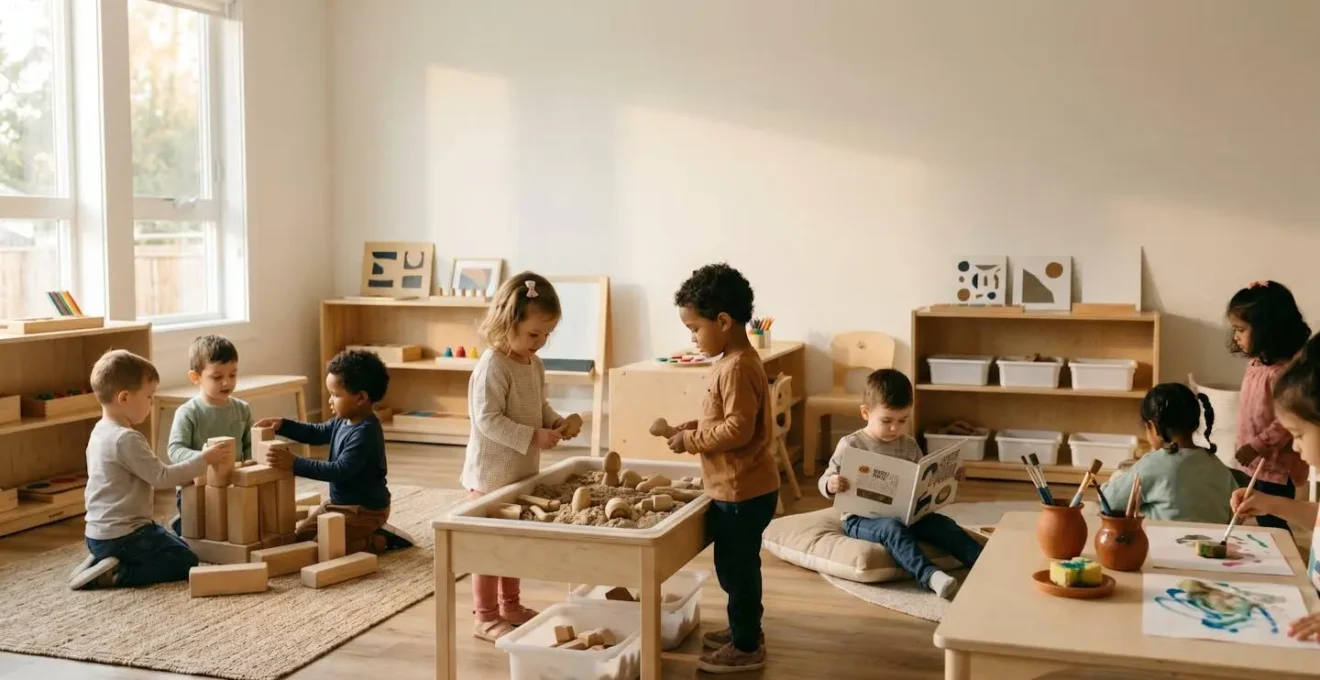
It’s a common concern for parents: you drop your child off at nursery and see them building a tower, and when you pick them up, they’re in the sandpit. It can look like they just “play” all day. This is perhaps the most misunderstood aspect of the EYFS. That “play” is actually a highly intentional, carefully planned learning environment known as Continuous Provision. The resources in the room—the sand, water, building blocks, and craft materials—are not just toys; they are tools for exploration and discovery, accessible for children to use independently.
Through this child-led play, all seven areas of the EYFS are developed. The child building the tower is exploring maths (height, balance), physics (gravity), and language (narrating their work). The child in the sandpit is developing fine motor skills (scooping) and engaging in imaginative play (Expressive Arts and Design). This isn’t accidental; it’s learning by doing, which is profoundly more effective than passive listening. Far from being a break from learning, play is the work of childhood. This approach is backed by significant evidence; a 2024 systematic review and meta-analysis demonstrates that game-based learning shows moderate to large positive effects on cognitive, social, and emotional outcomes.
During this play, children often exhibit ‘schemas’—repeated patterns of behaviour like transporting objects, enclosing things, or connecting items. These are not random habits but the brain’s way of testing theories and making sense of the world. A practitioner who observes a child constantly lining things up understands they are exploring the concept of order, a foundational mathematical idea.
As this image shows, the simple act of arranging blocks is a moment of deep cognitive engagement. The nursery environment is designed to allow these schemas to emerge and be explored. So when your child says they “just played,” they are really saying they have been a scientist, an engineer, an artist, and a storyteller, all in the course of their day.
The 2-Year Progress Check: What Happens If Your Child Misses a Milestone?
The 2-Year Progress Check is a statutory part of the EYFS, carried out in early years settings for children between the ages of 24 and 36 months. It’s often viewed with apprehension by parents, who worry it’s a test their child might “fail.” It’s crucial to reframe this: the check is not a test, but a conversation. It’s a collaborative review between your child’s key person, you, and other relevant professionals to take a snapshot of your child’s development, celebrate their strengths, and identify any areas where they might need extra support.
The check focuses primarily on the three Prime Areas: Communication and Language, PSED, and Physical Development. It’s a summary of what the practitioner has observed over time, combined with your own unique insights about your child at home. If the check does identify a potential developmental delay or an emerging need, the goal is not to label the child but to provide early support. This might involve simple strategies for you and the nursery to use, or it could mean a referral to a specialist like a speech and language therapist. The earlier a need is identified, the better the outcomes. It’s a safety net, not a judgment.
Remember, development is not a race, and every child follows their own unique timeline. A reassuring finding for all parents comes from the CliniKids Research Team, who note that perfection isn’t required for healthy development:
research suggests being responsive for around just 50 percent of serves helps babies develop a secure base
– CliniKids Research Team, Serve and Return Interactions Research
This principle applies broadly: your role is to be a supportive, engaged partner in your child’s journey, not a perfect instructor. Preparing for the check is about gathering your thoughts and observations to create a holistic picture of your amazing, developing child.
Your Action Plan: Preparing for the 2-Year Check
- Document your child’s unique strengths and interests at home in a simple journal or phone notes before the check.
- Prepare specific examples of how your child communicates, plays, and solves problems in familiar settings.
- List any concerns you have about development, however small, to discuss openly with the practitioner.
- Ask the practitioner to explain what they observed and how it relates to developmental expectations.
- Request clarification on next steps if concerns are identified, including timelines for additional support or monitoring.
Home Learning Environment: How Can You Support the Curriculum at Home?
Supporting your child’s learning at home doesn’t mean replicating a nursery classroom. The most powerful way to support the EYFS curriculum is to create an “enabling environment” where your child’s natural curiosity can lead the way. This is less about having the “right” educational toys and more about your attitude and the accessibility of simple, open-ended resources.
An enabling environment is one where a child feels safe, valued, and has the freedom to explore. This can be achieved by making simple materials available and accessible. A box of recycled cardboard tubes, fabric scraps, and pinecones is infinitely more valuable for development than a plastic toy that does only one thing. These are known as “loose parts.” They can become anything a child imagines, fostering creativity, problem-solving, and critical thinking in a way that single-purpose toys cannot.
Case Study: The Power of Loose Parts
Recent research highlights that play-based activities with open-ended materials significantly boost all-round development. A study comparing children playing with loose parts (like natural materials and everyday objects) to those using structured toys found that the loose parts group showed enhanced creativity, critical thinking, problem-solving abilities, and emotional control. This demonstrates that investing in simple, versatile materials is more effective for learning than buying expensive, specific “educational” products.
The role of the adult in this environment is not to direct the play, but to facilitate it. This means being a partner in their exploration: showing genuine interest, asking open-ended questions (“I wonder what would happen if…”), and narrating their actions to build their vocabulary (“You are carefully balancing that block on top of the other one!”). It’s about creating a space where trying things out and making “mistakes” is a celebrated part of learning.
A thoughtfully arranged space, with materials stored at child-height in simple containers, empowers your child to make their own choices and follow their own interests. This fosters independence and shows them that their ideas are valued—a cornerstone of Personal, Social and Emotional Development.
Nursery Rhymes: Why They Are the Key to Phonological Awareness?
Nursery rhymes can seem old-fashioned, a simple bit of fun to pass the time. But within the EYFS framework, they are a powerhouse tool, particularly for developing early literacy. Their true value lies in building a crucial pre-reading skill known as phonological awareness. This is the ability to hear and manipulate the sounds in spoken language—to recognise rhyme, identify syllables (the “beats” in a word), and hear the first sound in a word like ‘c-c-cat’.
A child with strong phonological awareness has a significant head start when they begin to learn phonics (the system of matching letters to sounds). They have already trained their ears to tune into the sound structure of language, making the process of decoding print much easier. The rhythm, rhyme, and repetition in nursery rhymes are a perfect workout for the developing brain. When a child shouts the last word in “Twinkle, twinkle, little ____,” they are actively predicting a rhyming sound, a sophisticated phonological task.
Research from The Ohio State University’s Crane Center for Early Childhood Research directly links this early vocabulary and sound exposure to later reading ability. Their work shows that children with stronger phonological awareness, built up through activities like sharing rhymes, acquire reading skills significantly faster when they start school. The playful nature of rhymes makes this learning effortless and joyful. Adding actions, clapping the beat, or using props turns it into a multi-sensory experience that engages the whole body and mind, strengthening memory pathways for sounds and words.
Frustration Tolerance: When to Help and When to Let Your Child Struggle?
Watching your child get frustrated with a task—a puzzle piece that won’t fit, a tower that keeps falling—triggers a strong parental instinct to jump in and fix it. While well-intentioned, always rescuing them can rob them of a vital learning opportunity. Developing frustration tolerance and resilience is a key part of Personal, Social and Emotional Development (PSED). The EYFS encourages creating moments of “productive struggle.”
Productive struggle is the sweet spot where a task is challenging but still achievable with effort. It’s in this zone that real learning and growth happen. When a child works through a moment of frustration and solves the problem on their own, they learn something far more important than how to do a puzzle. They learn that they are capable, that effort pays off, and that feeling frustrated is a normal, manageable part of learning. This builds self-esteem and a “can-do” attitude that will serve them for the rest of their lives.
The adult’s role here is not to solve the problem, but to provide just enough support to keep the child in that productive zone. This is called scaffolding. It might mean offering a word of encouragement (“I can see you’re working so hard on that!”), validating their feelings (“It’s tricky, isn’t it?”), or offering a tiny hint without giving away the solution. It’s about being a supportive presence that communicates confidence in their ability to figure it out.
The intense focus shown in moments of challenge is not negative stress; it is the face of deep engagement and brain-building. Learning to manage these small frustrations in a safe environment is how children develop the emotional regulation and perseverance they need to tackle bigger challenges later on.
- Position yourself nearby as a supportive presence without immediately solving the problem.
- Use language that acknowledges effort: “I see you’re trying lots of different ways to make that work.”
- Wait 10-15 seconds before offering assistance to give your child time to problem-solve independently.
- Model your own frustration management by narrating small challenges: “Oh, this jar is stuck! Let me try turning it the other way.”
- Validate their emotions while maintaining confidence in them: “I know this is frustrating, AND I know you can figure it out.”
Key Takeaways
- The 7 EYFS areas are an interconnected map for observing development, not a list of subjects to teach.
- Child-led play is the most effective and evidence-based method for learning across all seven areas.
- Your role as a parent or practitioner is to be a responsive partner who enriches the play environment, not a direct instructor.
Beyond ABCs: Essential Early Literacy Skill Building Activities for Home
As we’ve seen, building a foundation for literacy is about much more than learning the alphabet. It’s about creating a rich, interactive, and joyful relationship with language and stories. As you move towards the end of the EYFS and prepare your child for school, you can deepen this foundation with simple techniques that transform reading time into a powerful brain-building activity.
One of the most effective methods is called Dialogic Reading. This technique turns passive listening into an active conversation. Instead of you simply reading the text to your child, you become a facilitator, prompting them to become a storyteller alongside you. You use questions to encourage them to think more deeply about the pictures, the characters, and the plot. This back-and-forth dialogue builds critical thinking, vocabulary, and narrative skills far more effectively than just hearing the story. Even a small commitment to reading daily has a huge impact; research from The Ohio State University demonstrates that children read just one book daily hear about 290,000 more words by age 5 than their peers who aren’t read to.
Implementing dialogic reading is easy and can be done with any picture book. Focus on asking “wh-” questions (what, where, why), relating the story to your child’s own life, and letting them “read” the pictures to you. This empowers them and validates their interpretation, building their confidence as a future reader. Re-reading favourite books is also incredibly valuable, as repetition solidifies vocabulary and allows for deeper comprehension with each reading.
- Use the ‘PEER’ sequence: Prompt the child with a question, Evaluate their response, Expand on their answer, and Repeat the expanded information.
- Ask ‘wh-‘ questions: “What do you think will happen next?” “Why is the bear feeling sad?”
- Relate story events to your child’s own life: “Remember when we saw a red bus, just like in the book?”
- Let your child ‘read’ the pictures to you, narrating what they see to build storytelling skills.
- Revisit favourite books many times—repetition builds vocabulary and confidence more effectively than always choosing a new book.
By viewing the EYFS not as a series of hurdles but as a guide to the incredible world of your child’s development, you can shift your perspective from one of pressure to one of wonder. The seven areas of learning are happening all the time, in every interaction and every moment of play. Your role is simply to notice, nurture, and enjoy the journey.