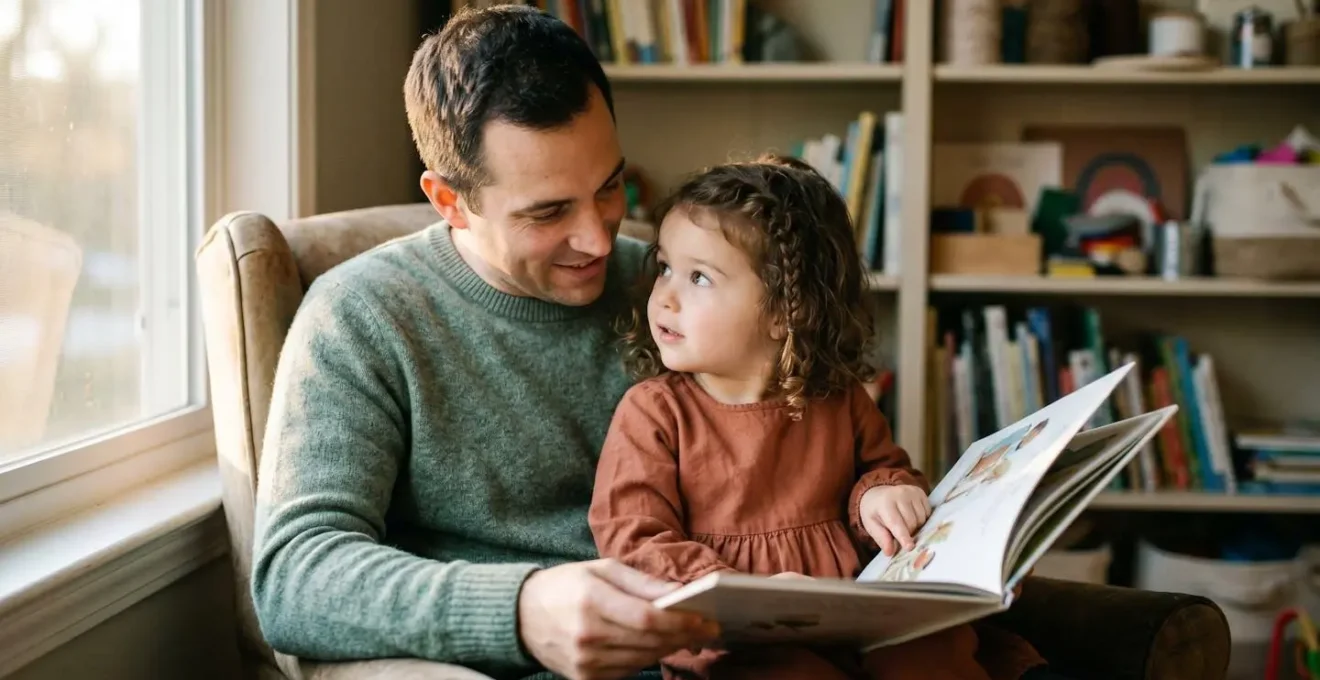
The secret to raising a successful reader isn’t flashcards or rote memorization; it’s building a ‘literacy brain’ through simple, playful activities that fit into your everyday life.
- Foundational skills like hearing sounds (phonological awareness) and understanding story structure are more critical than knowing letter names early on.
- Everyday environments, from the supermarket to the living room, are rich with opportunities to develop pre-reading abilities naturally.
Recommendation: Focus on making literacy a joyful, interactive experience by integrating sound games, story-telling, and fine motor play into your daily routines.
As a parent, you want to give your child the best possible start for their school journey, and reading is at the heart of that. The pressure to ensure they are “ready” can feel immense, often leading parents down a path of alphabet flashcards and memorization drills. We’re often told that early literacy is about knowing the ABCs. While letter knowledge has its place, this approach misses the vast, foundational world of pre-reading skills that truly prepare a child for success.
Many common strategies focus on the final product—reading words—without first building the essential neural architecture that makes reading possible. This article will shift your perspective. We are going to move beyond the ABCs and look at the underlying mechanics of reading. You’ll discover that the most powerful preparation doesn’t happen with worksheets, but through joyful, connected moments woven into your daily life.
Instead of drilling letters, what if the key was in the rhythm of a nursery rhyme? Instead of demanding they read, what if you “read” pictures together in a wordless book? This guide, structured by a reading specialist, will walk you through eight powerful, evidence-based activities. You will learn not just *what* to do, but *why* these simple actions are so critical for developing your child’s phonological awareness, narrative skills, print concepts, and the fine motor control necessary for future writing. Prepare to see literacy opportunities everywhere.
This article provides a structured path through the essential pre-reading skills you can nurture at home. The following summary outlines the key areas we will explore, from the foundational power of sound awareness to the physical dexterity required for writing.
Summary: Building a Strong Foundation for Reading
- Nursery Rhymes: Why They Are the Key to Phonological Awareness?
- Environmental Print: Reading Logos and Signs on the High Street
- Concepts of Print: Why Holding the Book the Right Way Up Matters?
- Wordless Picture Books: How to “Read” Pictures to Build Narrative Skills?
- I-Spy Sounds: Developing Initial Sound Recognition Without Letters
- The “Add One Word” Rule: How to Stretch Your Child’s Language?
- Pincer Grasp: Using Tweezers and Beads to Prep for Pencils
- How to Facilitate Natural Language Acquisition Without Flashcards?
Nursery Rhymes: Why They Are the Key to Phonological Awareness?
Before a child can read a word, they must be able to hear the individual sounds within it. This is the essence of phonological awareness, and it is arguably the single most important pre-reading skill. Nursery rhymes are a powerhouse for developing this ability. The predictable rhythm, the repetition, and the rhyming patterns are not just fun; they are explicitly training your child’s ear to detect, isolate, and manipulate the sounds of language. When you sing “Twinkle, Twinkle, Little Star,” and later, “How I wonder what you are,” you are highlighting that the “star” and “are” sound similar, building a neural category for that sound family.
This playful exposure to language structure is far more effective than direct instruction at this age. The melodic and rhythmic nature of rhymes makes the sound patterns of language memorable and engaging. An extensive body of research across multiple studies involving over 5,000 preschoolers consistently demonstrates a strong correlation between a child’s knowledge of nursery rhymes and their later success in reading and spelling.
The process is subconscious for the child. They are simply enjoying a moment of connection with you. Yet, with every verse, they are building a mental library of sounds, rhymes, and syllables. This foundation allows them to later understand that the letters on a page represent these very sounds they have been playing with all along. As the ERIC Educational Research Database highlights, this knowledge is not just a bonus but a catalyst for reading development.
Results of this research suggest that knowledge of nursery rhymes enhances children’s phonological awareness and sensitivity to individual phonemes and rhyme, and stimulates phonemic skill development.
– ERIC Educational Research Database, Nursery Rhyme Knowledge and Phonological Awareness in Preschool Children, Journal of Language and Literacy Education
Environmental Print: Reading Logos and Signs on the High Street
Long before children can decode the words in a book, they are already “reading” the world around them. This is called environmental print, and it includes everything from the logo on a cereal box to the big red sign of a favorite store. For a young child, the golden arches of McDonald’s don’t represent the letters M-c-D-o-n-a-l-d-‘-s; they represent the entire concept of “a place we sometimes get fries.” This is a form of logographic reading—associating a whole visual symbol with a specific meaning. This is the first, natural stage of reading development.
Your role as a parent is to notice and name this print. When you’re out for a walk or at the grocery store, you can say, “Look, there’s the sign for the Post Office. That’s where we mail letters,” or “I see the sign for Tesco; let’s go inside.” You are making a powerful connection: print carries meaning. You are showing them that those squiggles and shapes are a code that tells us important information about the world. This builds a child’s motivation to read because it demonstrates the immediate, practical value of literacy.
The image below captures a child in this exact moment of discovery—noticing the rich visual information in their surroundings. This engagement is the spark of emergent literacy.
By engaging with environmental print, you reinforce the understanding that print is everywhere and serves a purpose. Research confirms that these interactions are not trivial; they develop emergent literacy abilities that are direct precursors to conventional reading. The child begins to understand that print is different from pictures and that it communicates a consistent message each time they see it. This is a profound and essential step towards becoming a reader.
Concepts of Print: Why Holding the Book the Right Way Up Matters?
Imagine trying to learn a game without knowing any of the rules. This is what reading is like for a child who hasn’t yet grasped the “concepts of print.” These are the unspoken conventions of written language that skilled readers take for granted. It includes understanding that a book is held a certain way, that we read from left to right and top to bottom, that words are separated by spaces, and that the squiggles on the page are the “story,” not just the pictures. A child who constantly points to the pictures when you ask, “Where are the words?” has not yet developed this crucial understanding.
Teaching concepts of print is not a formal lesson; it’s a modeling process that happens naturally during shared reading. As you read aloud, use your finger to track the words. This simple act, called “print tracking,” is incredibly powerful. It visually connects the spoken word you are saying with the printed word on the page. You can make it explicit by saying, “I’ll start reading here on the left side,” or “Look, we’re at the end of the line, so we go down to the next one.”
You can also talk about the book’s features. Point out the author’s name (“She’s the person who wrote the words”) and the illustrator’s name (“He’s the person who drew the pictures”). This helps children understand the distinction between text and images. The evidence is clear: research consistently shows that children entering kindergarten with strong print awareness skills are significantly more likely to become proficient readers by third grade. Without this foundational knowledge, the act of reading can seem chaotic and nonsensical, creating a major barrier to progress.
Wordless Picture Books: How to “Read” Pictures to Build Narrative Skills?
What is a story? At its core, it’s a sequence of events with a beginning, a middle, and an end. It involves characters, a setting, and a problem that often leads to a resolution. Understanding this structure, known as narrative skill, is a key component of reading comprehension. And one of the best tools for building this skill, counterintuitively, is a book with no words at all.
Wordless picture books invite the child to become the storyteller. They must look closely at the illustrations, interpret the characters’ emotions from their facial expressions and body language, and infer what is happening from one page to the next. This is a highly active form of engagement. When you “read” a wordless book together, you can start by asking “What’s happening here?” or “How do you think he’s feeling?”. The goal isn’t to get the “right” story, but to encourage your child to create a logical and coherent narrative based on the visual evidence.
This process develops a host of critical pre-reading skills. As literacy expert Knudsen-Lindauer points out, these books are a pedagogical goldmine. They build sequential thinking (understanding the order of events), visual discrimination (noticing small but important details in the pictures), and inferential thinking (the ability to “read between the lines”). When a child can look at a series of pictures and confidently tell a story, they have demonstrated a deep understanding of narrative structure. This ability will directly transfer to their comprehension of written text later on, as they will be able to anticipate story patterns and make predictions, making them a more engaged and effective reader.
I-Spy Sounds: Developing Initial Sound Recognition Without Letters
Before a child can match the sound /b/ to the letter ‘B’, they first need to be able to isolate that /b/ sound in a word like “ball.” This skill, a specific part of phonological awareness called phonemic awareness, is about recognizing and manipulating the smallest individual sounds (phonemes) in spoken language. Many parents jump straight to teaching letter names and sounds, but this can be an abstract and difficult leap for a young child. A much more natural and effective first step is to play games with the sounds themselves, completely detached from their written form.
The classic game “I Spy” is perfect for this, with a small twist. Instead of “I spy with my little eye something beginning with C,” you say, “I spy… something beginning with the sound /k/.” This focuses their attention on the initial sound, not the letter’s name. You can start with objects right in front of you: “/k/… /k/… car!” You can do this in the car, at the dinner table, or while getting dressed. “I’m putting on my /sh/… /sh/… shoes.” “It’s time to brush your /t/… /t/… teeth.”
This kind of focused listening activity, as depicted in the image, is training the brain to tune into the specific sound components of language.
The goal is to make sound awareness automatic and fun. You are not testing them; you are playing a game. These activities are powerful because they are auditory. As Reading Eggs Educational Resources notes, phonological awareness is one of the strongest predictors of reading achievement, and these crucial early games don’t require any written words. The focus is entirely on hearing and playing with sounds, building the neural pathways that will later make connecting sounds to letters a simple and intuitive step.
The “Add One Word” Rule: How to Stretch Your Child’s Language?
A child’s spoken vocabulary is one of the greatest predictors of their future reading comprehension. A child who has heard and understands the word “enormous” has a much better chance of decoding and understanding it in a book than a child who has not. One of the most effective, in-the-moment strategies for building vocabulary and grammatical complexity is a technique called language expansion, or what we can call the “Add One Word” rule.
The concept is simple: when your child says something, you respond by repeating what they said and adding a little more language. You are not correcting them; you are affirming their communication and gently modeling a more complex way to say it. This technique meets them exactly where they are and provides the next logical step in their language development. It shows them what’s possible with language in a supportive, non-judgmental context.
This strategy can be adapted for any developmental stage. By consistently applying this rule, you are acting as a linguistic scaffold, helping your child build more sophisticated language structures one word at a time. This richer oral language becomes the foundation for understanding the richer, more complex language they will encounter in books. You are essentially pre-loading their brain with the vocabulary and syntax they will need to become successful readers.
- For early talkers: When your child points and says “Doggie!”, you expand by saying, “Yes, a big, brown doggie!” You’ve added descriptive words.
- For the two-word stage: When your child says, “Go car,” you expand it into a full grammatical sentence: “Yes, we are going in the car.”
- For emerging sentences: When your child says, “I see bird,” you can recast and expand: “You see a bird! Yes, that is a little red bird singing in the tree.”
- During joint activities: Narrate your own actions using richer vocabulary. Instead of “I’m cutting vegetables,” say, “I’m carefully chopping the bright orange carrots for our dinner.”
- Ask open-ended questions: Encourage longer responses by asking questions that start with “What do you think…” or “Tell me about…” instead of those that can be answered with a simple yes or no.
Pincer Grasp: Using Tweezers and Beads to Prep for Pencils
Literacy is not just a cognitive activity; it’s a physical one. The ability to write letters and words requires significant fine motor strength and control, particularly the development of a mature pincer grasp. This is the grasp used to hold a pencil, where the thumb and index finger work together with precision. Rushing a child to hold a pencil before their hand muscles are ready can lead to frustration and the development of an inefficient grip that is difficult to correct later. A far better approach is to prepare the hands for writing through playful, targeted activities.
Activities that require the use of tweezers to pick up small objects like beads, pom-poms, or dried beans are fantastic for this. Using tweezers mimics the pincer grasp and builds the small intrinsic muscles in the hand and fingers. Other great activities include using droppers with colored water, threading beads onto a string, manipulating play-doh, and using pegs on a pegboard. Each of these activities requires the precise, coordinated movements that are the foundation of handwriting.
The close-up image shows the exact kind of focused, precise hand movement we aim to encourage through these playful tasks.
Furthermore, research demonstrates that integrating literacy concepts into these fine motor tasks is a highly effective strategy. For example, you can have a child use tweezers to pick up alphabet beads and place them on the corresponding letter on a mat. This simultaneously builds hand strength while reinforcing letter recognition. These integrated activities strengthen not only muscles but also executive function skills like focus, patience, and the ability to persist with a challenging task—all of which are essential for learning to read and write in a classroom setting.
Key Takeaways
- The ability to hear and play with the sounds in words (phonological awareness), nurtured by nursery rhymes, is the most critical pre-reading skill.
- Literacy learning isn’t confined to books; everyday signs, logos, and packaging are powerful tools for teaching that print has meaning.
- Building the physical strength in a child’s hands through fine motor play is as important for literacy as cognitive activities.
How to Facilitate Natural Language Acquisition Without Flashcards?
The human brain is wired for language. For millennia, children have learned to speak their native tongue not through explicit instruction, but through immersion and interaction. This same principle applies to building the rich oral language foundation necessary for reading. The most powerful engine for language acquisition is the serve-and-return interaction between a loving caregiver and a child. Every time you respond to your child’s babble, gesture, or word, you are building and strengthening the neural pathways for language in their brain.
As neuroscience research reveals, a baby’s brain develops at a staggering rate, forming about 1,000 trillion connections by age three. The quality of their early interactions directly shapes this architecture. Flashcards and educational apps, which are often one-way and passive, cannot replicate the dynamic, responsive nature of a real conversation. The true work of language development happens when you talk, sing, and read with your child. Narrate your day (“Now I’m washing the dishes, the water is warm and soapy”), sing silly songs in the car, and share books together as a time for cuddling and connection, not as a test.
The goal is to create a language-rich environment where vocabulary, sentence structure, and the joy of communication are absorbed naturally. This approach respects the child’s developmental stage and fosters an intrinsic motivation to communicate and, eventually, to read. By focusing on connection and conversation over drills and performance, you are giving your child the most profound and lasting gift: a love of language that will serve as the bedrock for a lifetime of learning.
Your 5-Point Home Literacy Environment Audit
- Literacy Touchpoints: Identify three daily routines (e.g., mealtimes, bath time, car rides) where you can intentionally insert more conversation, singing, or storytelling.
- Resource Inventory: Gather all your children’s books. Are they easily accessible? Is there a variety of fiction, non-fiction, and rhyme-based books?
- Interaction Quality: For one day, pay attention to your reading sessions. Are you asking questions and encouraging your child’s participation, or primarily just reading the words on the page?
- Emotional Connection: Observe your child’s reaction to book time. Is it viewed as a joyful, bonding activity, or as a task? How can you increase the “cuddle factor”?
- Action Plan: Choose one new activity from this article (e.g., I-Spy Sounds, using a wordless book) to try this week. Commit to it as a playful experiment.
By shifting your focus from performance to connection and from rote memorization to playful skill-building, you create a positive and powerful foundation. The journey to literacy is a marathon, not a sprint, and these early years are for building the strength, stamina, and most importantly, the love for the road ahead. Your role is not to be a teacher with a curriculum, but a guide who points out the wonder of language everywhere.