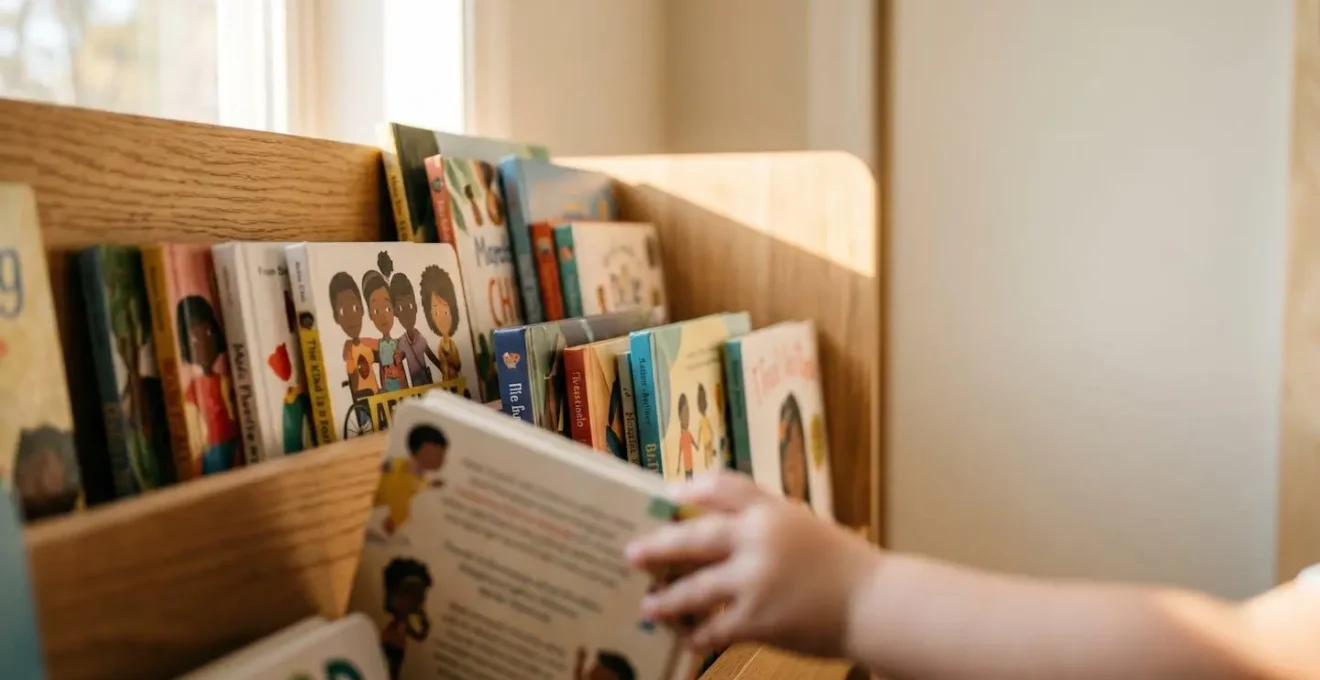
Building a diverse bookshelf is not a social obligation; it’s a powerful, science-backed parenting tool for actively developing your child’s emotional intelligence and resilience.
- Stories act as “flight simulators” for social life, allowing children to practice empathy and perspective-taking in a safe environment.
- Exposing children to varied narratives provides the “cognitive scaffolding” needed to understand complex issues like prejudice, grief, and identity.
Recommendation: Shift your goal from simply collecting “diverse books” to curating a library that serves as a practical toolkit for your child’s emotional and cognitive growth.
You’ve taken a look at your child’s bookshelf. It’s a good collection, full of beloved classics and bedtime favorites. But a quiet observation begins to form: the heroes are mostly white boys, or perhaps they’re all animals. The princesses all look the same, and every family has a mom, a dad, and 2.5 kids. It’s not that you chose this intentionally, but the pattern is undeniable. This realization can come with a pang of guilt or a sense of being behind the curve. Many parents believe the solution is simply to buy more books featuring diverse faces, as if filling a quota.
While that is a start, it misses the profound power you’ve just unlocked. As a librarian specializing in inclusion, I see parents at this crossroads every day. They come looking for a list, a quick fix. But what if the true key isn’t just changing *what* faces are on the page, but understanding *why* those different stories are fundamental to building your child’s emotional and psychological toolkit for the world? The goal isn’t just representation for its own sake; it’s about leveraging narrative to actively foster empathy, resilience, and emotional intelligence.
This article will move beyond the platitudes. We won’t just tell you diverse books are “important.” We will show you the science of how stories can physically reduce prejudice in the brain. We will explore how they become safe spaces to discuss life’s hardest topics, and how they affirm your child’s place in the world while building bridges to others. We’ll unpack the frameworks that transform a simple bookshelf into a dynamic engine for growing a well-adjusted, compassionate, and emotionally intelligent human being.
Summary: The Emotionally Intelligent Bookshelf: Unpacking the Power of Diverse Stories
- Mirrors and Windows: Why Kids Need Books About Themselves and Others?
- Walking in Their Shoes: How Stories Reduce Prejudice?
- Disability in Fiction: Moving Beyond Stereotypes and Inspiration Porn
- Princesses Who Save Themselves: Books That Challenge Gender Norms
- Folk Tales: Using World Stories to Connect with Heritage
- Bibliotherapy: Using Books to Talk About Death or Divorce
- Perspective Taking: “How Do You Think Your Friend Felt?”
- Fostering Emotional Intelligence Growth: The Key to Future Happiness
Mirrors and Windows: Why Kids Need Books About Themselves and Others?
The conversation about diversity in children’s literature always begins with one foundational concept, eloquently articulated by Dr. Rudine Sims Bishop. She proposed that books should function as “Mirrors, Windows, and Sliding Glass Doors.” This isn’t just a lovely metaphor; it’s a crucial framework for understanding a child’s developmental needs. A “Mirror” is a story that reflects a child’s own life and experience, validating their existence and affirming their identity. Seeing themselves on the page tells them: “You matter. Your story is worth telling.” This identity affirmation is critical for developing self-worth and a secure sense of self.
A “Window,” in contrast, offers a view into someone else’s world, someone whose life, culture, or circumstances are different. It’s through these windows that a child begins to understand the vastness of human experience. But Dr. Bishop’s most powerful addition was the “Sliding Glass Door,” which allows a child to step through the window and enter that other world, however briefly. This is the beginning of empathy. As she explained in an interview for Reading Rockets:
I wrote a piece maybe 1990 it was published which I called ‘Mirrors, Windows, and Sliding Glass Doors.’ Children need to see themselves reflected. But books can also be windows. And so you can look through and see other worlds and see how they match up or don’t match up to your own. But the sliding glass door allows you to enter that world as well.
– Dr. Rudine Sims Bishop, Reading Rockets interview on The Diverse Bookshelf
A bookshelf filled only with mirrors becomes an echo chamber, suggesting one’s own experience is the only one that exists. A bookshelf with only windows can lead to a feeling of alienation, as if one’s own life is invisible or unimportant. A balanced bookshelf, full of both, creates a well-rounded, secure, and curious child. The good news is that the publishing world is slowly responding. In a historic first, a 2025 report from the Cooperative Children’s Book Center shows that over half (51%) of children’s books received had significant BIPOC (Black, Indigenous, and People of Color) content.
Walking in Their Shoes: How Stories Reduce Prejudice?
The idea that books build empathy feels intuitive, but it’s not just a feel-good notion; it’s a scientifically observable phenomenon. When a child becomes engrossed in a story, they experience something researchers call “narrative transportation.” This is the feeling of being completely “lost” in a book, where the real world fades away. During this state, the brain’s barriers between self and other become more porous. The reader doesn’t just observe the character; they begin to adopt their perspective, feel their emotions, and understand their motivations from the inside.
This process has a powerful effect on our biases. Much of prejudice isn’t conscious; it’s a set of implicit, automatic associations our brains have formed. Narrative transportation actively works to dismantle this. Compelling research demonstrates that reading narrative fiction induces spontaneous empathy and perspective-taking, which in turn significantly reduces both implicit and explicit prejudice. In essence, stories are like flight simulators for social situations. They allow children to safely “walk in someone else’s shoes” and practice empathy, making it a more reflexive, natural response in the real world.
Case Study: Reducing Prejudice Through Stories
A landmark study illustrated this perfectly. In a six-week intervention, non-disabled children aged 5-10 were read stories featuring friendships between disabled and non-disabled peers. The results were clear: this “extended contact” through stories led to a significant increase in positive attitudes toward disabled people. The effect was most pronounced when the stories both highlighted the individual friendship and gently acknowledged the characters’ different group identities, showing that stories can help children navigate complex social realities with more grace and understanding.
This isn’t about a single “magical” book. It’s the cumulative effect of a bookshelf rich with varied perspectives. Each story adds another layer of understanding, another experience to draw from, slowly and surely rewiring a child’s brain for a more open and compassionate worldview. The story becomes the bridge between “us” and “them,” ultimately revealing that there is only “us.”
Disability in Fiction: Moving Beyond Stereotypes and Inspiration Porn
Nowhere is the need for authentic representation more critical than in the portrayal of disability. For too long, characters with disabilities in children’s literature have been relegated to one of two harmful tropes: the tragic victim to be pitied, or the saintly, one-dimensional figure whose only purpose is to inspire non-disabled characters—a phenomenon disability activists call “inspiration porn.” This does a profound disservice to the rich, complex, and normal lives of disabled individuals. The statistics reveal a stark gap: according to the Cooperative Children’s Book Center, only 3.4% of children’s books surveyed in 2019 featured disabled main characters, despite disabled people making up a significant portion of the population.
This is where the concept of “Own Voices” becomes paramount. An “Own Voices” book is one where the protagonist and the author share a marginalized identity. When a disabled author writes a disabled character, they bring a lived experience that is impossible to fake. They understand the nuance, the frustrations of an inaccessible world, and the joy and pride of disabled identity.
As editor Kayla Whaley, a powerful advocate at Disability in Kidlit, explains, this authenticity is not just about accuracy; it’s about preventing harm. Her words highlight the deep personal stake involved:
I’m intimately familiar with enduring and combating ableism, navigating an inaccessible world, exploring disabled identity, and embracing disability pride. I know not only which tropes to avoid, but how much those tropes hurt — because I’ve been hurt by them before.
– Kayla Whaley, Editor at Disability in Kidlit
When curating your bookshelf, seek out these authentic stories. Look for books where a character’s disability is just one part of their full, rich life. They have hobbies, get into arguments, have crushes, and save the day. The goal is normalization, not tokenism. A good book featuring a disabled character is simply a good book about a kid who happens to be disabled, allowing both “mirror” and “window” readers to connect on a human level.
Princesses Who Save Themselves: Books That Challenge Gender Norms
Gender is one of the first and most pervasive social categories children learn. From the moment they’re born, they are surrounded by cues about what it means to be a boy or a girl. Children’s books are a powerful, and often underestimated, source of these messages. The seemingly innocent picture book can be a vehicle for rigid stereotypes. In fact, research from Carnegie Mellon University found that many popular children’s books contain subtle but powerful information about gender, with stereotypes that can sometimes be even stronger than in books for adults.
These stereotypes can be insidious: boys are consistently portrayed as active, adventurous leaders, while girls are passive, nurturing, or focused on appearance. This constant repetition limits a child’s sense of possibility, teaching them that their interests, emotions, and future roles are pre-determined by their gender. It can discourage a boy from being gentle and caring, or a girl from being bold and analytical. A bookshelf that exclusively reinforces these norms is not just reflecting culture; it is actively building a cage of expectations around a child.
Case Study: Persistent Gender Inequality in Picture Books
A 2024 study that analyzed 19 popular picture books used in preschools revealed how deeply these biases run. The researchers found three persistent patterns of gender inequality: the simple absence of female characters in central roles, language patterns that reinforced stereotypes (like praising girls for being “pretty” and boys for being “strong”), and the constant perpetuation of traditional maternal roles. The study showed how these formative reading experiences have a significant, direct impact on how young children understand gender and their place in the world.
The antidote is a bookshelf that actively challenges these norms. Look for books featuring “princesses who save themselves,” boys who are sensitive and artistic, girls who are brilliant scientists, and characters who exist outside of a strict gender binary. These stories don’t just provide better role models; they provide permission. They tell a child, “You can be anything. Your personality, your interests, and your heart are what define you, not a set of outdated rules.” By offering a wider range of what it means to be human, these books give children the freedom to build their own authentic identity.
Folk Tales: Using World Stories to Connect with Heritage
In our quest for a “diverse” bookshelf, it’s easy to focus only on contemporary stories set in modern cities. But one of the richest and most powerful resources for building both windows and mirrors is the vast world of folk tales, myths, and legends. These stories, passed down through generations, are the cultural DNA of a people. They contain the values, fears, humor, and wisdom of a heritage, distilled into narrative form. For a child with roots in that culture, these tales are the ultimate “mirror.”
Hearing the stories of Anansi the Spider, the Golem of Prague, or the Monkey King connects a child to a long chain of ancestry. It tells them that their heritage has a rich literary and imaginative tradition, giving them a sense of pride and belonging that is deep and enduring. It’s a way of saying, “This is where you come from. These clever, foolish, brave, and magical people are your people.” It anchors their identity in something ancient and powerful.
For a child from a different background, these same tales are the most fascinating of “windows.” They offer an authentic glimpse into another culture’s worldview, far more meaningful than a dry list of facts about holidays or foods. As the organization Our Ancestories aptly puts it:
When children read books that feature characters from different cultures and experiences, they can develop a greater sense of empathy and understanding towards others. They can also learn about different customs, beliefs, and traditions, leading to a more open-minded and inclusive worldview.
– Our Ancestories, The Power of Representation: Why Diversity in Children’s Books Matters
What makes folk tales so effective is their universality. While the settings and characters are specific, the themes are human: the struggle between good and evil, the triumph of wit over brute strength, the consequences of greed, the power of kindness. A child in Ohio can see themselves in a clever trickster from West Africa because the core human emotion is recognizable. This creates a powerful connection, teaching that while our stories may be different, our hearts often beat to the same rhythm.
Bibliotherapy: Using Books to Talk About Death or Divorce
A child’s life is not always sunny. They experience confusion, grief, fear, and loss. Difficult events like the death of a grandparent, a parental divorce, a serious illness, or a big move can leave them struggling with emotions they don’t have the words for. As a parent, finding the right way to start these conversations can feel impossible. This is where the bookshelf transforms from a source of entertainment into a vital therapeutic tool, a practice known as bibliotherapy.
Bibliotherapy is the use of stories to help people understand and cope with psychological and emotional challenges. A book provides a safe, third-person space to explore a difficult topic. Instead of talking directly about their own fear or sadness, a child can talk about the character’s fear or sadness. This emotional distance makes the topic approachable. The story provides a narrative structure—a beginning, a middle, and an end—to a chaotic and overwhelming feeling, suggesting that even the most difficult experiences can be navigated.
As the literacy organization Room to Read states, books are fundamental sense-making tools:
Books are more than just a fun pastime. For children, they are tools for building literacy and identity, developing vocabulary and empathy, and making sense of the world around them and the experiences they live through.
– Room to Read, I see me, I see you: Why diverse children’s books belong in every child’s hands
The right book at the right time can provide what we call “cognitive scaffolding.” It gives the child the vocabulary and the framework to understand their own experience. Reading a story about a child whose parents are divorcing can help them identify their own feelings of guilt or sadness. It shows them they are not alone in their experience—a profoundly comforting realization. A story about grief can validate their sadness and model healthy ways of remembering a loved one. When choosing these books, look for stories that are honest without being terrifying, that validate feelings, and that offer a glimmer of hope or a path toward healing, even if the ending isn’t perfectly happy.
Perspective Taking: “How Do You Think Your Friend Felt?”
We’ve established that books are powerful tools for building the foundations of empathy. But a book is only half of the equation. The other half is the conversation that happens around it. As a librarian, I see the magic happen not just when a child is silently reading, but when a parent or caregiver pulls them out of the story for a moment to engage in active perspective-taking. This is the conscious act of encouraging a child to imagine the world from another’s point of view, and it’s a skill that can be explicitly taught.
The simplest way to do this is with one powerful question: “How do you think [the character] felt when that happened?” This question shifts a child from being a passive consumer of a story to an active emotional detective. Follow-up questions deepen the skill: “Why do you think they felt that way?” “What would you have done?” “What do you think they will do next?” This practice helps children develop what psychologists call a “Theory of Mind”—the understanding that other people have thoughts, feelings, and beliefs that are different from their own. This is the absolute bedrock of social interaction.
Research confirms that structured, story-based conversations are highly effective. For example, in the prejudice-reduction study mentioned earlier, the most effective intervention involved not just reading the story, but discussing it in a way that emphasized both the individual characters’ feelings and their group identities. This guided conversation helped the children build a more nuanced understanding of social dynamics. By using books as a springboard, you give your child a low-stakes environment to practice one of life’s most complex and crucial skills.
Action Plan: Facilitating Perspective-Taking
- Pause and Point: When a character shows a strong emotion (on their face or through their actions), pause the story. Say, “Look at their face. What do you think they are feeling right now?”
- Connect to Experience: Link the character’s emotion to your child’s own life. “Remember when you felt sad because your toy broke? Maybe the character feels a bit like that.”
- Explore Motivations: Ask “why” questions. “Why do you think the dragon was so grumpy? Do you think it was just mean, or maybe it was lonely?” This teaches children to look beyond surface behavior.
- Predict Outcomes: Encourage them to think ahead. “Given how sad they are, what do you think they’ll do on the next page? What could we do to help them feel better?”
- Label the Emotion: Give them the vocabulary. Use specific words like “frustrated,” “disappointed,” or “ecstatic” instead of just “sad” or “happy.” This builds emotional granularity.
Key Takeaways
- Mirrors and Windows: A child’s bookshelf needs books that reflect their own life (Mirrors) to build self-worth and books that offer views into others’ lives (Windows) to build understanding.
- Narrative Transportation: Getting lost in a story is a scientific process that reduces implicit prejudice by allowing children to “walk in a character’s shoes” and adopt their perspective.
- Cognitive Scaffolding: Stories provide a safe structure (scaffolding) to discuss difficult topics like death, divorce, or injustice, giving children the language and framework to process complex emotions.
Fostering Emotional Intelligence Growth: The Key to Future Happiness
We’ve journeyed through the science of prejudice reduction, the nuances of authentic representation, and the therapeutic power of stories. When you pull all these threads together, a clear picture emerges. The ultimate purpose of curating a diverse bookshelf is not about ticking boxes or performing political correctness. It is one of the most effective and loving things a parent can do to foster their child’s emotional intelligence (EI).
Emotional intelligence—the ability to understand, use, and manage your own emotions, and to recognize and influence the emotions of others—is consistently ranked as one of the most critical predictors of life success, healthy relationships, and overall happiness. A diverse bookshelf is a gymnasium for building this emotional muscle. Each story is a new piece of equipment. A “window” book exercises the empathy and perspective-taking muscles. A “mirror” book strengthens the self-awareness and identity muscles. A book used for bibliotherapy builds the emotional regulation and resilience muscles.
By exposing children to a wide range of human experiences—joy, grief, injustice, triumph, confusion—we give them a rich emotional vocabulary. This “emotional granularity” allows them to move beyond simple “happy” or “sad” and identify nuanced feelings in themselves and others. This is the foundation of compassion and self-awareness. The overwhelming public consensus supports this approach; a survey by equality charity Scope found that an incredible 89% of respondents believe it’s important for all children to see themselves represented in books, and 87% agree that this representation promotes a more inclusive and accepting society.
Ultimately, the child who has traveled to different worlds through books, who has felt the heartbreak of a character an ocean away, and who has seen their own quiet struggles reflected on a page, is a child who is better prepared for the beautiful, complex, and diverse world they will inherit. They are building a more flexible mind and a more compassionate heart. The initial discomfort you felt looking at your homogenous bookshelf was the start of a wonderful and important journey. It’s an invitation to stop seeing books as simple objects and to start wielding them as the powerful tools they are: tools for building a better, kinder, and more emotionally intelligent human.