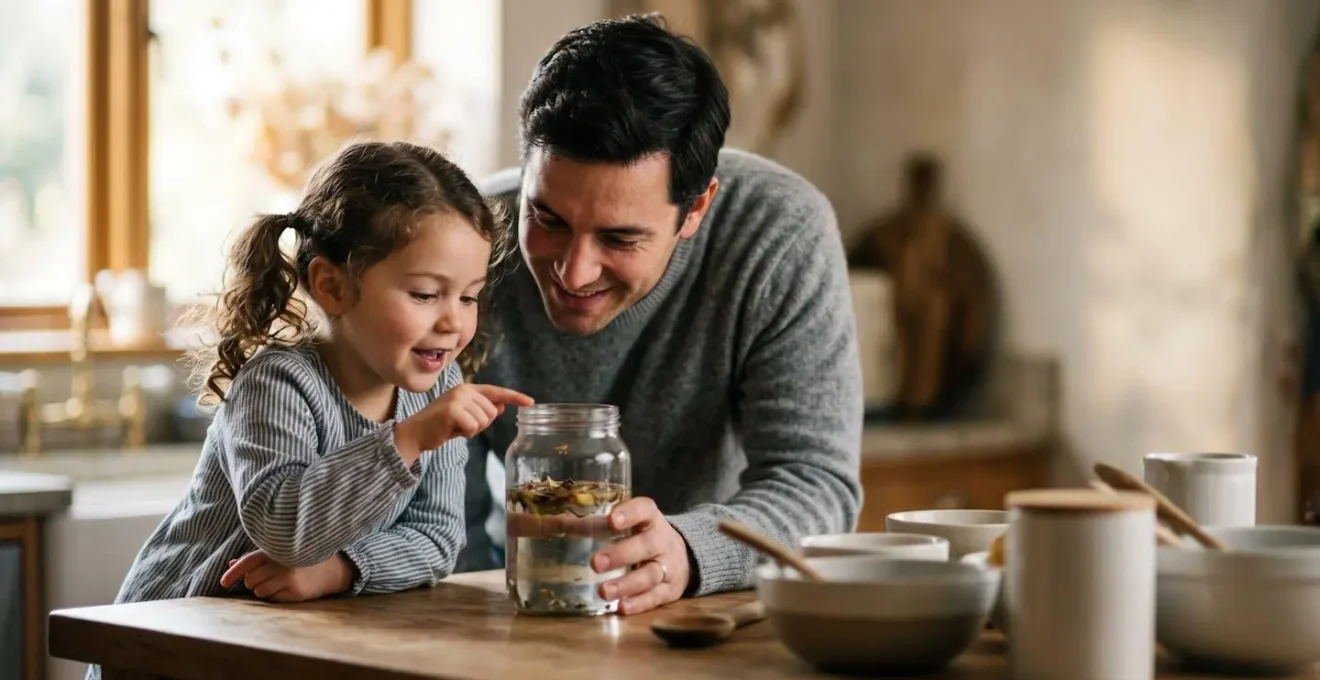
The secret to nurturing a brilliant mind isn’t in scheduled lessons, but in unlocking the hidden learning potential of everyday life.
- Everyday chores and routines are rich environments for developing foundational skills in math, literacy, and science.
- The parent’s role shifts from a “teacher” to a “learning architect” who designs and scaffolds discovery.
Recommendation: Start by choosing one daily routine, like preparing a snack, and ask “how” or “why” questions to spark your child’s curiosity instead of giving instructions.
As a parent, you’re constantly bombarded with the message that you need to be your child’s first and best teacher. This pressure can turn your home into a stressful classroom, filled with flashcards, educational apps, and the nagging feeling that you’re not doing enough. We’re often told to add more “educational” activities to our already packed schedules. But what if the most powerful learning doesn’t come from a box or a screen? What if it’s already woven into the fabric of your daily life, waiting to be discovered?
This is the core of playful learning. It’s a paradigm shift. Instead of adding more, you learn to see what’s already there. The real key is not to become a formal instructor, but to become a learning architect—someone who artfully reveals the hidden curriculum in the world around your child. It’s about transforming chores into missions, errands into expeditions, and simple questions into grand explorations. This approach fosters a genuine love for learning because it’s driven by curiosity, not by curriculum.
In this guide, we won’t give you a new to-do list. Instead, we’ll give you a new set of eyes. We will explore how to reframe everyday moments, from the kitchen to the laundry basket, into profound opportunities for growth, turning your daily life into the ultimate discovery adventure.
The following sections break down how this philosophy comes to life in practical, simple ways. You’ll find concrete examples and the developmental science that makes them so effective, empowering you to nurture your child’s innate curiosity without a single lesson plan.
Summary: A Practical Guide to Unlocking the Hidden Curriculum in Your Home
- Kitchen Math: Weighing, Measuring, and Counting Ingredients
- The Grocery List: Reading and Finding Items in the Supermarket
- Laundry Basketball: Trajectory and Force with Dirty Socks
- Potion Making: Mixing Shampoos and Waters (Safely)
- Bug Hunt: Counting Legs and Spotting Wings
- Continuous Provision: Why Does My Child Just “Play” at Nursery All Day?
- Open-Ended Questions: Why “Why” and “How” Are Better Than “What”?
- Creative Arts and Motor Skills: Why Messy Art is Essential for Writing Later
Kitchen Math: Weighing, Measuring, and Counting Ingredients
The kitchen is often the first place parents think of for hands-on learning, but it’s much more than just counting cookies. When you invite your child to cook with you, you’re not just making a meal; you’re opening a practical mathematics laboratory. This is where abstract numbers become tangible quantities. A cup of flour isn’t just “one,” it’s a volume that can be seen, touched, and compared to half a cup. This sensory experience builds a deep, intuitive understanding of concepts like fractions, estimation, and sequencing.
The parent’s role as a learning architect here is to provide the language and the “what if” questions. As your child pours a cup of water, you can ask, “I wonder how many small spoons it would take to fill that cup?” You are scaffolding their understanding of volume and units. As research on math in the kitchen shows, preschoolers who engage in these types of activities develop stronger, more flexible mathematical thinking because they’re solving real-world problems. They’re not just learning to count; they’re learning how numbers work.
Simple activities can be adapted for different ages. A toddler can help by counting the three eggs you need, while an older child can be challenged to figure out how to double a recipe, an exercise in multiplication and proportion. You’re not teaching a math lesson; you’re simply thinking aloud and inviting your child into the problem-solving process that is inherent in cooking. The learning is incidental, but the impact is profound.
The Grocery List: Reading and Finding Items in the Supermarket
A trip to the supermarket can be a source of stress for parents, but with a small shift in perspective, it can become a powerful literacy-building expedition. The key is the grocery list. By putting your child in charge of the list—whether they are “writing” it with scribbles, drawing pictures of items, or writing the actual words—you are giving them a purpose and a role. Their job is not to follow you, but to lead the mission.
This simple act transforms them from a passive passenger into an active participant. It gives their budding literacy skills a real-world, high-stakes context. They are not just reading words on a page; they are deciphering codes to find the treasure (the cereal!). As a 2017 study on early literacy skills found, the more parents empower children to use their own developing writing and reading skills for practical tasks like grocery lists, the stronger their future abilities become. It validates their attempts and shows them that writing has a purpose beyond the classroom.
The supermarket itself is a text-rich environment. Challenge your child to find the a-p-p-l-e-s or to spot the letter “M” on the milk carton. This isn’t a quiz; it’s a game. The goal is to foster an awareness of the print that surrounds them, making reading a natural and integrated part of their world.
Case Study: The Grocery Store as a Literacy Playground
The literacy organization Reading Rockets provides a powerful example of this in action. They document how putting children in charge of the grocery list transforms routine shopping into a dynamic literacy practice. As parents add items to the cart, children are responsible for crossing them off the list, practicing their reading skills. If an unlisted item is added, the child is tasked with adding it to the list, developing their writing and spelling skills in a meaningful context. As a further step, children read product labels to find specific items, like the brand of yogurt with the strawberry on it, which builds real-world reading comprehension and visual decoding skills.
Laundry Basketball: Trajectory and Force with Dirty Socks
Even the most mundane chores contain a “hidden curriculum.” Take laundry. For a child, a pile of dirty clothes and a laundry basket are not a chore; they are an invitation to play. Tossing a balled-up pair of socks into the hamper is a classic childhood game, but it’s also a high-level physics experiment. With every throw, your child is intuitively exploring complex concepts like trajectory, force, and gravity. They are learning that a gentle toss might fall short, while a harder throw might overshoot the target. They are adjusting their aim and the power of their throw based on immediate feedback.
This is where the learning architect steps in, not to explain physics with a whiteboard, but to provide the language that connects action to concept. You can simply comment on their discoveries: “Wow, that one went really high! I wonder what would happen if you threw it from closer?” or “You aimed for the back of the basket that time, and it bounced right in!” These comments are not instructions; they are observations that help your child become more conscious of their own problem-solving. You are giving them the vocabulary to describe their intuitive understanding.
This is a perfect example of a “cognitive spark,” a moment where playful action ignites a deeper understanding. The child isn’t thinking, “I am learning about projectile motion.” They are just trying to get the sock in the basket. But their brain is building neural pathways that will form the foundation for understanding these scientific principles later on.
As you can see, the focus is on the action and the immediate result. This hands-on, trial-and-error process is far more powerful than a verbal explanation. It turns a boring task into a game of skill and a moment of genuine scientific inquiry, all without your child ever realizing they’re “learning.”
Potion Making: Mixing Shampoos and Waters (Safely)
The bathroom, with its collection of bottles, running water, and interesting containers, is a natural laboratory for a young child. The irresistible urge to mix different soaps, shampoos, and lotions into a “potion” is not just about making a mess; it’s the beginning of scientific inquiry. This is early chemistry in its purest form. Your child is exploring the properties of different substances: some are thick, some are thin, some make bubbles, and some change color when mixed.
They are observing cause and effect in real-time. “What happens when I add water to this thick goo? It gets runny!” “What happens if I shake this bottle? Bubbles!” These are foundational experiments in solubility, viscosity, and aeration. The child is a researcher in their own lab, formulating hypotheses (“I bet this will turn blue”) and testing them through direct action.
The crucial role of the parent as a learning architect here is to be the “lab safety officer.” Instead of banning this messy but important play, you scaffold the experience with clear boundaries. This means defining what can and cannot be used. You can provide a designated “potion-making kit” with a few drops of food coloring, child-safe bubble bath, different-sized containers, and maybe a funnel or a baster. The rule is simple: you can mix anything in this kit, but other bottles are off-limits. This teaches a vital scientific (and life) lesson: exploration must happen within safe and respectful boundaries.
Bug Hunt: Counting Legs and Spotting Wings
A walk in the backyard or a local park can be transformed from a simple stroll into a scientific expedition with one simple shift: becoming “bug detectives.” This isn’t just about pointing out a beetle and moving on. It’s about adopting the mindset of a naturalist, engaging in the process of observation, classification, and data collection. The mission is not just to find bugs, but to study them.
Your tools are simple: your eyes and your curiosity. When you find a creature, the investigation begins. The role of the learning architect is to guide this inquiry with open-ended questions. “Look at this interesting fellow! How many legs can you count? Does it have wings? I wonder where it’s going in such a hurry.” These questions direct the child’s attention to specific details, teaching them to look closely and systematically. You’re not quizzing them; you’re modeling the process of scientific observation.
This activity builds a foundation for biological sciences. Children learn about the basic characteristics of insects (six legs) versus arachnids (eight legs). They notice patterns and differences. A ladybug and a beetle both have hard shells, but a spider has a soft body. This is the very beginning of understanding taxonomy and classification. You’re building a mental framework for organizing information about the natural world, all through a simple, engaging game.
The goal is not to identify every bug correctly. The goal is to cultivate a habit of curiosity and close observation. It’s about valuing the process of looking and wondering, which is the heart of all scientific discovery.
Continuous Provision: Why Does My Child Just “Play” at Nursery All Day?
Many parents look at a nursery or preschool environment and wonder, “What are they actually learning? They just seem to play all day.” This question reveals a common misunderstanding of how young children learn best. The “playing” you see is actually a highly sophisticated educational approach known as continuous provision. It’s the philosophy that underpins all the activities we’ve discussed. It is the art and science of creating an environment so rich with learning opportunities that children teach themselves through exploration and play.
Think of it as the ultimate learning architecture. The educators have carefully designed the space—the “provisions”—with specific learning intentions in mind. The sand pit is there to explore texture, volume, and measurement. The water table is a physics lab for studying flow and displacement. The art corner is a workshop for developing fine motor skills and color theory. The child isn’t being explicitly taught; they are drawn by their own curiosity to these provocations, and the learning happens organically as they interact with the materials.
This is not an excuse to let children run wild. It’s a deliberate, evidence-based strategy. In fact, as play-based strategies lead to measurable gains in reasoning, language, and emotional intelligence, according to a 2024-2025 study. When a child is deeply engaged in play, their brain is firing on all cylinders. They are problem-solving, collaborating, and making connections at an incredible rate. Play is not the opposite of learning; for a young child, play is the work. It is the very engine of their development.
Open-Ended Questions: Why “Why” and “How” Are Better Than “What”?
If the environment is the “hardware” of playful learning, then open-ended questions are the “software.” They are the single most powerful tool a parent can use to deepen a child’s thinking and extend their learning. The difference between a closed question and an open one is the difference between a dead-end and a highway of discovery. A closed question has a single right answer: “What color is that block?” (Red). “How many cars are there?” (Three). These questions test knowledge, but they don’t build it.
An open-ended question, on the other hand, invites conversation, speculation, and creativity. It has no single right answer. “Why do you think the tower fell over?” “How could we make it stronger next time?” “I wonder what the people in your drawing are talking about?” These questions transfer the intellectual heavy lifting to the child. You are not giving them an answer; you are inviting them to construct their own. This process is crucial for developing critical thinking and problem-solving skills.
Using open-ended questions is a cornerstone of the learning architect’s toolkit. It requires you to be more of a curious co-explorer than an all-knowing expert. As studies on open-ended questioning consistently show, children who are regularly engaged in these types of conversations develop stronger cognitive and social-emotional skills. They learn to articulate their thoughts, consider different perspectives, and become more confident in their own ideas.
Your Action Plan: Asking Better Questions
- No “Yes” or “No”: Structure your questions so they cannot be answered with a simple yes or no. Instead of “Did you have fun?”, try “What was the most fun part of your day?”.
- Assume Less, Discover More: Avoid questions that assume an outcome. Instead of “Why did you make the tower so wobbly?”, ask “Tell me about your tower.”
- Hand Over Control: Let the child direct the conversation. Your question is just the starting point; follow their lead and their interests.
- Stimulate Conversation: Your goal is to start a back-and-forth dialogue, not a quiz. Build on their answers with follow-up wonders like, “That’s interesting, what happened next?”.
- Embrace All Answers: Remember, there is no right or wrong answer. The goal is to encourage problem-solving and hear their unique thought process.
Key Takeaways
- Your primary role is not to be a teacher, but a “learning architect” who reveals the learning hidden in everyday life.
- The most powerful learning is often incidental, happening during play and routine activities, not formal lessons.
- Open-ended questions (“How?” and “Why?”) are your most powerful tool to spark curiosity and deepen your child’s thinking.
Creative Arts and Motor Skills: Why Messy Art is Essential for Writing Later
It can be tempting to see “messy play”—finger painting, squishing playdough, splashing in mud—as just a chaotic activity that requires a lot of cleanup. But for a developing child, this sensory exploration is a critical precursor to one of the most important academic skills they will ever learn: writing. The connection may not be obvious, but the developmental path is direct. Writing is a complex physical act that requires significant fine motor control, hand strength, and hand-eye coordination.
Where does a child develop these skills? Not by holding a pencil from day one. They develop them by squishing, squeezing, pinching, and manipulating materials. When a child rolls playdough into a snake, they are strengthening all the small muscles in their hands and fingers. When they use their whole arm to make big strokes with paint, they are developing the shoulder and elbow stability necessary to eventually make small, controlled marks on a page. When they pick up small beads or tear paper for a collage, they are practicing the pincer grasp—the same one they will later use to hold a pencil.
As a learning architect, your job is to provide opportunities for this kind of messy, physical, creative work. It’s about valuing the process over the product. The beautiful, recognizable drawing is not the goal; the strengthening of muscles and the building of neural pathways is. By providing a rich variety of materials and the freedom to explore them, you are laying the physical groundwork that will make the cognitive task of learning to write so much easier down the road.
Embrace the mess, trust the process, and start seeing your daily life not as a series of chores to be completed, but as a rich landscape of discovery waiting for you and your child to explore together.