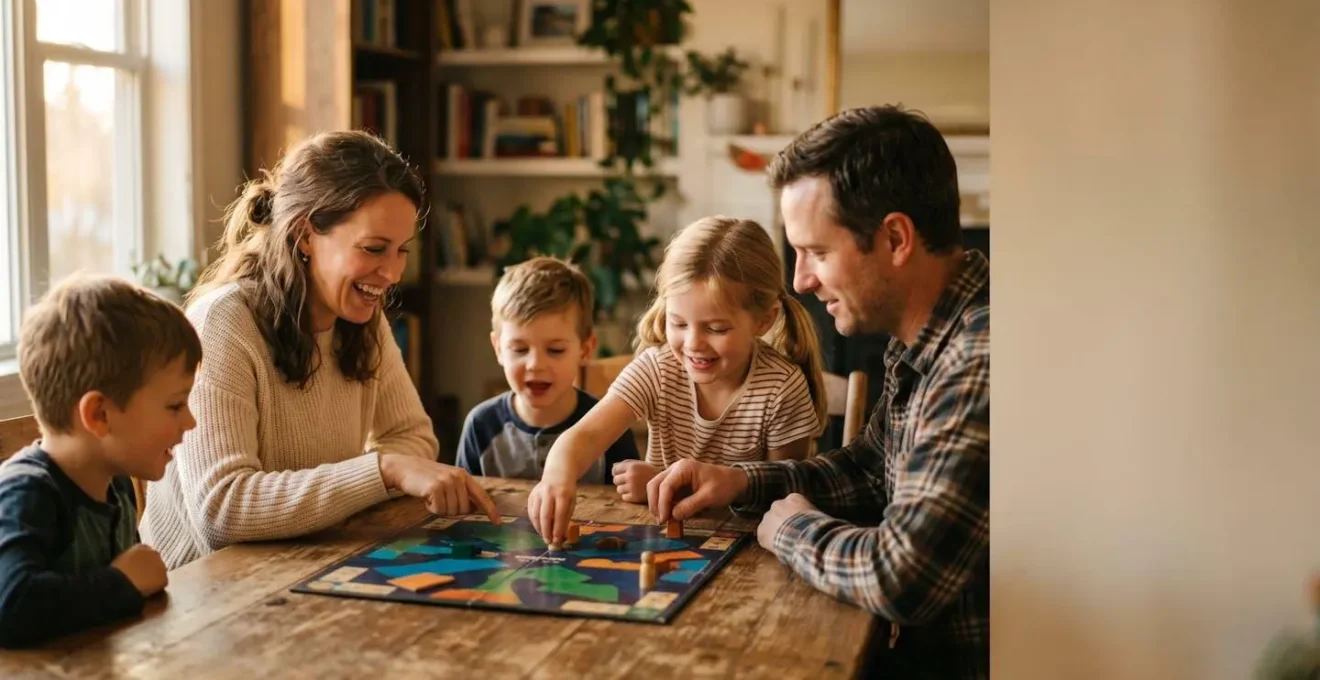
Beyond simple fun, board games are structured learning environments that actively build your child’s cognitive, social, and emotional skills with every roll of the dice.
- Game mechanics are a hidden curriculum, teaching everything from numeracy and financial literacy to logical deduction.
- Cooperative and competitive play provides a safe space for “emotional rehearsal,” helping kids manage frustration and practice empathy.
Recommendation: Shift your focus from just winning or losing to facilitating the “metacognitive dialogue”—the conversation about choices and strategies—where the most profound learning occurs.
As the holidays approach, the search for the perfect gift begins. It’s easy to grab the most brightly-colored box on the shelf, hoping it will provide hours of entertainment and a welcome break from screens. Many parents know intuitively that board games are “good” for kids; they encourage family time and teach basic concepts like taking turns. We often hear about the benefits of “critical thinking” or “social skills,” but these terms can feel vague and abstract.
But what if we looked deeper? What if the true power of a board game wasn’t just in its theme or its ability to entertain, but in its very structure? The real secret is that every game is a miniature learning laboratory. The rules, the pieces, and the objectives are not just for fun; they are a carefully designed curriculum. The key is shifting our perspective from just playing the game to understanding the learning processes it triggers. This guide moves beyond simple recommendations to deconstruct *how* specific, popular games build foundational skills.
We will explore how the simple act of moving a piece along a board can cement number sense, how managing play money introduces complex financial concepts, and how even losing a game can be a powerful lesson in emotional intelligence. By understanding the game mechanics as a curriculum, you can transform family game night from a simple pastime into a dynamic and intentional learning experience, equipping your child with skills that last a lifetime.
This article breaks down the hidden educational value within some of the most beloved family board games. The following summary provides a roadmap to understanding how you can turn playtime into a powerful engine for your child’s development.
Summary: Unlocking Your Child’s Potential Through Playful Learning
- Snakes and Ladders: One-to-One Correspondence and Counting On
- Monopoly Junior: Introduction to Money and Spending
- Guess Who: Using Process of Elimination and Descriptive Language
- Scrabble Junior: Spelling and Word Recognition
- Outfoxed: Winning or Losing as a Team
- The Art of Losing: Teaching Good Sportsmanship in Board Games
- High Fives: Encouraging Kids to Cheer for Each Other
- Fostering Emotional Intelligence Growth: The Key to Future Happiness
Snakes and Ladders: One-to-One Correspondence and Counting On
At first glance, Snakes and Ladders seems like a game of pure luck. You roll a die, you move your piece, and you hope to avoid the snakes. However, for a young child, this simple process is a powerful lesson in foundational mathematics. The game board is a physical representation of the number line, an essential tool for developing number sense. Each move reinforces one-to-one correspondence—the understanding that one number word (“one, two, three…”) corresponds to one object (one square on the board).
As Elida Laski, a Boston College Assistant Professor of Education, points out, the educational benefits are deeply tied to the specific actions involved. In the Developmental Psychology journal, she states:
It’s the way that children count — whether the counting procedure forces them to attend to the numbers in the spaces of a board game — that yield benefits.
– Elida Laski, Boston College Assistant Professor of Education, Developmental Psychology journal
This isn’t just a theory; it’s backed by data. Research shows there is a high probability of improving numeracy skills through these types of games. The game also naturally introduces the concept of “counting on.” Instead of starting from one every time, a child on square 12 who rolls a 3 learns to count “thirteen, fourteen, fifteen.” This is a crucial mental math strategy that moves them beyond basic counting to more fluid calculation.
Action Plan: Evidence-Based Counting Strategies for Board Games
- Play Linear Games: Choose games where children move pieces along a clear, numbered path for just 10 minutes per session to build number line understanding.
- Encourage ‘Counting On’: Instead of counting from 1 each time, prompt them by asking, “You are on square 6, and you rolled a 3. What number comes after 6?”
- Adapt the Difficulty: Use adaptive games or rules that adjust to the child’s skill, keeping it simple for beginners and adding challenges (like using two dice) for advanced players.
- Direct Their Attention: Explicitly point to the numbers on the game board as they count to maximize the connection between the numeral and its value.
- Reinforce After Play: Create post-game moments to discuss numbers, asking, “What was the biggest number you landed on?” to reinforce number magnitude concepts.
Monopoly Junior: Introduction to Money and Spending
As children grow, their understanding of the world expands to include more abstract concepts, like money. Monopoly Junior serves as a perfect form of cognitive scaffolding, simplifying the complex world of finance into a manageable and engaging game. It trades the high-stakes property development of the classic version for a more straightforward loop: collect money, buy properties you land on, and pay rent. This simple mechanic is a child’s first hands-on lesson in budgeting and financial decision-making.
This early exposure is critical. The game provides a tangible context for financial vocabulary like income, rent, and buying, allowing children to see the immediate consequences of their choices. Spend all your money on the first few properties? You might not have enough to pay rent on the next turn. Save your money? You might miss out on a valuable opportunity. These are low-stakes rehearsals for real-world financial dilemmas.
This isn’t just play; it’s the beginning of habit formation. The skills practiced in the game—counting money, weighing a purchase, understanding that assets can generate income—lay the groundwork for future financial competence. It transforms an abstract idea into a concrete experience.
Case Study: How Financial Habits Form by Age Seven Through Game Play
A landmark Cambridge University study revealed that financial habits begin to form by age seven, making an early introduction to money concepts critical. When children play Monopoly, they practice essential skills: counting money, deciding whether to buy properties or save, understanding that spending more than you earn leads to bankruptcy, and learning that strategic investments generate returns. The game introduces financial vocabulary like rent and debt in an experiential context where children see immediate consequences, cementing these concepts far more effectively than a lecture.
Guess Who: Using Process of Elimination and Descriptive Language
“Does your person have a hat?” “Is your person wearing glasses?” These simple questions in the game Guess Who? are a masterclass in logical deduction. The game’s brilliance lies in its core mechanic: the process of elimination. To win, a player must formulate a series of binary (yes/no) questions that systematically narrow down a field of possibilities. This is the scientific method in its most playful form—formulate a hypothesis (the person has brown hair), test it (ask the question), and analyze the result (flip down all the characters who don’t have brown hair).
This process teaches children to think strategically about information. A “bad” question is one that eliminates very few possibilities, while a “good” question splits the remaining candidates in half. Children quickly learn that asking about a unique feature like a hat is less efficient than asking about a common feature like gender or hair color early in the game. This is an intuitive lesson in data analysis and efficiency.
As noted by one educational analysis, the game’s power is in its structure:
Guess Who? gives children opportunities to solve a mystery by figuring out who the person on the other player’s card is by asking questions and processing information.
– Forsyth Family Magazine Education Analysis
Furthermore, the game is an exercise in descriptive language. To ask effective questions, children must observe details and categorize them accurately—distinguishing between hats and hair accessories, mustaches and beards, or different shades of hair. They learn to use precise vocabulary to communicate their observations, a skill that is fundamental to both clear communication and effective writing. The game becomes a training ground for turning visual data into verbal inquiry.
Scrabble Junior: Spelling and Word Recognition
For many children, learning to spell can be a source of anxiety. The pressure of tests and corrections can make an already complex task feel daunting. Scrabble Junior brilliantly transforms this challenge into a game of matching and discovery. The double-sided board is a key feature of its design. One side provides a pre-set crossword with pictures, allowing younger children to practice word recognition and letter matching. They aren’t spelling from scratch; they are reinforcing the visual shape of words by finding the right tiles to fit.
This low-pressure environment is crucial. It removes the fear of being “wrong” and replaces it with the satisfaction of completing a word. The tactile nature of the letter tiles also adds a multisensory layer to the learning, helping to cement letter shapes and sounds in a child’s memory. The game acts as a form of playful phonics, where building a word like “C-A-T” is a fun objective, not a graded assignment.
As children gain confidence, they can flip the board over to an empty grid, where they can begin to create their own words. This represents a seamless transition from guided practice to independent application. The game grows with the child, providing the right level of challenge at each stage of their literacy development. It’s a perfect example of how the right game mechanics as a curriculum can support and encourage a child’s journey into reading and writing without the pressure of formal instruction.
Outfoxed: Winning or Losing as a Team
In a world that often emphasizes individual achievement, cooperative board games like Outfoxed! offer a refreshing and vital lesson: we are stronger together. In this clever deduction game, players don’t compete against each other; they work as a team to unmask a pie-stealing fox before it escapes. This fundamental shift in objective—from “me versus you” to “us versus the problem”—is a powerful tool for developing social skills.
Every decision is a collaborative one. Should we search for clues or reveal suspects? The group must discuss the options, weigh the probabilities, and come to a consensus. This process teaches negotiation, communication, and the importance of listening to different perspectives. A child learns that their idea might not be the only good one and that combining strategies can lead to a better outcome for everyone. The game mechanic itself mandates cooperation.
This focus on teamwork is a core life skill. As educational researchers from HABA USA note, the impact of these games extends far beyond the game board:
Cooperation and collaboration are necessary life skills. This requires having an awareness of the impact your actions will have on others. Luckily, these skills are promoted by cooperative games.
– HABA USA Educational Research, Life Skills That Board Games Can Teach Your Kids
Most importantly, the team wins or loses together. If the fox escapes, the shared disappointment buffers the sting of failure for any single individual. If they succeed, the victory is a shared celebration. This collective outcome fosters a sense of shared responsibility and group identity, teaching children the joy of contributing to a team’s success rather than focusing solely on personal glory.
The Art of Losing: Teaching Good Sportsmanship in Board Games
Few moments in childhood are as emotionally charged as losing a game. The overturned board, the frustrated tears—these are familiar scenes in many family rooms. While our first instinct might be to say, “It’s just a game,” this moment is a golden opportunity for learning. Board games provide a safe and controlled environment for what can be called “emotional rehearsal.” A child can experience the genuine sting of disappointment when they land on a snake or an opponent’s property, but in a low-stakes context where they can practice how to manage that feeling.
The key to teaching good sportsmanship is to shift the focus from the outcome (winning or losing) to the process (playing the game). This requires active facilitation from the parent. Instead of just celebrating the winner, you can celebrate a clever move, a resilient comeback, or a moment of good strategic thinking, even if it didn’t lead to victory. This teaches a child to find value and pride in their effort and choices, not just the final result.
Modeling this behavior is paramount. When you as a parent lose, congratulate the winner enthusiastically. When you make a mistake, acknowledge it openly (“Oops, I probably shouldn’t have done that!”). This shows that losing is not a reflection of personal failure but a normal and acceptable part of any challenge. The goal is to cultivate a growth mindset, where setbacks are seen as opportunities to learn and improve for the next game.
A simple post-game debrief can be incredibly effective. By asking questions like, “What was your favorite move you made?” or “What would you do differently next time?”, you initiate a metacognitive dialogue. This conversation helps a child reflect on their decisions, separating their actions from the random luck of the dice and empowering them to see themselves as strategic thinkers, not just passive players.
High Fives: Encouraging Kids to Cheer for Each Other
Beyond managing the disappointment of losing, a truly well-rounded player learns to celebrate the success of others. This is a higher-level social skill that moves from simple sportsmanship to genuine empathy and group encouragement. While competitive games can make this challenging, the structure of cooperative games provides a natural training ground for this behavior. When the team’s success depends on everyone’s contributions, cheering for a teammate’s good move is the same as cheering for yourself.
However, this spirit of mutual encouragement can be fostered even in competitive games. The parent’s role as a facilitator is crucial here. By being the first to point out a clever move by an opponent—”Wow, that was a really smart play!”—you model the behavior for your children. It reframes the game from a zero-sum battle into a shared experience where everyone can appreciate the skill and strategy on display. A high-five for an opponent’s great roll isn’t a sign of weakness; it’s a sign of a confident player who respects the game.
This creates a positive feedback loop. When children feel that their good plays are acknowledged and celebrated, even by their “rivals,” the atmosphere of the game changes. It becomes less about the anxiety of winning and more about the joy of playing well together. This builds a child’s social awareness, helping them to recognize and respond to the feelings of those around them.
Case Study: How Cooperative Game Mechanics Build Social Awareness
In cooperative games like Animal Upon Animal, children must think not only about where to place their piece but also about leaving a stable base for the next player. This dexterity game creates a practical scenario where one child’s success is directly linked to considering others’ needs. Educational research on cooperative play shows this mechanic promotes awareness of how individual actions impact the group, teaching children to celebrate team achievements. The game’s structure itself rewards empathetic observation—noticing when a teammate makes a smart move despite a wobbly stack—which naturally encourages positive reinforcement behaviors like high-fives and verbal encouragement.
Key Takeaways
- Board games are more than fun; they are curriculum-driven labs for cognitive and social skills.
- The parent’s role is not just to play, but to facilitate a “metacognitive dialogue” about strategy and emotions.
- Developing emotional intelligence through play—managing losses and celebrating others’ wins—is a key predictor of future success and happiness.
Fostering Emotional Intelligence Growth: The Key to Future Happiness
When we tie all these threads together—numeracy from Snakes and Ladders, financial literacy from Monopoly, logic from Guess Who?, and sportsmanship from every game played—we see that what we are truly building is Emotional Intelligence (EI). EI is the ability to understand and manage our own emotions, and to recognize and influence the emotions of those around us. It’s a combination of self-awareness, self-management, social awareness, and relationship management, and it is a powerful predictor of future happiness and success.
Family game night is one of the most effective and organic arenas for developing these skills. Every turn is an exercise in impulse control (self-management). Every negotiation in a trading game is a lesson in relationship management. Noticing a sibling’s frustration after a bad roll is an act of empathy (social awareness). Recognizing your own rising anger when you lose is a moment of self-awareness. A recent 2024 study published in Brain Sciences found that playing math games showed medium to large effect sizes in several executive functions, including emotional regulation, compared to control groups.
The following table breaks down exactly how common game mechanics serve as a direct curriculum for the core components of emotional intelligence.
| EI Component | Board Game Mechanic | Real-World Application | Example Game Moment |
|---|---|---|---|
| Self-Awareness | Recognizing frustration after a bad turn | Identifying emotions in challenging situations | Pausing to say ‘I’m feeling frustrated right now’ before next move |
| Self-Management | Waiting for turn / impulse control | Delaying gratification and managing impatience | Resisting the urge to interrupt or rush others’ turns |
| Social Awareness | Observing how others feel during play | Developing empathy and perspective-taking | Noticing a sibling’s disappointment and offering encouragement |
| Relationship Management | Negotiation in trading games | Conflict resolution and win-win thinking | Trading resources in Catan by understanding what others need |
| Responsible Decision-Making | Weighing risks vs. rewards | Thinking through consequences before acting | Deciding whether to save money or invest in Monopoly |
By seeing game night through this lens, you transform your role. You are no longer just a player, but a coach and a facilitator of deep, meaningful learning. You are helping your child build a toolkit of emotional and social skills that will serve them long after the box is put away.
Therefore, when you choose a game this Christmas, look beyond the theme. Look at the mechanics. Ask yourself: What “emotional rehearsals” will this provide? What “metacognitive dialogue” can I start? By embracing your role as a facilitator in this learning lab, you give your child a gift that truly keeps on giving: the resilience, empathy, and intelligence to navigate a complex world.