The most effective educational games aren’t just ‘fun alternatives’ to screens; they are targeted workouts for specific executive functions like logic, memory, and focus.
- Classic games like Simon Says are powerful tools for training working memory and inhibitory control simultaneously.
- Modern games like Robot Turtles demystify programming logic and normalize errors as a core part of the learning process.
Recommendation: Shift your role from entertainer to a ‘cognitive coach’ by using guided questions to help your child see the thinking behind the play.
As a parent, the search for smart, engaging alternatives to video games can feel like navigating a maze. The market is flooded with products promising to make your child “smarter,” but the claims are often vague. We all intuitively know that puzzles and logic games are beneficial, but this understanding rarely goes beyond the surface-level idea that “they’re good for the brain.” We buy the games, but we’re not always sure what to do with them to maximize their impact.
The common advice is to find “fun” activities and encourage problem-solving. But what if the true power of these games lies not in their entertainment value, but in their specific, almost surgical, ability to train distinct cognitive skills? The secret isn’t just to play the game; it’s to understand the mental muscles it’s designed to flex. What if, instead of just being a playmate, you could become a cognitive coach?
This guide pulls back the curtain on that process. We will move beyond simply listing popular games and instead deconstruct *why* they work. By understanding the core mechanics of each activity, you’ll learn to identify the executive functions they target—from deductive reasoning and working memory to inhibitory control and strategic planning. This isn’t about turning playtime into a chore; it’s about empowering you with the knowledge to make every puzzle, every game, a deliberate and powerful brain-training session that feels like nothing more than play.
This article will break down several key games and concepts, showing you the cognitive science behind the fun. You will discover how to transform simple activities into powerful tools for building a resilient, logical, and strategic mind.
Summary: Brain Training That Feels Like Play
- Picture Sudoku: Teaching Logic Without Numbers
- Robot Turtles: Programming Directional Logic
- Spot the Difference: Training Visual Attention to Detail
- Pattern Blocks: Predicting What Comes Next
- Home Escape Room: Creating Logic Puzzles for a Rainy Day
- Focus Training: Gradually Increasing Time on Single Tasks
- Simon Says: Why Classic Games Build Working Memory?
- Strategic Thinking for Kids: Teaching Them to Look Before They Leap
Picture Sudoku: Teaching Logic Without Numbers
The brilliance of Picture Sudoku is that it isolates the core skill of deductive reasoning by removing a major barrier for young children: numbers. For a 4 or 5-year-old, numerical symbols can add unnecessary cognitive load, distracting them from the real task. By using familiar images—like animals, shapes, or colors—the game presents the pure logic of Sudoku: no item can be repeated in any row, column, or block. This allows children to engage with complex logical constraints in a way that feels intuitive.
Your role as a cognitive coach here is to guide their thinking process with questions. Instead of asking, “What picture goes here?”, try “Which pictures *can’t* go here and why?”. This small shift encourages the use of elimination, a cornerstone of logical problem-solving. Research confirms that 4×4 picture grids work the same logic muscles as number Sudoku while being perfectly matched to the developmental stage of a young learner. The goal isn’t just to complete the puzzle, but to celebrate every small deductive leap along the way.
To make this effective, keep sessions short and positive, especially for children aged 4 to 8. Aim for 10-15 minutes to maintain high engagement without risking frustration. Reinforce the process, not just the outcome. Praising a moment of clear logic (“That was great how you figured out the star couldn’t go there because it’s already in that row!”) is more valuable than just saying “Good job!” at the end. This builds their confidence in their own thinking abilities.
Robot Turtles: Programming Directional Logic
Robot Turtles is more than a board game; it’s a child’s first, completely screen-free, lesson in programming. It brilliantly translates the abstract concepts of coding into a tactile, story-driven experience. The child, or “Turtle Master,” lays down cards with simple commands (Forward, Turn Left, Turn Right) to guide their turtle to a jewel. You, the parent, act as the “Turtle Mover,” executing their commands precisely. This dynamic teaches the single most important rule of coding: the computer does exactly what you tell it to, not what you *want* it to do.
As a leading computer scientist explains, this is part of a crucial modern skill set. Ed Lazowska, PhD, from the University of Washington, puts it this way:
In the 21st century, ‘computational thinking’ is essential for everyone. ‘Computational thinking’ is problem analysis and decomposition, algorithmic thinking and expression, functions and abstraction, fault isolation and debugging.
– Ed Lazowska, PhD, Bill & Melinda Gates Chair in Computer Science & Engineering, University of Washington
This concept of “debugging” is where the game’s true genius lies. The game’s design normalizes mistakes as an expected and manageable part of the process, a stark contrast to the fear of failure that can paralyze learning.
Case Study: Normalizing Errors with the ‘Bug’ Card
Robot Turtles includes a ‘Bug’ card. When a child’s code doesn’t work as planned—the turtle hits a wall—they can flip over the ‘Bug’ card, shout “Bug!”, and undo their last move. This simple mechanic is transformative. It reframes errors not as failures, but as “bugs” to be fixed. The creator intended for the parent to be an “infinitely patient but incredibly stupid servant” (the computer). This dynamic teaches children resilience and a growth mindset, showing them that troubleshooting is a natural, and even fun, part of creating something that works.
Spot the Difference: Training Visual Attention to Detail
Spot the Difference puzzles are a classic for a reason. They are a direct and effective workout for visual attention, a critical component of the brain’s executive functions. This skill is not just about finding a missing button on a character’s shirt; it’s about training the brain to perform systematic, focused, and comparative analysis of visual information. This is the same underlying skill required for proofreading an essay, checking a math problem for errors, or even recognizing subtle social cues.
The key to maximizing the benefit is to teach a systematic approach. Instead of letting a child’s eyes dart randomly across the page, coach them to scan methodically. A simple “grid method”—dividing the image into four imaginary quadrants and scanning each one from left to right, top to bottom—prevents overwhelm and ensures no area is missed. This turns a fun distraction into a deliberate training exercise in organized perception. The impact of such training is not trivial; a 2020 study found that just 10 minutes of visual attentional training improved reading speed and eye movement capabilities in children.
As a coach, you can also use this activity to strengthen working memory. Ask your child to find one difference, cover the images, and then describe the difference from memory. Explicitly connect this skill to other parts of their life: “See how we’re carefully checking for small changes? It’s the same focus we need when we double-check our spelling.” This metacognitive link helps them generalize the skill beyond the puzzle book.
Pattern Blocks: Predicting What Comes Next
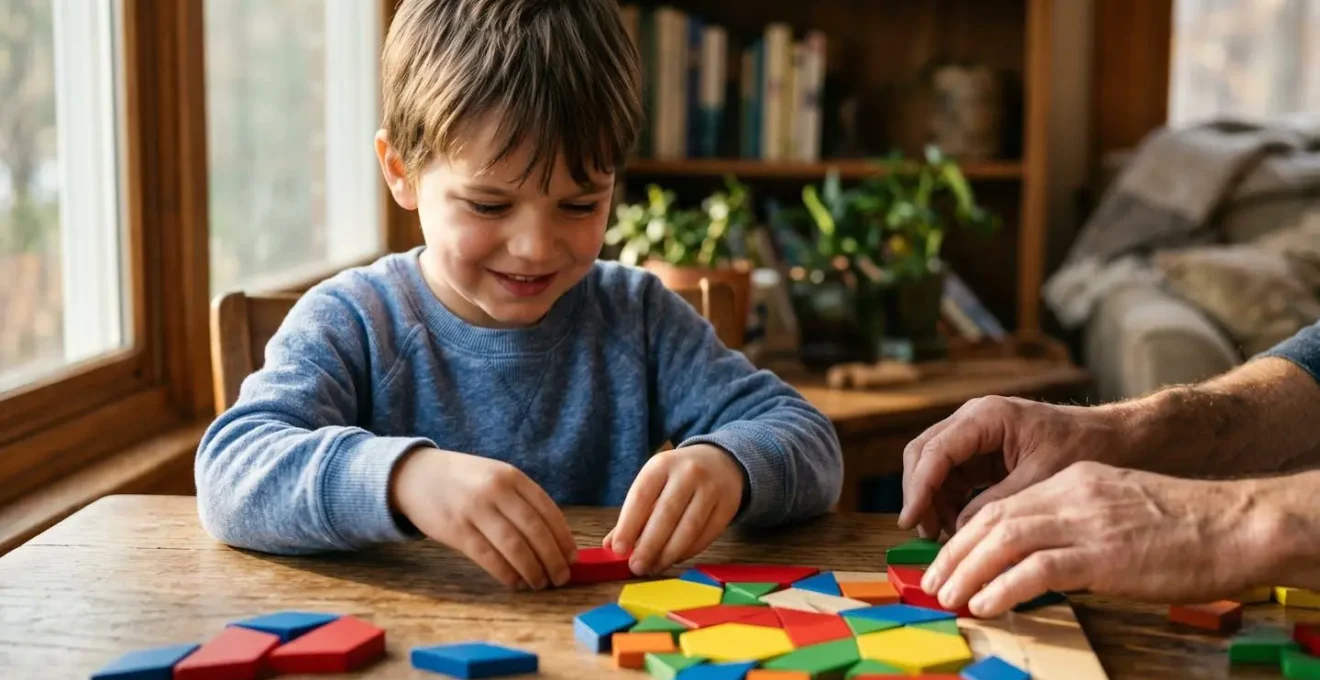
Patterning is one of the most fundamental concepts in mathematics and logical reasoning. It is the brain’s ability to identify a rule in a set of data and then use that rule to predict what will happen next. Pattern blocks, with their distinct shapes and colors, offer a tangible, playful way to explore this core cognitive skill. An activity can start simply: you create a “red-blue-red-blue” sequence and ask your child, “What comes next?”
This simple act is profoundly important. As children progress, the patterns can become more complex, involving shape, orientation, and number: “triangle-square-triangle-square” (AB pattern), or “circle-circle-square-circle-circle-square” (AAB pattern). According to experts, educational research identifies pattern recognition as the foundation upon which many higher-level cognitive abilities are built. It’s the same mental process we use to understand musical rhythms, sentence structures, and even scientific principles.
The progression of this skill is natural and can be gently guided. A toddler might start by simply sorting the blocks by color. A preschooler can duplicate a simple pattern you create. An older child can be challenged to create their own complex patterns, or even use the blocks to explore fractions and tessellations. The key is to see these blocks not just as building toys, but as a complete, scalable curriculum for teaching the brain to find order in chaos. By verbalizing the patterns (“I see you made a pattern with a yellow hexagon then a green triangle”), you help solidify their understanding and build their metacognitive awareness of the rules they are discovering.
Home Escape Room: Creating Logic Puzzles for a Rainy Day
An escape room, at its heart, is a series of interconnected logic puzzles leading to a final goal. You don’t need a fancy commercial setup to capture this magic; a “Home Escape Room” is one of the most engaging ways to get children to apply multiple types of thinking in a high-stakes, playful context. The goal is simple: create a series of 3-5 puzzles that lead from one clue to the next, culminating in a “treasure” (like a favorite snack or the start of a movie).
The beauty of this activity is its versatility. You are the designer, which means you can tailor the puzzles to the exact skills you want to reinforce. A puzzle might be a riddle whose answer is a location (“I have a spine but no bones. Find the next clue inside me.”). Another could be a substitution cipher where different small toys represent letters of the alphabet, spelling out a secret message. You can create a directional puzzle using furniture as waypoints or a memory challenge involving a tray of objects.
The most powerful move you can make as a cognitive coach is to involve your child in the creation process. Have them design one of the puzzles for a sibling or for you to solve. This forces them to think from another person’s perspective—a critical aspect of strategic thinking and social-emotional intelligence. They are no longer just solving a problem; they are constructing one, testing it, and seeing it through someone else’s eyes. This is a masterclass in logic, empathy, and creative problem-solving, all disguised as a game.
Your Rainy Day Puzzle Designer’s Checklist
- Substitution Cipher: Create a key matching toys to letters (e.g., car = A, block = B) to spell a clue.
- Riddle Navigation: Write a riddle whose answer is an object or book where the next clue is hidden.
- Directional Puzzle: Write instructions using furniture as waypoints (‘Take 4 steps toward the sofa, turn left…’).
- Memory Challenge: Briefly show a tray of items, remove one, and the name of the removed item is a password.
- Co-Creation Test: Have your child design one puzzle and watch someone else solve it to build perspective.
Focus Training: Gradually Increasing Time on Single Tasks
In a world of constant digital interruption, the ability to sustain focus on a single task is a superpower. This skill, known as sustained attention, is not an inborn trait but a muscle that can be trained. The principle is the same as in physical fitness: progressive overload. You don’t start by running a marathon; you start with a short jog and gradually increase the distance. Similarly, you can’t expect a child accustomed to 30-second video clips to sit with a complex puzzle for an hour.
The training starts by defining a clear, achievable “focus set.” For a younger child, this might be just five minutes dedicated to a single activity—a puzzle, a drawing, or a building project. This is followed by a mandatory two-minute break. Over several weeks, you gradually increase the duration of the focus set to six, then seven minutes. The goal is to stretch their attention span gently, without it snapping from frustration. Research from Developmental Science has found that 8-10 year-olds showed maximum cognitive gains from puzzles requiring 15-20 minutes of sustained effort, a benchmark that can be reached through this gradual training.
Creating a ritual around these focus sessions can be incredibly effective. Clearing the table, taking a deep breath, and setting a gentle, visible timer signals to the brain that it’s time to enter “focus mode.” It’s also crucial to define a clear, task-based endpoint rather than a vague time-based one. Saying “We’ll work until we finish these three rows of the puzzle” is much more motivating than “We’ll work for 10 minutes.” It provides a tangible goal and a clear sense of accomplishment, reinforcing the positive feeling of deep, uninterrupted concentration.
Simon Says: Why Classic Games Build Working Memory?
Simon Says is far more than a simple party game. From a cognitive perspective, it is an elite-level training exercise that targets two of the most critical executive functions simultaneously: working memory and inhibitory control. It’s a mental workout that requires the brain to both hold information and resist an impulse at the same time, which is an incredibly demanding task.
First, the game trains working memory, which is the brain’s “mental notepad” for holding information temporarily. When the leader says, “Simon says touch your nose,” the child must hold that instruction in their mind while preparing to execute the action. For a more advanced challenge, you can add a delay: “Simon says, in three seconds, touch your toes.” That three-second pause forces the working memory to work harder to retain the command.
Second, and most importantly, the game is a masterclass in inhibitory control—the brain’s braking system. The entire game hinges on the ability to suppress the impulse to act when the magic phrase “Simon says” is omitted. This constant monitoring and self-regulation is foundational for everything from classroom behavior (not shouting out an answer) to emotional regulation (not reacting impulsively when upset).
Case Study: Simon’s Dual Cognitive Training
The game simultaneously strengthens attention, memory, and processing speed. When the instruction is given, the brain must engage its working memory to hold the command (e.g., “touch your head”). In parallel, it must engage its inhibitory control system to check for a condition (Was “Simon Says” uttered?). If the condition isn’t met, the brain must slam on the brakes and suppress the pre-programmed action. This dual-demand of holding a rule while inhibiting a default response makes it a uniquely efficient tool for strengthening the brain’s capacity for self-control.
Key Takeaways
- Shift your role from “entertainer” to “cognitive coach” by asking guiding questions.
- Focus on the process of thinking, not just the correct answer or puzzle completion.
- Normalize mistakes as “bugs” to be fixed, which is a natural part of learning and problem-solving.
Strategic Thinking for Kids: Teaching Them to Look Before They Leap
The ultimate goal of all these logic puzzles and brain games is not just to make a child good at solving puzzles. It’s to cultivate strategic thinking—the ability to think ahead, anticipate consequences, and make decisions based on a long-term goal. This is the skill that bridges the gap between game-board success and real-world success. You can actively teach this by making it a conscious part of your gameplay.
The most powerful tool in your coaching toolkit is the “If-Then” questioning framework. During any turn-based game, from checkers to Go Fish, you can pause and ask, “If you move your piece there, then what do you think I will do next?” This simple prompt forces them to move beyond their own immediate move and consider the game from their opponent’s perspective. It’s the first step toward second-order thinking: “I know what you might do, so I will do this instead to prepare.”
This “If-Then” logic is not confined to games. You can build a bridge to social-emotional learning by asking, “If you say that to your friend, then how might they feel?” This connects the cold logic of a game to the warm, complex world of human interaction, showing that strategic thinking is also about empathy and perspective-taking. By consistently prompting your child to visualize consequences and consider multiple future possibilities—”What are three different things that could happen next?”—you are training them to look before they leap. You are teaching them to be not just players, but strategists.
By shifting from simply providing games to actively coaching the thinking process behind them, you transform playtime. It becomes a rich, intentional practice in building the foundational cognitive skills that will serve your child for a lifetime, all while feeling like nothing more than a game.