Teaching conversation isn’t about memorizing abstract social rules; it’s about rehearsing a performance where your child feels confident and prepared.
- Physical tools (like a “talking stick”) are props that build the crucial cognitive skills needed for conversational turn-taking.
- Connection is more important than forced eye contact, especially when respecting neurodiverse communication styles.
Recommendation: Use structured role-play scenarios not just to practice words, but to help your child embody the physical and emotional dynamics of social interaction, turning you from a worried parent into a supportive director.
As a speech and drama teacher, I see the stage as a laboratory for life. When a child fumbles a line or misses a cue, we don’t just tell them to “try harder.” We break the scene down. We give them props, blocking, and a safe space to rehearse until the interaction feels natural. For a parent whose child struggles to hold a conversation, the world can feel like a daunting, unscripted stage. You’ve probably been told to encourage practice, model good behavior, or use role-play, but these suggestions often feel vague, leaving you without a clear script.
The frustration is understandable. You see your child’s wonderful personality, but it seems to get lost in translation during social exchanges. They might interrupt, stand too close, or miss the cue to ask a question back. The common advice falls short because it treats conversation like a test of rules rather than a dynamic, interactive performance. But what if the secret wasn’t in memorizing more rules, but in rehearsing the performance itself? What if you, the parent, could become a supportive director for your child?
This is where the drama studio’s toolkit becomes incredibly powerful. We’re going to move beyond just “practicing” and into the realm of “rehearsing.” This guide will provide you with concrete, playful, and effective techniques borrowed from the stage to help your child master the rhythm of dialogue, understand physical presence, and listen with the intent to connect. We will transform abstract social cues into tangible actions, giving both you and your child the confidence to navigate any social scene.
This article provides a complete framework for you to act as your child’s personal dialogue coach. We will explore eight key areas, from the fundamental mechanics of turn-taking to the nuances of active listening, providing you with a step-by-step director’s guide for each.
Summary: A Director’s Guide to Social Interaction
- Turn-Taking Talk: Using a “Talking Stick” to Teach Listening
- Eye Contact: Is It Essential or Cultural/Neurodiverse?
- The Art of Conversation: Teaching Kids to Ask “And You?”
- Personal Space: The “Bubble” Concept for Kids Who Stand Too Close
- Jokes and Pranks: Understanding the Line Between Funny and Mean
- Sportscasting: How Describing Your Actions Boosts Vocabulary?
- Active Listening: Teaching Kids to Listen to Understand, Not Just Reply
- Developing Social Competence: Manners, friendship, and fitting in
Turn-Taking Talk: Using a “Talking Stick” to Teach Listening
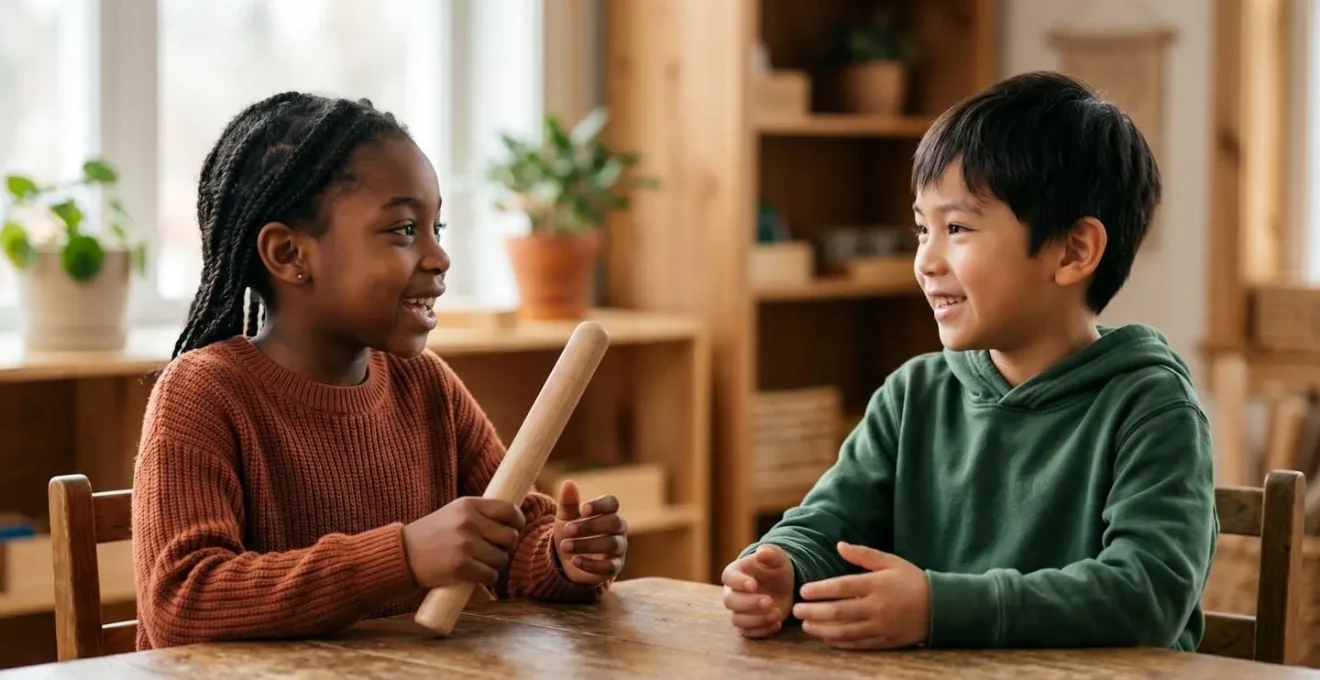
Every good scene in a play has a rhythm, a give-and-take between actors. A conversation is no different. For children who tend to interrupt or dominate a conversation, the concept of “waiting your turn” can be too abstract. In the drama studio, we use a simple prop to make this concept tangible: a “talking stick.” This can be any object—a decorated stick, a special stone, or even a specific toy. The rule is simple: only the person holding the object can speak.
This isn’t just a game; it’s a powerful cognitive exercise. When a child has to wait for the stick, they are actively practicing inhibitory control—a core executive function. They learn to listen to what the other person is saying instead of just planning their own next sentence. A longitudinal study on early childhood development found that this back-and-forth exchange happens incredibly fast, with temporal gaps averaging just 250 milliseconds between turns. The talking stick slows this down, making the rhythm of conversation visible and manageable.
To start, use the talking stick during a structured time, like dinner or a specific playtime. Ask a question and pass the stick to your child. When they are done, they pass it back to you. This simple act of passing an object transforms the invisible rule of turn-taking into a physical, concrete action. It’s a rehearsal that builds the mental muscle for real-world conversations, where the “stick” is invisible but the rhythm remains. In fact, research has shown a strong connection between the number of conversational turns a child experiences and their performance on standardized language tests.
Eye Contact: Is It Essential or Cultural/Neurodiverse?
“Look at me when I’m talking to you” is one of the most common directives given to children. From a performance perspective, eye contact is a powerful tool for connection. However, insisting on it as a non-negotiable rule can be counterproductive and even distressing, particularly for neurodiverse children. For many on the autism spectrum, maintaining direct eye contact can be overwhelming or physically uncomfortable, diverting cognitive resources away from listening and processing language.
The goal of a conversation is connection, not compliance. As a director, you must ask: is the actor connecting with the scene, or just hitting a technical mark? Brain scan studies have found that while neurotypical children’s brains show increased activity with direct gaze, children with autism often react more strongly to an averted gaze. Forcing eye contact can effectively shut down their ability to engage. Instead of a rigid rule, we should coach our children to find alternative ways to show they are listening. This could mean:
- Looking at the speaker’s mouth or nose.
- Orienting their body toward the speaker.
- Using verbal cues like “uh-huh” or “I see.”
- Briefly glancing at the person’s eyes at the beginning or end of a thought.
This approach respects a child’s individual sensory needs while still teaching the importance of showing engagement. As one study on the experiences of autistic adults highlights, adapting to neurotypical expectations can be a highly conscious and difficult effort. A researcher noted:
Not making eye-contact may be a choice that is easier to facilitate in all-autistic settings, but many neurotypicals may not be aware of the degree to which eye contact can be uncomfortable for autistic people.
– Research study on autistic adults’ deliberate adaptation, Deliberate and Self-Conscious Adaptation of Eye-Contact by Autistic Adults – PMC
The Art of Conversation: Teaching Kids to Ask “And You?”
A monologue is not a conversation. Many children are great at answering questions but struggle with the next step: returning the conversational ball. The simple phrase “And you?” is a foundational piece of conversational scriptwriting. It signals to the other person, “I am interested in you, too.” Teaching this isn’t about rote memorization; it’s about rehearsing the flow of reciprocity until it becomes second nature. This is where role-play becomes our most valuable directing tool.
Don’t just tell your child to ask questions; create a scene. You can be a new friend at the park, a cashier at a store, or a guest at a party. Start the scene with a simple question like, “I had a great time playing on the swings today. What was your favorite part?” After your child answers, pause expectantly. If they don’t volley the question back, gently coach them: “That sounds fun! A good next line here would be to ask me about my day. You could say, ‘And you?’ or ‘What about you?'” Then, rerun the scene. Rehearsal builds muscle memory.
The key is to make it a low-stakes, fun activity. You’re not correcting a mistake; you’re refining a performance. By practicing in a safe environment, your child builds a ‘script’ they can rely on in real-world situations, reducing social anxiety and making interactions more fluid and enjoyable. This structured rehearsal is far more effective than abstract advice.
Your Action Plan for Effective Role-Play
- Identify the Social Skill: Start with a single, clear goal, such as “asking a question back” or “joining a group conversation.”
- Create Scenarios: Develop a few realistic, age-appropriate scenes. Examples: meeting a new classmate, talking to a family friend, or ordering food.
- Assign Roles: You play the other character. Keep it simple and focus on giving your child the chance to practice their “lines.”
- Practice and Feedback: Run the scene. Afterward, offer positive and specific feedback. Say, “I loved how you asked me about my favorite game!” instead of just “Good job.”
- Generalize the Skill: When you see them use the skill in real life, praise them. This reinforces the connection between rehearsal and real-world success.
Personal Space: The “Bubble” Concept for Kids Who Stand Too Close
On stage, where an actor stands is called their “blocking.” It’s a critical part of storytelling that communicates relationships and emotional states. In life, this is called personal space, and for some children, the unspoken rules of physical distance are a mystery. They may stand too close to others, making them uncomfortable, or be overly sensitive to others approaching them. The “personal space bubble” is a brilliant theatrical concept to make this invisible boundary visible.
Ask your child to imagine they are surrounded by a big, invisible bubble. Have them stretch their arms out to the sides and in front to “feel” the edges of their bubble. Explain that this is their personal space, and it’s polite to keep their bubble from bumping into someone else’s. You can make it a game: “Let’s walk around the room without letting our bubbles pop!” This physicalizes the concept, turning an abstract social rule into a kinesthetic experience.
It’s important to recognize that this perception of space can be fundamentally different for some children. Research using the stop-distance paradigm revealed that children with autism spectrum disorders (ASD) not only preferred a larger personal space but also showed less flexibility in adjusting that space after interacting with someone. While typically developing children would shrink their “bubble” after becoming familiar with a person, children with ASD often did not. This highlights why explicit teaching of this concept is vital; we cannot assume they will learn it implicitly. The “bubble” is not just a cute idea; it’s a necessary visual aid for social navigation.
Jokes and Pranks: Understanding the Line Between Funny and Mean
Humor is one of the most complex parts of social interaction. It relies on shared context, tone of voice, and the ability to predict an “audience’s” reaction. For a child, the line between a funny tease and a hurtful comment can be blurry. A joke that gets a laugh in one situation might cause tears in another. From a directing standpoint, this is about teaching an actor to read their audience and understand the emotional impact of their lines.
Role-playing is the perfect rehearsal space for this. Create simple scenarios. Scenario 1: You and your child are building with blocks, and you playfully hide one. This is a gentle prank where everyone is in on the fun. Scenario 2: Your child’s character works hard on a drawing, and your character scribbles on it as a “joke.” After the scene, talk about the feelings involved. In the second scenario, the “audience” (the character with the drawing) feels sad and disrespected. The joke wasn’t shared; it was at their expense. This is the crucial distinction between laughing *with* someone and laughing *at* someone.
This process helps children develop empathy and social perspective-taking. Research shows that role-play enhances emotional understanding by allowing children to explore real-life situations in a safe, controlled environment. They learn to analyze social cues, predict responses, and understand that the “funniest” jokes are the ones where everyone feels included in the laughter. You are not just teaching them rules about humor; you are coaching them to become more aware and empathetic performers in the social scenes of their lives.
Sportscasting: How Describing Your Actions Boosts Vocabulary?
Before a child can be an active participant in a conversation, they need a rich library of words to draw from. “Sportscasting,” also known as parallel talk, is a powerful technique where you become the narrator of your own or your child’s actions. It’s like a sports announcer describing a play-by-play, and it’s one of the simplest yet most effective ways to build a child’s vocabulary and model conversational language without any pressure.
Imagine you are preparing a snack. Instead of doing it in silence, you narrate. “I’m opening the refrigerator. Wow, it’s cold in here! I’m getting the big, red apple. Now I’m going to wash it under the running water. Look how the water splashes!” You’re not asking your child any questions or demanding a response. You are simply filling the space with rich, descriptive language connected to a real-time event. This provides a constant stream of linguistic input that links words to objects, actions, and concepts.
You can also “sportscast” your child’s play. “You’re pushing the blue car so fast! Vroom! It’s going up the ramp. Oh, and now you’re stacking the green block on top of the yellow one. What a tall tower!” This validates their play and provides them with the specific vocabulary to describe their own experiences. From a drama perspective, you’re providing the “script” for their actions, helping them build an internal monologue and the expressive language they’ll need when it’s their turn to speak their lines in a real conversation.
Active Listening: Teaching Kids to Listen to Understand, Not Just Reply
In a performance, acting is reacting. An actor who is only waiting for their next line isn’t truly in the scene. The same is true for conversation. Active listening is the skill of listening to understand the other person’s meaning and feelings, not just waiting for a pause to speak. It’s the difference between a dialogue and two competing monologues. This skill is not only crucial for social connection but also for learning, as research shows that strong communication skills, including listening, directly correlate with academic success.
As a director, you can coach this skill using a few key techniques. When your child tells you something, show them what active listening looks like. You can use simple methods to demonstrate you’re engaged:
- Encouraging: Use small verbal cues like “uh-huh,” “wow,” and “tell me more” to show you’re following along and want them to continue.
- Restating: Paraphrase the facts they’ve shared. “So, it sounds like you thought the math test was really hard today.” This confirms you’ve heard them correctly.
- Reflecting: Help them label their feelings. “You seem really frustrated that the tower kept falling down.” This shows you’re hearing the emotion *behind* their words.
- Summarizing: Pull the key points together. “Okay, so you want to play with the blocks, but you’re worried your little brother will knock them over. What could we do about that?” This helps guide them toward problem-solving.
By modeling these techniques, you give your child a powerful script for showing empathy and engagement. You can practice this by having them “interview” you about your day, with the specific goal of using one of these techniques. This rehearsal teaches them that being a good conversationalist is as much about how you listen as it is about what you say.
Key Takeaways
- Frame conversation as a “performance” to be rehearsed, turning you into a supportive director rather than a critic.
- Use physical props and actions, like a “talking stick” or a “personal space bubble,” to make abstract social rules concrete and learnable.
- Prioritize genuine connection over rigid rules like forced eye contact, especially when supporting neurodiverse children.
Developing Social Competence: Manners, friendship, and fitting in
The ultimate goal of all this rehearsal is for your child to step onto the stage of life with confidence. Social competence isn’t about having a perfect, flawless performance; it’s about having a toolkit of strategies to navigate friendships, understand social etiquette, and feel a sense of belonging. It’s the culmination of all the skills we’ve practiced: the rhythm of turn-taking, the awareness of personal space, the reciprocity of asking questions, and the empathy of active listening.
Think of it as a final dress rehearsal. By using role-play as a consistent tool, you’ve given your child a safe space to try, to fail, and to try again without real-world social consequence. As experts in the field note, role-playing is a dynamic approach that enables children to engage in simulations of real-life situations, fostering skills like analyzing social cues and predicting others’ responses. Each rehearsal builds their confidence and their ability to improvise when a social scene doesn’t go exactly as planned.
Your role as the director is to be the ultimate source of encouragement. Celebrate the small victories—when they remember to ask “and you?”, when they give a friend space without being told, or when they tell a joke that makes everyone laugh. These are signs that the rehearsals are working, and the skills are moving from conscious practice to unconscious competence. You are not just teaching manners; you are equipping your child with the emotional resilience and social agility needed to build meaningful connections.
Start today by choosing one simple “scene” to rehearse with your child. By transforming social skills practice into a playful, supportive, and structured activity, you can help your child find their voice and shine in any social setting.