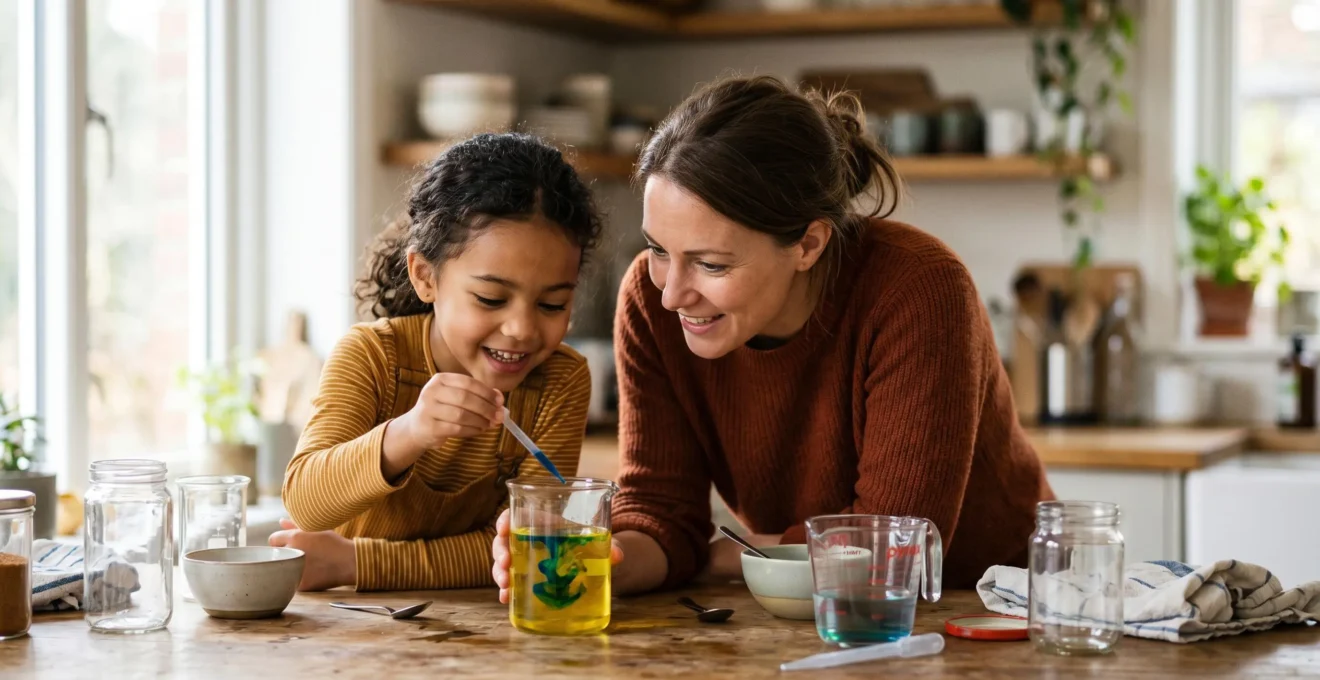
Contrary to popular belief, teaching science at home isn’t about getting the ‘right’ answer in a volcano experiment. It’s about reframing the parent’s role from an encyclopedia to a ‘Chief Curiosity Officer.’ This guide shows you how to use kitchen chaos to model a scientific mindset, transforming ‘I don’t know’ into ‘Let’s find out,’ and proving that failed experiments are the most valuable data you can get.
The kitchen is a battlefield of flour clouds, sticky countertops, and a trail of mysterious spills. For many parents, the idea of a “kitchen science experiment” conjures images of a baking soda volcano erupting onto a freshly mopped floor, with a fleeting moment of excitement but little lasting educational value. We’re often told to make learning fun, but this usually translates into following a recipe for a single, spectacular result. The focus is on the *what*—the fizz, the pop, the color change—while the crucial lesson of science, the *how* of discovery, gets lost in the cleanup.
This approach misses the point. The true power of science isn’t in finding the right answer on the first try; it’s in the systematic, curious process of figuring things out. It’s about asking questions, making predictions, observing closely, and learning just as much from a soggy, failed cookie as from a perfect one. But if the real key wasn’t the experiment itself, but rather the mindset we bring to it? What if we could transform the chaos into a structured, yet wondrous, laboratory for critical thinking?
This guide is about that transformation. We will explore how to move beyond simple demonstrations and cultivate a genuine scientific mindset in your child. We’ll break down how to frame a hypothesis without pressure, isolate variables for a “fair test,” document observations with rigor, and, most importantly, celebrate “failed” experiments as the invaluable data they truly are. It’s time to stop being an answer-giver and start being a co-discoverer.
This article provides a roadmap for turning your kitchen into a hub of inquiry. The following sections break down the core components of the scientific method into playful, practical, and parent-friendly strategies.
Summary: Teaching the Scientific Method Through Kitchen Chaos
- The Hypothesis: “What Do You Think Will Happen If…?”
- Fair Test: Why We Only Change One Variable at a Time?
- Nature Journaling: Drawing What You See, Not What You Imagine
- Failed Experiments: Why Getting It Wrong Is Part of Science?
- Simple Graphs: How to Chart the Weather for a Week?
- Potion Making: Mixing Shampoos and Waters (Safely)
- The “I Wonder” Approach: Modeling Curiosity Instead of Giving Answers
- Hypothesis Testing: Turning “I Don’t Know” into “Let’s Find Out”
The Hypothesis: “What Do You Think Will Happen If…?”
The first step in any scientific inquiry is the hypothesis, but for a child, the pressure to have the “right” guess can be paralyzing. The goal isn’t to be a psychic; it’s to practice making an educated prediction based on prior knowledge. The magic question, “What do you think will happen if…?”, opens the door. It shifts the focus from correctness to the process of thinking. When a child says, “I think the heavy rock will sink,” the follow-up is crucial: “That’s an interesting thought! Why do you think that?” This encourages them to connect cause and effect, the very foundation of scientific reasoning.
It’s vital to differentiate between a wild guess and an educated one. A child might guess a car will float “because it’s blue.” That’s a starting point. An educated guess might be, “I think the big apple will sink because it’s heavier than the small one.” This shows they are using an observable property—weight—to make their prediction. Our role is to gently guide them from pure imagination to evidence-based reasoning, without extinguishing the flame of creativity.
Hypothesis Spectrum Framework in Practice
The educational program I’m the Chef Too! found great success by implementing a ‘hypothesis spectrum’ approach. They distinguish between ‘wild guesses’ (pure imagination) and ‘educated guesses’ (evidence-based predictions). By framing hypothesis-making as ‘scientific storytelling’ rather than a simple right-or-wrong question, the program effectively removed performance pressure. This simple reframe led to increased engagement and a greater willingness among children to make predictions and, critically, to explain the reasoning behind them.
To make this process more concrete for both parent and child, breaking down the steps of forming a hypothesis can provide a helpful scaffold for their thinking. It transforms an abstract concept into a manageable series of actions.
Your Action Plan: Helping Kids Form a Hypothesis
- Start with observation: Encourage your child to notice patterns and interesting things in their environment. “I notice the ice on the pond is gone.”
- Ask a ‘what if’ or ‘why’ question: Based on the observation, prompt a question. “Why did the ice melt?” or “What if we put an ice cube in the sun?”
- Discuss what they already know: “What do you know about ice and sun?” This activates their existing knowledge base.
- Form an ‘If… then…’ statement: Guide them to make a predictable statement. “If we put the ice cube in the sun, then it will melt.”
- Check for testability: Is this something we can actually test and observe? Yes, we can put an ice cube outside.
Fair Test: Why We Only Change One Variable at a Time?
Once a hypothesis is formed, the instinct is to jump in and start mixing, building, and testing. But this is where a crucial scientific principle comes into play: the fair test. Explaining “controlling your variables” to a child can seem daunting, but the kitchen offers the perfect classroom. The core idea is simple: to find out what really causes a change, you can only change one thing at a time. If you want to see if adding more sugar makes cookies sweeter, you can’t *also* change the baking time and the type of flour. If you do, you won’t know if the change in taste was due to the sugar, the time, or the flour.
This concept can be introduced through simple comparisons. “Let’s make two batches of lemonade. This first one will be our ‘control’—our regular recipe. In the second one, let’s change just *one* thing. What should it be? More lemon juice? Let’s try it and see what difference it makes.” This teaches a fundamental aspect of logical problem-solving. Research shows that children are surprisingly adept at this. A study published in Psychonomic Bulletin & Review demonstrates that 104 children aged 7-13 successfully performed controlled experiments, showcasing an intuitive grasp of the concept when presented clearly.
Visually representing this concept is incredibly effective. Setting up the experiment with clear, side-by-side comparisons helps solidify the idea that everything else must remain constant for the test to be “fair.”
As the image suggests, arranging your ingredients methodically helps a child see the controlled environment. Three identical bowls, three identical sets of ingredients, with only one element—the independent variable—changed between them. This isn’t just about good lab practice; it’s a powerful visual lesson in methodical thinking and logical deduction, skills that extend far beyond the kitchen.
Nature Journaling: Drawing What You See, Not What You Imagine
A huge part of science is observation. Not just a quick glance, but a detailed, careful recording of what is happening. In the field, scientists use nature journals. In the kitchen, we can adapt this powerful tool into an “experiment notebook.” The key rule, borrowed directly from nature journaling, is to draw what you see, not what you think you should see. This practice trains the eye to be a precise instrument and pushes the brain to notice details it might otherwise ignore. When a child is asked to draw a cookie before and after it bakes, they are forced to observe the change in color, texture, and shape.
This documentation shouldn’t be limited to visuals. The kitchen is a multi-sensory environment, and a great lab notebook should reflect that. Encourage your child to be a full-spectrum data collector. Did the dough make a sound when it was mixed? What did the vinegar and baking soda smell like before and after they were combined? Was the bread dough sticky, then smooth, then firm? Capturing this sensory data makes the experience richer and the observations more complete.
Here are some ways to structure a multi-sensory lab notebook:
- Visual Observation: Draw the “before” and “after” states of your experiment. For a melting ice cube, this could be a series of drawings over time.
- Olfactory Documentation: Describe what it smelled like at each stage. “Smelled like yeast and sugar,” or “Smelled sour like vinegar.”
- Auditory Recording: Note the sounds that occurred. “The water fizzed,” “The oil sizzled,” or “The popcorn made a loud pop!”
- Tactile Description: Record how the texture changed. “The dough was wet and sticky, now it’s smooth and bouncy.”
This act of documentation, of translating observation into a permanent record, is a deeply scientific practice. It slows down the process and encourages a more profound level of engagement with the materials.
The focus here isn’t on artistic talent; it’s on attentive observation. A simple, careful drawing of a dissolving sugar cube is a more valuable scientific record than a beautiful but inaccurate painting. This process teaches children to trust their own senses as their primary data-gathering tools, a foundational skill for any budding scientist.
Failed Experiments: Why Getting It Wrong Is Part of Science?
The cookies are burnt. The tower collapsed. The “potion” turned a sludgy brown instead of a brilliant purple. The immediate reaction is often disappointment—a sense of failure. But in the world of science, this is where the real learning begins. An unexpected result is not a failure; it is simply new data. This is perhaps the most critical and counter-intuitive lesson a parent can teach. The goal is to reframe “I got it wrong” into “That’s interesting! I wonder why that happened?”
This shift in perspective is directly linked to the concept of a “growth mindset”—the belief that intelligence and abilities can be developed. Research consistently shows that how we react to mistakes is crucial. In fact, a study published in Developmental Cognitive Science revealed that children with growth mindsets show a larger brain response after making a mistake and are more likely to improve their performance on the next attempt. When a parent groans at a burnt batch of cookies, they signal that failure is a negative outcome. When they say, “Fascinating! The edges are dark but the middle is raw. What could we change next time to fix that?” they model resilience and curiosity.
It’s not enough to simply tell a child “it’s okay to fail.” The belief is transmitted through action and reaction. As a Stanford researcher on mindsets points out, the parent’s response to struggle is what truly shapes the child’s beliefs.
Parents can endorse a growth mindset, but they might not pass it on to their children unless they have a positive and constructive reaction to their children’s struggles.
– Kyla Haimovitz, Psychological Science, Stanford University research on mindsets
So, the next time an experiment “fails,” treat it like a detective discovering a vital clue. The burnt cookie isn’t a mistake; it’s data that tells you the oven was too hot, or the baking time was too long. The collapsed tower isn’t a failure; it’s evidence that the base wasn’t wide enough. Each “wrong” turn provides information that will inform the next, better experiment. This is the iterative, self-correcting process at the heart of all scientific discovery.
Simple Graphs: How to Chart the Weather for a Week?
Once an experiment is complete, you’re left with results: the ice cube in the sun melted in 5 minutes, while the one on the counter took 15. The plant on the windowsill grew 2 inches, but the one in the closet didn’t grow at all. This is raw data. The next step in the scientific process is to make sense of it, and one of the most powerful tools for this is a graph. The word “graph” might sound intimidating, but it’s simply a way to tell a story with pictures instead of words.
The kitchen and home provide endless opportunities for simple, tangible data visualization. Forget complex software; a child’s first graph can be made with LEGO bricks, paper plates, or crayons. The goal is to make abstract numbers and results visible and easy to compare. This process of translating observations into a visual format is a cornerstone of data analysis and helps children see patterns they might otherwise miss. Did the temperature consistently drop every evening? A simple line graph makes that pattern jump off the page.
Here are some fun, kitchen-based activities to introduce the concept of graphing:
- ‘Chart the Melt’ Line Graph: Use a simple chart to track the melting time of ice cubes in different locations (in the sun, on the counter, in a bowl of water). The x-axis is location, the y-axis is time.
- Physical LEGO Bar Charts: After a “sink or float” experiment, build towers with LEGO bricks. A green tower for items that floated, and a red tower for items that sank. The height of the tower represents the number of items in each category.
- Paper Plate Pie Charts: Conduct a taste test with different ratios of juice to water. Use a paper plate and markers to create a pie chart showing which mixture was the family favorite.
- Tangible Graphs: For kinesthetic learners, use physical objects. Plot the growth of a bean sprout by lining up a new dried bean next to a ruler each day to mark its height.
By turning data into a physical object or a simple drawing, you are teaching a profound concept: that information can be organized and presented in a way that reveals its hidden meaning. It’s the final step in turning a simple observation into a powerful conclusion. The story of the data becomes clear.
Potion Making: Mixing Shampoos and Waters (Safely)
There is an almost primal urge for children to mix things. This is the “potion making” instinct: a chaotic, joyful exploration of liquids, powders, and whatever else they can get their hands on. While it may look like pure mess-making, it’s actually a form of raw, unstructured experimentation. Our role as parent-scientists isn’t to stop it, but to provide “structured wonder”—a safe framework that preserves the magic of discovery while subtly introducing scientific concepts.
The first and most important rule is safety. This means establishing a “Scientist’s Code of Conduct” from the very beginning. Rule #1: We only experiment with parent-approved materials. No raiding the cleaning supply cabinet. Rule #2: We never taste our experiments unless a parent says it’s food. Rule #3: We wear our “lab gear” (an old t-shirt or apron, and maybe some fun goggles). These rules don’t stifle creativity; they create a safe space for it to flourish.
Once safety is established, we can begin to add layers of scientific vocabulary to the play. The child sees a mix of oil and water. The parent sees an opportunity to talk about density and solubility.
Density Layering Experiment for Property Investigation
The curriculum experts at KiwiCo effectively transform simple mixing activities into structured property investigations. Their signature density layering experiment uses safe household liquids like honey, dish soap, water, and oil. By observing how these liquids stack instead of mixing, children get a stunning visual demonstration of density. This activity maintains the playful ‘potion’ appeal while introducing core physics principles and vocabulary like ‘viscosity’ (how thick a liquid is) and ‘solubility’ (whether it dissolves).
This approach allows a child’s natural curiosity to be the guide. The joy of pouring and mixing remains, but it’s now paired with the intellectual thrill of understanding *why* the liquids are behaving in such a fascinating way. It is in these moments of pure wonder that the most profound learning can occur.
The “I Wonder” Approach: Modeling Curiosity Instead of Giving Answers
A child asks, “Why is the sky blue?” The default parent mode is to either search for the answer or make one up. The “I Wonder” approach offers a third, more powerful path: turning the question back to the child. The most effective way to foster a scientific mind is not to be an encyclopedia, but to model what a curious mind does. It’s about shifting from “Here’s the answer” to “That’s a fantastic question. What are your first thoughts on it?“
This technique, sometimes called the “Turn It Back” technique, does two critical things. First, it validates the child’s curiosity, signaling that their questions are valuable and interesting. Second, it empowers them to be active participants in the learning process rather than passive recipients of facts. When we admit, “You know, I’m not actually sure what makes a cake rise. How could we find out together?” we model intellectual humility and collaborative problem-solving. We show them that learning isn’t about already knowing everything; it’s about having the tools and the drive to find out.
Here are some practical phrases and techniques to become a “Chief Curiosity Officer” in your home:
- The Turn-Back: When asked “why,” respond with, “That’s a great question. What do you think?”
- Model Co-Learning: Say, “I don’t know the answer to that. What a great mystery! Should we look in a book, or watch a video about it?”
- Create an “I Wonder Jar”: Keep a jar and slips of paper handy. Whenever someone in the family has a question (“I wonder how birds fly”), write it down and put it in the jar. Once a week, pull one out and investigate it together.
- Distinguish Question Types: Help them see the difference between a “closed” wonder with a single answer (What is the capital of France?) and an “open” wonder that invites exploration (What is the best way to build a strong fort?).
This approach transforms the dynamic. The parent is no longer a teacher with a lesson plan, but a facilitator of discovery. You are a co-adventurer on a quest for knowledge, and your most powerful tool is not your knowledge, but your own expressed curiosity. By consistently modeling this behavior, you are giving your child a gift far more valuable than any single fact: a lifelong love of inquiry.
Key Takeaways
- Model curiosity, don’t just give answers. Your “I don’t know, let’s find out” is more powerful than any correct answer.
- Frame “failures” as interesting data, not mistakes. A burnt cookie is a clue for the next experiment.
- Structure play with the “fair test.” Teach them to change only one variable at a time to build real scientific understanding.
Hypothesis Testing: Turning “I Don’t Know” into “Let’s Find Out”
We’ve arrived at the core of the scientific mindset. It’s the powerful, transformative moment when a child’s “I don’t know” is met not with an answer, but with an enthusiastic, “Let’s find out!” This phrase is the engine of all discovery. It turns a moment of uncertainty into a call to action. It reframes the parent not as the source of all knowledge, but as the lead investigator and chief facilitator of the family’s curiosity projects. This is where all the previous steps—hypothesis, fair testing, observation, and learning from failure—come together in a dynamic process.
The beauty of the “Let’s Find Out” philosophy is that it scales. A single, simple question can blossom into a whole series of investigations. This process naturally teaches children that science isn’t a single, linear path but a branching tree of inquiry. To support this, it’s helpful to have a basic framework in mind. Research on elementary science education shows that the scientific method can be effectively implemented with children using six core steps: observation, question, hypothesis, experiment, results, and conclusion.
Scaling Inquiry: From Single Question to Investigation Series
Educational research highlights how a simple kitchen experiment can naturally expand when parents adopt the “Let’s Find Out” philosophy. An initial hypothesis (“Will this apple float?”) systematically grows. This leads to follow-up questions: “What about an orange? What about a *peeled* orange? What if we cut the apple in half?” This approach demonstrates that scientific research involves multiple methods. We can find out through physical experimentation (testing the fruits), book research (looking up density), or even expert consultation (watching a documentary about why boats float).
Ultimately, teaching the scientific method in the kitchen isn’t about memorizing steps or producing perfect results. It’s about cultivating a family culture of curiosity, resilience, and critical thinking. It’s about demonstrating, through shared messes and discoveries, that the most exciting thing in the world is not knowing something, because that’s the starting point for every great adventure.
Your journey as a ‘Chief Curiosity Officer’ begins now. The next time you’re in the kitchen with your child, embrace the inevitable mess, listen for that first “I wonder,” and be ready with the most powerful phrase in science: “Let’s find out.”